

Audio By Carbonatix
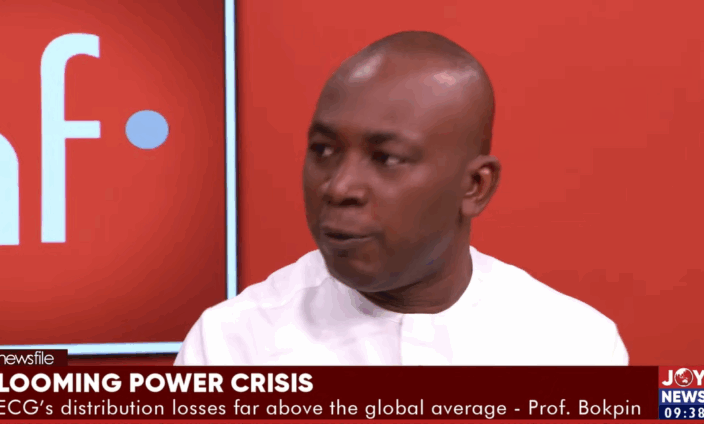
Economist Prof Godfred Bokpin highlighted critical challenges facing the energy sector.
Speaking on Newsfile, he called for urgent structural reforms and private sector participation.
The lecturer stressed the unsustainable nature of current electricity distribution, pointing to significant collection losses of approximately 15% - well above the global average.
He argued that many government ministries, departments, and sensitive installations are not paying electricity bills, further straining the system.
According to him, "You cannot pass on all those losses to the ultimate consumer."
"Then again, you want to look at collection losses. Collection losses, we are, we are looking at close to 15% again, that's above the world average. It's not sustainable. Apart from that, you also want to look at the tariff gaps in terms of the pricing formula and all of that. If you put all of these things then, apart from that, you also see that there are ministries, department agencies. And you heard the minister saying that it's about time ministry, department agencies take responsibility for their energy consumption," he said on JoyNews on May 17.
The economist advocated for private sector involvement in electricity distribution, suggesting that the Electricity Company of Ghana (ECG) could remain government-owned while inviting private sector expertise to improve efficiency and reduce losses.
"We should support government in private sector participation in downstream distribution," Prof Bokpin stated.
He stressed that this approach differs from completely selling ECG, instead proposing a model where the government remains the sole shareholder while bringing in private sector capital and management skills.
Prof Bokpin also highlighted the challenges of implementing such reforms, acknowledging potential staff resistance and the complex political landscape.
He called on Ghanaians to support these reforms, noting that power outages affect everyone regardless of political affiliation.
The proposed reforms are part of an IMF-supported program aimed at restructuring Ghana's energy sector and improving its economic sustainability.
Latest Stories
-
Abass Nurudeen accuses Minority of ‘scandal scavenging’ over World Cup visa controversy
1 minute -
US Embassy recognised NSA, GFA and GTA as separate entities for visa applications – Sports Minister’s aide
8 minutes -
Only 30% of Ghanaian teachers satisfied with their jobs – CAPCOE data reveals
19 minutes -
Communities affected by construction of Akosombo Dam urge government to speed up compensation process
40 minutes -
World Cup visa scandal: Sports Ministry not shielding anyone – Sports Minister’s special aide
1 hour -
World Cup visa scandal: Over 30 people misrepresented as GTA board members to US Embassy – Vincent Assafuah alleges
1 hour -
Fire destroys wooden structure near Yesu Mo Villa at Bush Road
1 hour -
NDC threatens sanctions over oversized campaign posters, gives aspirants 5 days to comply
2 hours -
Star Oil paid GH¢2.7bn in taxes, levies in nine months of 2026
2 hours -
Samson’s Take: The rule of law is cheaper before the bulldozer
2 hours -
GRA blames system failure for delay in issuing receipt over passenger’s customs duty
3 hours -
Livestream: Newsfile discusses World Cup visa scandal, beach demolitions, education strikes, BRICS bid
3 hours -
NC-PTAs welcomes end of teachers’ strike, urges parents to prepare children for Monday
3 hours -
Government procures over 2,000 transformers as Ghana’s electricity access hits 89.13% – Energy Minister
3 hours -
UTAG-UG threatens strike on October 19 over unpaid allowance
3 hours