

Audio By Carbonatix
The increasing number of health workers leaving Ghana for positions well below their skill level is a grave concern to health experts.
Prof James Avoka Asamani, a World Health Organisation Health Economist and Health Systems Scientist, is one of the specialists raising concerns.
"Some nurses/midwives leaving Ghana are settling for jobs abroad well below their skill set. Migrants accepting lower level jobs, particularly in adult and social care, is not just a loss for our health sector, but it is also a gross underutilisation of their abilities."
Prof Asamani argues that, in comparison to the country's current production of health personnel, it may appear insignificant. However, the situation necessitates interventions.

"But let me assure you, it is. Most of those leaving are the experienced and specialised ones who are more expensive and take longer to replace through our training system," he said.
Prof Asamani noted that available numbers reveal that over 1,200 highly competent nurses have already joined the English NHS, excluding a larger number in social care.
According to him, about 16, 000 nurses have requested emigration permission, and others intend to do so in future.
"Ongoing research indicates that over 16,000 nurses have applied for clearance to emigrate, and 62% of health workers surveyed nationwide intend to emigrate."
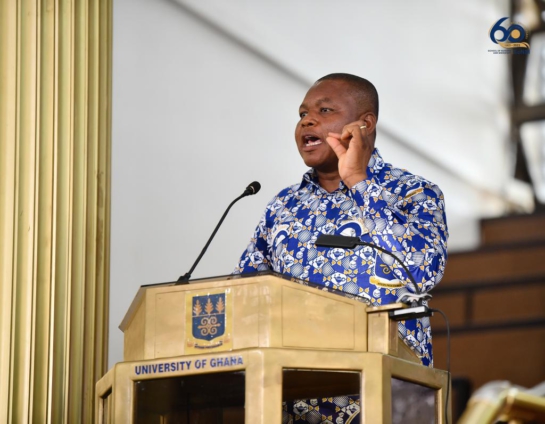
Speaking at the 60th-anniversary grand durbar of the University of Ghana School of Nursing and Midwifery, Prof Asamani, mentioned targeted interventions to address the different groups.
He said there are those who will migrate no matter what, those who need assistance to migrate through a managed migration programme and those who cannot migrate no matter what.

He added that others who are in the vast majority wish to stay but are pushed to migrate due to circumstances primarily unsatisfactory working conditions.
Prof Asamani stated that government must establish a climate in which the final two feel respected, driven, and urged to stay and serve our country.
"A strong and up-to-date curriculum is essential for nursing/midwifery education, with regular review to incorporate advancements in health, emerging technologies, evidence-based practices, and cultural relevance/competence."
Prof Asamani has THEREFORE proposed that basic training for nurses and midwives be upgraded to the first-degree level, as well as rationalising and diversifying training capacity across general and specialities to align with the capacity to absorb and export in line with population and health system needs.
"Nursing education requires competent and knowledgeable faculty members who can effectively teach and mentor students. If we want excellence, all tutors should aspire to have at least a master’s and all lecturers with PhDs.
"Mandatory clinical practice for faculty and tutors (who teach clinical courses) to possess strong clinical expertise to ensure that students receive adequate practical training.

Prof Asamani has urged the Ghanaian health sector to embrace the power of technology and artificial intelligence (AI) for blended learning, in which expertise can be shared with students regardless of location.
"AI systems such as ChatGPT and the like are here with us. It is no longer if, but how we should use it. If not already done, it is now urgent to develop guidelines for the ethical use of AI to enhance learning and research in nursing and midwifery education – indeed, in education generally.
Prof Asamani also called on the government to invest in the training of thousands of nurses and midwives at home and to use available evidence to prioritize graduate-level nurse/midwife specialization.
"Fully sponsors nurses/midwives seeking specialisation training in Ghana. Create regulations and other incentives for the private sector to employ trained nurses (the private sector trains 40% but employs 10%).
"Set up a “Nursing Research and Innovation” fund to stimulate and sustain nursing research and innovation."
Latest Stories
-
Asha Bhosle: The sound of Bollywood dies aged 92
26 minutes -
Fire destroys section of 4-bedroom apartment at Tantra Hill
28 minutes -
Safe city: Unnoticeable protection
35 minutes -
North East Regional Police Commander raises alarm over burning of checkpoints
44 minutes -
Free Primary Healthcare Programme set for take-off — Health Ministry confirms readiness
60 minutes -
3 co-wives, 5 children perish in canoe disaster – Maritime Authority insists life jackets use mandatory for all water transport
2 hours -
Iran war lands ‘triple blow’ to flood-ravaged Sri Lankans
2 hours -
Gunmen kill at least 11 people at Afghanistan picnic spot
3 hours -
Woman, 25, in court for stealing baby at Bogoso
3 hours -
Trump unveils giant gold-accented victory arch design for US capital
3 hours -
We spoke to the man making viral Lego-style AI videos for Iran. Experts say it’s powerful propaganda
3 hours -
Hungarians vote in big numbers on whether to end Orbán rule and elect rival
3 hours -
At least 30 feared dead in crush at Haitian tourist site
3 hours -
Boxing: Abdul Ahmed wins WBA Africa Cruiserwight title after dispatching Nigeria’s Eradeye
3 hours -
Nearly 2,000 displaced, schools damaged as windstorm wreaks havoc in Gushegu
3 hours