

Audio By Carbonatix
Health workers in Agona East and West districts are sounding the alarm over what they describe as a looming outbreak of waterborne diseases, including typhoid and cholera.
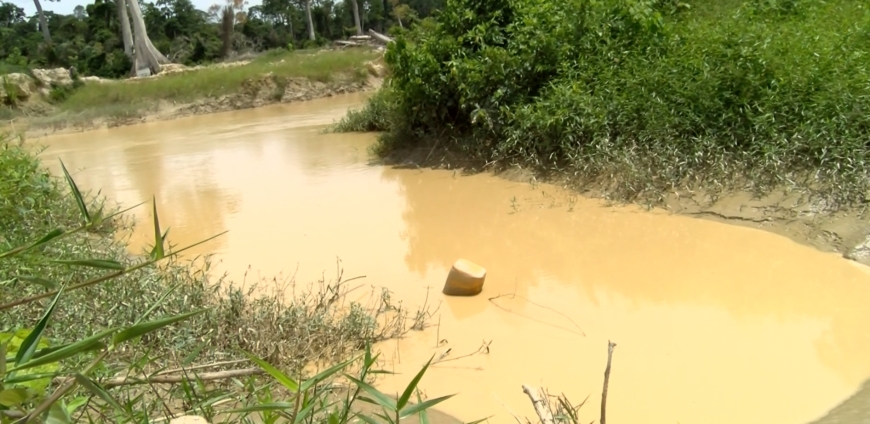
The warning follows the shutdown of the Kwanyaku Headworks two months ago due to illegal mining (galamsey), which has polluted the main water source for several communities.
With taps running dry, residents now depend on stagnant, contaminated water from ponds shared with livestock, and health workers say the consequences are already showing.
At the Kwesitwikrom CHPS Compound, the situation has become desperate. Nurse in charge, Maureen Adjei Dansoa, says the clinic now buys sachet water to treat patients.
“It’s been very difficult,” she said. “At times, we have to let patients take their start doses at home instead of starting treatment here because there’s no water.”
Aresident also said: “There is no water at our CHPs compound. Patients who visit the facility are sometimes treated with satchet water.”
The facility’s borehole broke down months ago, and with no government support, Maureen uses her own salary to buy water from nearby towns.
“Yes, from my own pocket. Nobody is paying,” she admitted quietly, her voice heavy with fatigue.
Outside the clinic, the community of Kwesitwikrom relies on a dark, smelly pool of water for drinking and cooking. Maureen fears that the same water, polluted and breeding insects, could soon spark a full-blown public health crisis.
“Definitely, there is going to be an outbreak of cholera. It has even started — just last week we had diarrhea cases here,” she revealed.
In the nearby Nyakrom Township in Agona West, the story is no different. The once-clear river that supplied households now flows in thick, tea-coloured currents, tainted by illegal mining upstream.
At the Nyakrom Health Centre, Senior Physician Assistant and head of the facility, Florence Mavis Odoom, says cases of typhoid and other waterborne infections are rising fast.
“In a month, we can record about 10 to 20 cases, sometimes more. It’s not easy,” she said. “We had the problem far away, but today it’s right next to us. Look at what we’re facing now.”
She says the government must act decisively if Ghana is to escape an even greater catastrophe.
“It still boils down to the government. If there are ways of getting rid of galamsey totally, we need to do it — else Ghana will be in a great mess.”
Latest Stories
-
LA 2028: Black Queens pumped up for second leg of Mauritius tie
23 seconds -
LA 2028: Black Queens hold final training session ahead of second leg against Mauritius
34 minutes -
Standards are not Seasonal: What the EC appointments teach both sides
48 minutes -
King Mohammed VI urges private sector to create youth jobs and spread benefits of growth
49 minutes -
KGL U17 Colts 2026: Greater Accra win title after penalties win over Western Region
49 minutes -
UK Investment Roadshow opens in London to advance UK-Ghana growth partnership
1 hour -
Assemblies of God requires pastors to resign before entering partisan politics – Rev. Wengam
1 hour -
Ghana targets 20% annual reduction in maternal deaths – Health Minister
1 hour -
Cyber attacks in Africa grow faster than global rate, report finds
1 hour -
Ghana signs UAE deal to create 5,000 overseas jobs
1 hour -
One Million Coders Programme targets 100,000 digital jobs in two years – Sam George
1 hour -
John Jinapor, Italian Ambassador explore opportunities for energy sector investment
1 hour -
NHIA seeks legal reforms to support Free Primary Healthcare
2 hours -
Beatrice Annan defends Afi Agbenyo’s EC appointment, cites record of gender advocacy
2 hours -
Ghana seeks investment deals in Bangkok amid global economic crises
2 hours