

Audio By Carbonatix
Nicholas Issaka Gbana, a Development Economist and Chartered Accountant, has raised concerns over the parallel implementation of the Agriculture Ministry’s Feed Ghana programme and the Grow24 initiative under the 24-Hour Economy Policy, describing them as duplicative and potentially counterproductive.
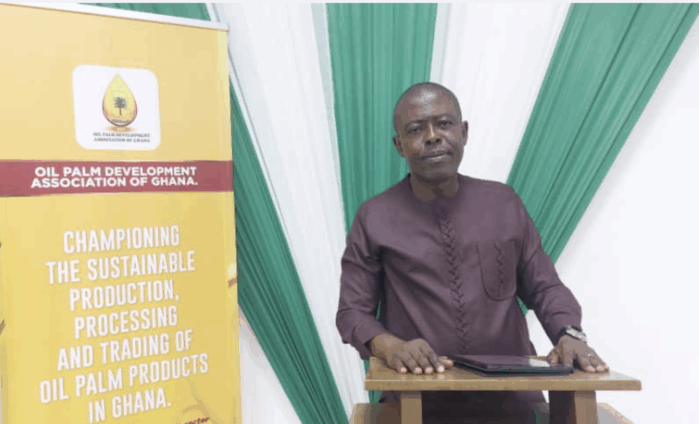
Delivering the keynote address at the third Annual General Meeting of the Oil Palm Development Association of Ghana (OPDAG), Mr. Gbana said both programmes mirrored each other in goals, expected outcomes, and implementation strategies, posing a significant risk to effective policy execution.
“The bottom line is this: Feed Ghana and Grow24 are parallel and duplicative programmes as it relates to our industry and tree crops generally,” he noted.
Mr. Gbana highlighted that both policies identified agriculture, particularly the oil palm sector, as a key driver of economic growth.
Quoting the Feed Ghana report, he said the programme aimed to accelerate agricultural transformation, ensure food security, create jobs, and reduce import dependency.
Similarly, he said Grow24 was framed to reposition agriculture as a dynamic pillar of national prosperity through technology, agribusiness scaling, and export expansion.
“The two programmes have the same goals—only in different wording,” he stressed, adding that they both promote expanding irrigation systems, developing cooperatives, building farmer service centres, increasing access to concessionary finance, and climate-resilient agriculture.
Mr. Gbana warned that the lack of coordination between the two could result in competition for limited government resources, donor funding, and private sector engagement, as well as fragmented monitoring and evaluation frameworks.
He urged the Tree Crops Development Authority (TCDA) to lead the effort in consolidating the programmes into a single, unified strategy for the sector.
Touching on broader policy issues, Mr. Gbana called for a review and reset of the TCDA’s Five-Year Strategy and Implementation Plan (2022–2027).
He stressed the need to avoid the trend where new administrations abandon existing frameworks and reinvent the wheel, which he said often stalled policy progress.
The current TCDA strategy includes investments in research, sustainable production, value chain development, and capacity building.
He revealed that the strategy had already birthed the $100 million World Bank-funded Tree Crop Diversification Project (2023–2029), targeting coconut, cashew, and rubber.
Mr. Gbana further urged OPDAG and other value chain associations to work with TCDA to align this strategy with Feed Ghana, Grow24, and the upcoming Agribusiness Policy being developed by the Ministry of Trade and Industry.
“There are too many ingredients in the soup,” he remarked, cautioning against an overcrowded policy mix that could dilute focus and impact.
On the issue of climate action, Mr. Gbana referenced a 2019–2020 study by Solidaridad West Africa, which identified land use and cultivation practices as major contributors to greenhouse gas emissions in the oil palm value chain.
He noted that the area under oil palm cultivation had shrunk by about five per cent between 2018 and 2022 due to galamsey activities, farm abandonment, and human settlement expansion.
He cited successful agro-forestry pilot projects in Central and Ahafo Regions, advocating for the integration of oil palm, fruit trees, timber species, and livestock as part of a climate-resilient and biodiversity-friendly model.
He recommended that TCDA and COCOBOD form a joint technical committee to explore the feasibility of mixed tree cropping and agroforestry models across Ghana.
In his final point, Mr. Gbana urged OPDAG and other tree crop associations to amplify their voices on macroeconomic policies, including taxation and monetary decisions by the Ministry of Finance and the Bank of Ghana.
“The import lobby is still very strong and vociferous, and politicians respond to the loud,” he said, encouraging OPDAG to form a coalition of tree crop associations to influence national economic policies that impact the agricultural sector.
He concluded by challenging stakeholders to shift from rhetoric to coordinated policy advocacy that ensured a profitable and sustainable future for Ghana’s oil palm and broader tree crop sector.
Latest Stories
-
La Beach demolition: Senyo Hosi condemns lack of consultation
5 minutes -
Russian glide bomb attack on Zaporizhzhia kills at least 15 people
20 minutes -
Jinapor warns underperforming energy sector CEOs of consequences, says no protection for failure
22 minutes -
Fire destroys head of tipper truck on Lower Volta Bridge
27 minutes -
Palmer signs new Chelsea contract until 2034
28 minutes -
World Cup visa scandal: Mahama will act on corruption allegations – Abass Nurudeen
30 minutes -
Abass Nurudeen accuses Minority of ‘scandal scavenging’ over World Cup visa controversy
31 minutes -
US Embassy recognised NSA, GFA and GTA as separate entities for visa applications – Sports Minister’s aide
38 minutes -
Only 30% of Ghanaian teachers satisfied with their jobs – CAPCOE data reveals
49 minutes -
Communities affected by construction of Akosombo Dam urge government to speed up compensation process
1 hour -
World Cup visa scandal: Sports Ministry not shielding anyone – Sports Minister’s special aide
2 hours -
World Cup visa scandal: Over 30 people misrepresented as GTA board members to US Embassy – Vincent Assafuah alleges
2 hours -
Fire destroys wooden structure near Yesu Mo Villa at Bush Road
2 hours -
NDC threatens sanctions over oversized campaign posters, gives aspirants 5 days to comply
2 hours -
Star Oil paid GH¢2.7bn in taxes, levies in nine months of 2026
3 hours