

Audio By Carbonatix
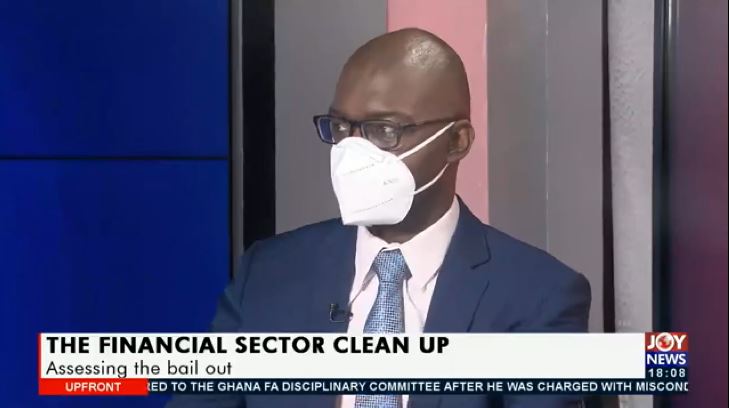
Deputy Director-General of the Securities and Exchange Commission (SEC), Paul Ababio, says about 84 per cent of depositors affected by the financial sector clean-up exercise have been compensated.
Speaking in an interview on Joy Business, he indicated that all affected depositors will receive their compensation as the majority who have completed the laid process have been settled.
“Out of the total amount, about 84 per cent of those who signed up have actually been paid,” he told JoyNews' Winston Amoah.
According to him, government provided about ¢3.5 billion for the programme, however, there’s a remaining ¢5.5 billion that was asked out of the budget.
“So of the ¢3.5 million, a portion of that which is just about one billion is in the full bailout, so of that portion, ¢500 million was on the short term.”
Paul Ababio was providing an update on the Bank of Ghana’s clean-up exercise which caused locked up funds that were deposited in the affected banks.
During the exercise, the licenses of the class 1 banking of about nine banks, some microfinance institutions, and savings and loans companies were revoked.
Following the action, the collapsed banks were merged into an establishment of the Consolidated Bank Ghana (CBG) where the depositor can file for their claims.
However, there had been some indications that some depositor to date are yet to receive any compensation.
The SEC Deputy Director-General explained the bailout was done on two principles, “one is, for the firm we obtained full liquidation order, we started the bailout process on the bases of those firms.”
According to him, that was the government policy at the time; “to obtain the liquidation orders and ensure that the legal biases or assuming those assets are secured.”
However, he added that towards the end of 2020, the government also initiated a partial bailout scheme to address pending liquidation orders.
Under the full bailout, “again there is the tire one,” which he said is the short term portion of the fund and can be withdrawn immediately.
“The tire two is the long term portion of the fund and that’s what we paid over a five-year period, but the balance can be withdrawn every anniversary of the fund,” he apprised.
Mr Ababio said the bailout was funded with the government bonds so, at the time of withdrawals, the fund manager will liquidate those bonds to make a payout.
“The partial bailout pays the caped amount of ¢50,000, so that one irrespective of the size of your claims, currently we are paying a fixed amount of ¢50,000 and that all goes into tier one,” he apprised.
He further explained that under the partial bailout, depositors below an amount of ¢50,000 are given full payment while depositors above that amount will have to wait for their funds to move from pending liquidation and pending core processes into the full scheme.
Mr Ababio said then, “we recalculate their tire one and their tire two-portion for payment.”
Latest Stories
-
Dede Chancelor makes appearance at Milan Fashion Week 2026
16 minutes -
Today’s Front pages: Friday, October 9, 2026
56 minutes -
Edmond Kombat named Energy Sector Reform Programme Champion of the Year 2026
2 hours -
PAC summons Takoradi doctor over GH¢341,229 study leave salary
3 hours -
37 Military Hospital traders given 7-days to clear pedestrian walkway
3 hours -
Wontumi challenges EOCO’s handling of Exim Bank loan dispute
3 hours -
Government keeps appealing to striking teachers to resume work – Apaak
3 hours -
Dr Daniel Acquaye urges Christian business leaders to build sustainable enterprises
3 hours -
Chief Justice urges employers to tackle mental health stigma in workplaces
4 hours -
52,000 teachers’ promotion payments targeted for October 15
4 hours -
Nzema chiefs honour Lands Minister, demand sustainable revival of Adamus Resources
4 hours -
ExxonMobil return talks emerge as GIPA CEO holds back details
4 hours -
Council of State meets teacher unions over strike today
4 hours -
Ntim Fordjour appeals to Mahama to abandon regulation restricting preaching in buses
4 hours -
Volta youth farmers commend Agric Minister, appeal for markets for cassava growers
4 hours