

Audio By Carbonatix
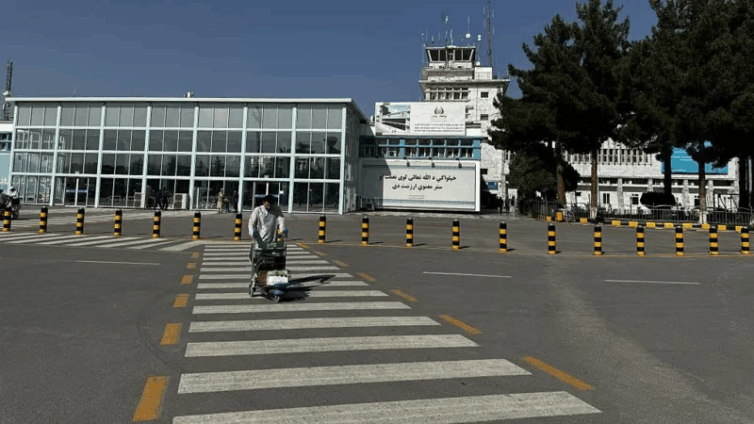
Afghanistan's main airport is at a standstill as the country grapples with the fallout of a nationwide internet shutdown imposed by the Taliban government.
The Taliban has yet to give an official reason for the decision, which took effect on Monday, but did say it would last until further notice.
Communication within Afghanistan, and out to the wider world, has been severely impacted, as have essential services - including banking and payments - and access to online education, a lifeline for many women and girls.
The airport in the capital Kabul, meanwhile, was "nearly deserted", according to one resident, with no evidence of planes arriving or departing.
Flight tracking service Flightradar24 showed that a handful of incoming and outgoing flights on Tuesday had been cancelled. Many more simply had their status marked as "unknown".
One passenger who planned to fly into Kabul International Airport on Tuesday was told there would be no flights until Thursday at the earliest.
Another local said all flights from Kabul airport had been cancelled since Monday evening.
He added that life in Kabul "seems to be normal", but added that there was "no communication at all" across the country.
'We are blind without internet'
The Taliban government have for weeks been severing fibre-optic internet connections across several provinces, saying this was part of an effort to prevent immorality.
It began in a handful of provinces, but did not impact the capital Kabul until Monday, with several people telling the BBC their fibre-optic internet stopped working towards the end of the working day, around 17:00 local time (12:30 GMT).
And on Tuesday, many awoke across the country to find essential services paralysed.
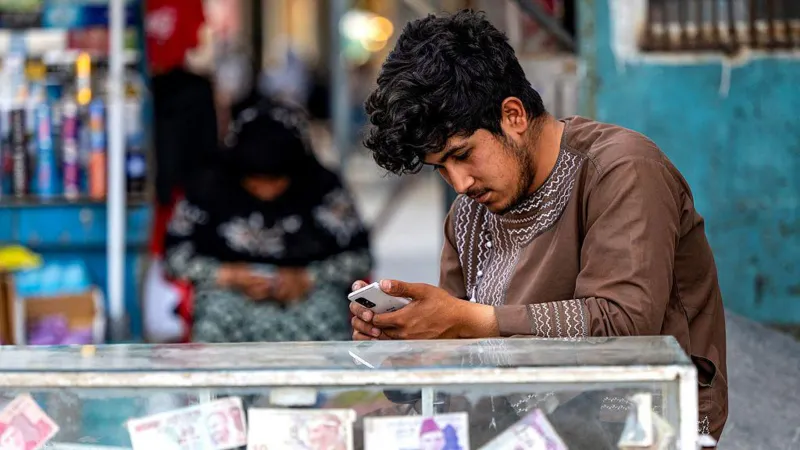
Najibullah, a 42-year-old shopkeeper in Kabul, told news agency AFP that residents felt like they were left "blind without phones and internet".
"All our business relies on mobiles. The deliveries are with mobiles. It's like a holiday, everyone is at home. The market is totally frozen."
Another Kabul local, who did not wish to be identified, said that banks across the capital were open, but that there were huge crowds wanting to withdraw money, but that only "very little cash" could be paid out.
However, a money changer in the country's southern Helmand province said all banks in his area were closed and that he was not able to process payments.
Diplomatic officials had earlier warned the BBC that the internet cuts could affect banking and e-commerce systems nationwide.
International news agencies also say they have lost contact with offices in the capital Kabul. Mobile internet and satellite TV has also been severely disrupted across the country.
Tolo News, a privately owned Afghan news channel, told people to follow its social media pages for updates as it expected disruptions to its television and radio networks.
One Kabul journalist told the BBC that they were unable to even call or contact guests for interviews, and needed to send camera crews directly to their interviewees' homes.
"We have never experienced such [a] thing," he added.
Several residents, who requested anonymity, previously told the BBC that their businesses and lives had been seriously affected by the internet cuts.
A man who works as a money changer in Takhar province said that his daughters' online English classes were disrupted. "Their last opportunity to study and stay engaged is now gone," he said.
Another woman previously told the BBC that she could not attend online classes since her home internet was cut off. "I had hoped to finish my studies and find an online job, but that dream has also been destroyed," she said. "Without internet access, I don't know what will happen next."
A 'total internet blackout'
In an earlier post on social network Mastodon.social, Netblocks had said the country was "in the midst of a total internet blackout as Taliban authorities move to implement morality measures, with multiple networks disconnected through the morning in a stepwise manner; telephone services are currently also impacted".
A spokesperson for the Taliban governor in Balkh wrote on X earlier this month that the ban on fibre-optic internet was meant to curb "evils". He added that authorities would explore alternatives.
It is unclear exactly what the reason for this week's shutdown is.
The shutdown is the latest in a series of restrictions which the Taliban have enforced since returning to power.
Earlier this month they removed books written by women from the country's university teaching system as part of a new ban which has also outlawed the teaching of human rights and sexual harassment.
Women and girls have also been particularly hard-hit: they are barred from accessing education beyond the age of 12, with one of their last routes to further training cut off in late 2024, when midwifery courses were quietly shut down.
A university student told the BBC that she had "no other choice except online study" after her midwifery course was banned. "When I heard that the internet had been cut, the world felt dark to me," she said.
The Taliban retook control of Afghanistan in 2021 in a lightning advance, weeks after the withdrawal of US and other international forces.
Latest Stories
-
SSNIT says La Beach clearance was to protect hotel investments, beaches to remain public
7 minutes -
APSU congratulates St Augustine’s College after back-to-back National Investment Quiz wins
11 minutes -
Renewed flood intervention at Mallam Junction raises hopes among residents, businesses
51 minutes -
St Augustine’s College retain National Investment Quiz title after nail biting grand finale
1 hour -
Education infrastructure investment will drive Banda’s development – Ahmed Ibrahim
1 hour -
Teacher unions strike: Gov’t presents fresh proposals as talks end inconclusively
2 hours -
51,000 teachers’ promotion arrears to be validated for October payment – Education Minister
2 hours -
Kwabena Boamah appointed Board Chair for Impact Investing Ghana
2 hours -
Striking teacher unions to meet Fair Wages and Salaries Commission on October 6
3 hours -
EOCO working with AG to arraign Nana Baffour Awuah before weekend court
3 hours -
Duraplast reassures customers after fire, announces October 5 reopening
3 hours -
Call off strike, gov’t will not renege on promotion arrears pledge – Haruna Iddrisu to teacher unions
3 hours -
Committee set up to validate teachers eligible for 20% deprived-area allowance – Education Minister
3 hours -
Five-member committee to search for new Black Stars coach after Sports Ministry-GFA meeting
4 hours -
Pinktober: Breast cancer survival exceeds 90% when detected early – Breast Society of Ghana
4 hours