


Audio By Carbonatix
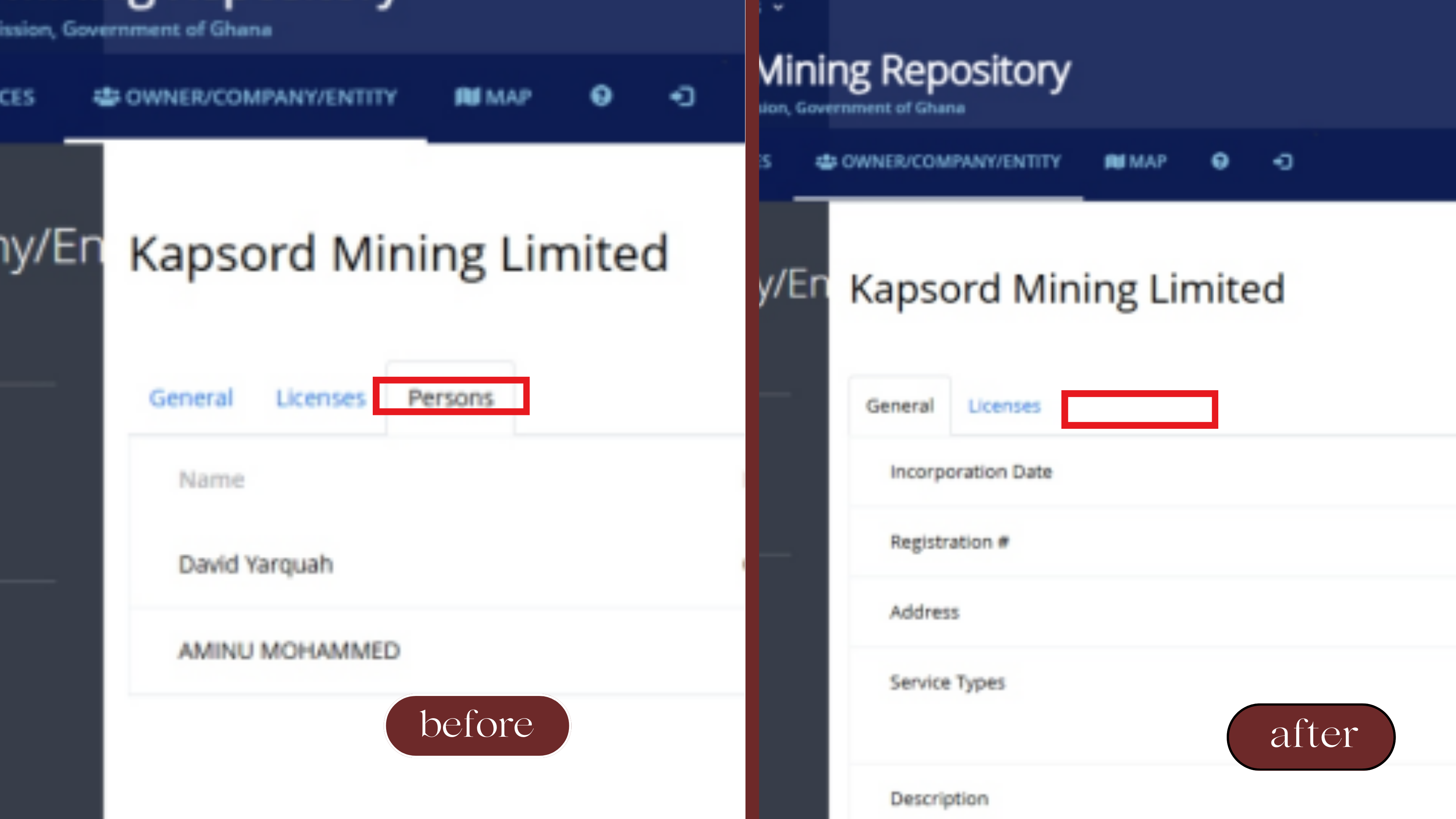
The Minerals Commission has deleted crucial information about mining companies from its website after The Fourth Estate reported on how leading members of the New Patriotic Party (NPP) and government appointees had been granted concessions to mine and prospect in forest reserves.
The deleted information pertains to the ‘contact persons’ of mining companies and the political affiliations of applicants for mining leases. The Chief Executive of the Minerals Commission, Martin Ayisi, had referred to contact persons as “consultants” in an interview with The Fourth Estate. These individuals apply for mining licenses on behalf of mining companies and serve as the liaison between the mining industry regulator and the companies.
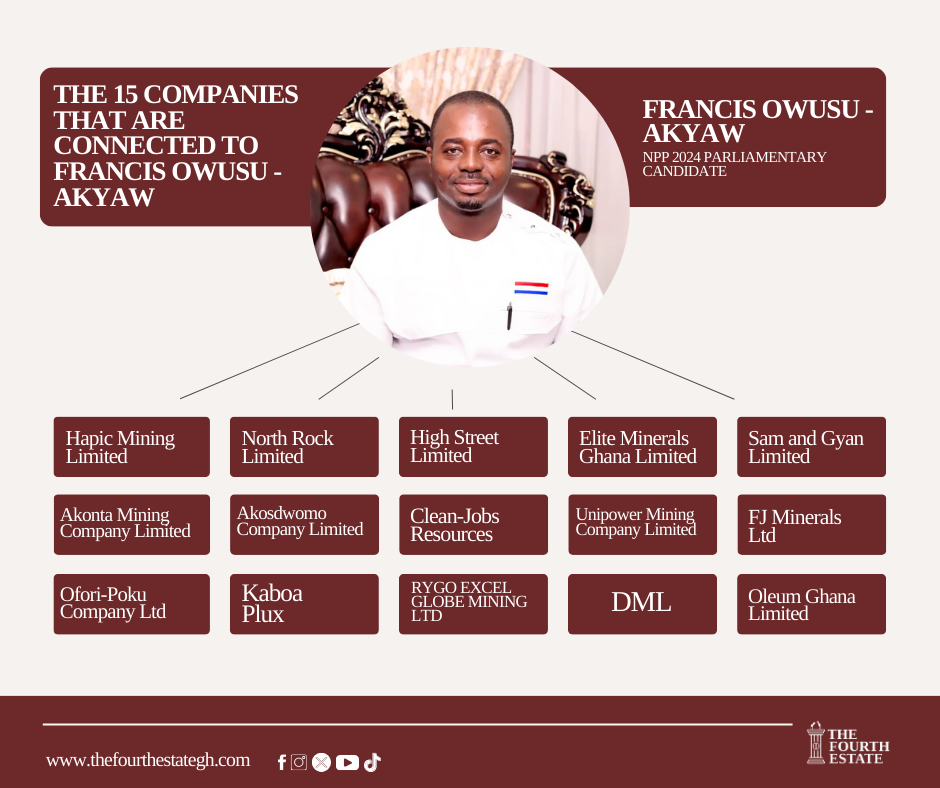
In a recent exposé, The Fourth Estate revealed that the NPP Parliamentary Candidate for Juaben, Francis Owusu-Akyaw, serves as the contact person for at least 15 mining companies. Some of these companies, including his own, FJ Minerals Limited, have obtained mining licenses to operate or prospect in forest reserves across various regions in Ghana.
He also owns another company, DML Investment Limited. DML is the company through which Mr Owusu-Akyaw provides consultancy services for mining companies. On its website, the company touts its connections to the top hierarchy of the Minerals Commission as a competitive advantage.
“We have established key relationships with upper management at the Ghana Minerals Commission. These relationships have been instrumental in securing and operating concessions in the country,” it says.
When The Fourth Estate questioned Mr Ayisi about the relevance of knowing the political affiliations of individuals applying for mining leases in an earlier interview, he responded: “Sometimes it informs the kind of decision you should make.”
However, the Minerals Commission removed this crucial information from its website on the very day The Fourth Estate published its report.
The Commission’s Chief Executive, Mr Ayisi, did not respond to The Fourth Estate’s enqiries regarding the reason for the deletion of the information
EITI’s Response
In an email to The Fourth Estate, the Extractive Industries Transparency Initiative (EITI), an international organization promoting open and accountable management of oil, gas, and mineral resources, emphasized the importance of disclosing the identities of Politically Exposed Persons (PEPs) in the minerals application process.
Gilbert Makore, EITI’s Regional Director for Anglophone and Lusophone Africa, stated that this is crucial because “a PEP, by using their political prominence and influence, maybe in a position to abuse their power to solicit bribes, secure public funds, or engage in other corrupt practices, including on issues relating to license allocations.”
Regarding Francis Owusu-Akyaw’s consultancy services for the 15 companies, Mr. Makore said he could not comment specifically on the case as he was unaware of it. He noted that any follow-up action would be the responsibility of the relevant authorities.
Without referencing any particular case, Mr. Makore highlighted that the involvement of PEPs in companies seeking mining licenses can elevate the risk of conflicts of interest. To mitigate these risks, he said: “It is imperative that the procedures for licensing are clear and that there are no deviations from the established processes.” He added that the Ghana EITI publishes an annual report that provides citizens and stakeholders with a diagnostic summary of potential deviations in the licensing process.
With many applicants owning multiple companies and applying for various concessions—some for as many as 10—Mr. Makore noted that most mineral licenses in Ghana are allocated on a ‘first-come, first-served’ basis, with some awarded through a tendering process. He explained that if an owner with multiple companies uses one to apply for a mining right, priority is given to the first company that applies, provided they meet all the obligations and requirements of the Minerals and Mines Act and its regulations.
He also noted that laws regarding mining ownership vary significantly by country and jurisdiction. For example, Zambia’s mining sector is considering anti-monopoly provisions that would limit a company to holding no more than five mining permits. Such provisions help manage risks related to ownership concentration, political capture, and conflicts of interest in the mining sector.
Latest Stories
-
Iran war lands ‘triple blow’ to flood-ravaged Sri Lankans
26 minutes -
Gunmen kill at least 11 people at Afghanistan picnic spot
40 minutes -
Woman, 25, in court for stealing baby at Bogoso
41 minutes -
Trump unveils giant gold-accented victory arch design for US capital
44 minutes -
We spoke to the man making viral Lego-style AI videos for Iran. Experts say it’s powerful propaganda
49 minutes -
Hungarians vote in big numbers on whether to end Orbán rule and elect rival
49 minutes -
At least 30 feared dead in crush at Haitian tourist site
50 minutes -
Boxing: Abdul Ahmed wins WBA Africa Cruiserwight title after dispatching Nigeria’s Eradeye
1 hour -
Nearly 2,000 displaced, schools damaged as windstorm wreaks havoc in Gushegu
1 hour -
Ghana’s Derrick Kohn to work under Marie-Louise Eta as she becomes first woman to coach men’s Bundesliga team
1 hour -
Accra Open Championships conclude with strong performances ahead of African Championships
2 hours -
Ghana to begin camping with 12 athletes after Accra Open Championships – Bawa Fuseni
2 hours -
Anthony Joshua declines showdown with Tyson Fury but admits they ‘probably’ clash next
2 hours -
Tyson Fury dominates Makhmudov, calls out Joshua next
2 hours -
I have supported highway authority financially to fix roads in my constituency – A Plus
4 hours