

Audio By Carbonatix
Galamsey, once known as “gather and sell,” began as a small-scale survival activity deeply rooted in Ghanaian communities. Though it was technically illegal under Article 257 of the 1992 Constitution, which vests mineral resources in the President on behalf of the people, the practice was done with some regard for the environment.
Rivers remained clean, forests were intact, and farms flourished. The miners dug with conscience. Their methods were crude but cautious, a far cry from what we are witnessing today, a new wave of destruction I call Neo-Galamsey.
The Rise of Neo-Galamsey: When Greed Replaced Conscience
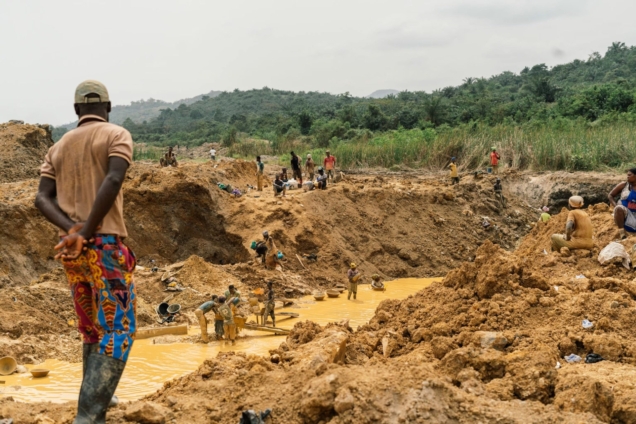
We have entered a dangerous new era, an era of “Neo-Galamsey.” This is no longer about survival or gathering and selling. It is about industrial greed disguised as poverty relief. Heavy machines rip through riverbeds; toxic chemicals poison the very soil that feeds us. Neo-galamseyers no longer mine for livelihood, they mine for quick wealth, leaving behind destruction and death.
Forests that once sheltered life now lie bare. Rivers that once sustained farms now flow with poison. And yet, we are told that four million people depend on this menace to survive.
A Nation at War with Itself
The President’s claim that we cannot stop galamsey because “four million livelihoods depend on it” should trouble the conscience of every Ghanaian. Since when did we begin to justify evil by the number of people committing it?
This is not about four million livelihoods, it is about thirty-four million lives. It is about every Ghanaian who drinks poisoned water, eats contaminated food, and breathes polluted air. It is about a country that is slowly killing itself in the name of survival. We are becoming the living answer to the biblical question: “What shall it profit a man if he gains the whole world and loses his soul?”
The Cost Too Heavy to Bear
The price of galamsey is beyond economics. It is environmental, moral, and generational.
Our water bodies are choking under turbidity levels never seen before. The Ghana Water Company is struggling to purify what God gave us freely. Farmers are losing fertile lands. Staple foods, even gari, now test positive for heavy metals. And our forests, the lungs of the nation are gasping for life. Is this our idea of national development?
The Politics of Silence and Complicity
What is most shameful is how political hypocrisy has turned galamsey into a partisan issue. Successive governments, both NPP and NDC have failed Ghana, and this matter must never be reduced to political point-scoring. Political power brokers protect illegal miners while pretending to fight them. Ministers look away; local leaders take bribes; law enforcement agencies turn a blind eye. As a nation, we are expending great energy on galamsey yet achieving little, for we are running on treadmills, captivated by appearances instead of substance. A leader who watches as his subordinates engage in illegality is not innocent, he is complicit. This is not an NPP versus NDC fight, it is Ghana versus galamsey and a struggle to secure our future.
When Patriotism Becomes Performance
Our love for country has become performative, loud on Independence Day, silent in the face of national decay. How did we reach a point where access to power means access to plunder? How did we lose the ability to be ashamed? Every Ghanaian from the miner to the politician to the silent observer is guilty. We have sold our conscience for gold and traded our children’s future for coins that cannot buy clean water.
The Way Forward: Lives Before Livelihoods
We cannot continue like this. What is not sustainable must not be encouraged. If it means scrapping community mining to reset our moral compass and eschew our sense of entitlement, so be it. If it means jailing a few powerful men to save millions of lives, then justice must be done. We must choose between gold and life, between greed and the future, between comfort and conscience.
Because when the last river dies and the last forest falls, we will finally understand that you cannot drink gold.
*******
Author: Bernard K. Osei-Marfo is an advocate for environmental sustainability and a lifelong student of Natural Resources Law and communication.
Email: Bernardomarfo@gmail.com
Latest Stories
-
Prioritise cocoa sector with better prices, timely payments-Annoh-Dompreh urges NDC
17 minutes -
Lands and Mines Watch Ghana endorses Heath Goldfields’ mining capacity
33 minutes -
Gbintiri residents protest alleged diversion of 24-hour market project
58 minutes -
Justin Bieber headlines Coachella with nostalgia-fuelled set
1 hour -
Ukraine and Russia accuse each other of hundreds of ceasefire violations
1 hour -
Asha Bhosle: The sound of Bollywood dies aged 92
2 hours -
Fire destroys section of 4-bedroom apartment at Tantra Hill
2 hours -
Safe city: Unnoticeable protection
2 hours -
North East Regional Police Commander raises alarm over burning of checkpoints
2 hours -
Free Primary Healthcare Programme set for take-off — Health Ministry confirms readiness
2 hours -
3 co-wives, 5 children perish in canoe disaster – Maritime Authority insists life jackets use mandatory for all water transport
3 hours -
Iran war lands ‘triple blow’ to flood-ravaged Sri Lankans
3 hours -
Gunmen kill at least 11 people at Afghanistan picnic spot
4 hours -
Woman, 25, in court for stealing baby at Bogoso
4 hours -
Trump unveils giant gold-accented victory arch design for US capital
4 hours