

Audio By Carbonatix
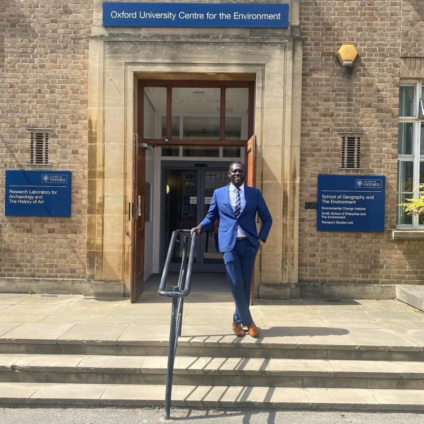
What began with four Fs and three Es in secondary school has culminated in a PhD and a teaching position at the prestigious University of Oxford.
For Dr George Asiamah, the journey from Chichibon in the Atwima Kwanwoma District of the Ashanti Region to Oxford has been shaped by failure, determination, mentorship, and a change in environment that helped him see possibilities beyond his circumstances.
At age 15, his poor secondary school results left him questioning his future. Years later, however, that same young man would earn a PhD and become a Fellow and Tutor at Exeter College, University of Oxford.
Dr Asiamah has documented this remarkable journey in his new memoir, The Back Route: A Memoir of Delay, Discipline, and Becoming.
The book explores how failure, limited opportunities, mentorship, and the support of others influenced his path to academic success.
According to Dr Asiamah, one of the major turning points in his life was moving from his village to Accra, where he encountered people pursuing higher education and began to believe that he too could achieve his ambitions.
“Back in my village, there was not much mentorship. I didn’t know that somebody from there could actually make it to the top.”
He explained that his new environment exposed him to possibilities he had previously not considered.
That experience has also shaped his views on how Ghana supports young people who struggle academically.
Dr Asiamah believes poor academic results should not become a permanent verdict on a young person’s future.
He says families, teachers, and educational institutions all have a responsibility to provide the mentorship and encouragement needed to help struggling students recognise their potential.
“Failure at one point shouldn’t be the verdict. We need to know the circumstances surrounding failure.”
He recalled how, after receiving his own results at age 15, he did not receive the kind of counselling or encouragement he needed.
For him, that experience demonstrates why young people who perform poorly academically need a strong support network rather than being written off.
Dr Asiamah is therefore urging young people struggling with academics not to give up on their ambitions.
He says his own experience demonstrates that failure may delay a person’s journey without necessarily determining their destination.
“Keep moving. That’s not the end of the road. There’s always a back route.”
He encouraged young people to believe in themselves, remain focused, and stay determined even when the path ahead appears difficult.
“If I’ve been able to make it, then I believe you can also make it,” he said.
Dr Asiamah shared his story during an exhibition and conversation centred on his memoir, The Back Route: A Memoir of Delay, Discipline, and Becoming.
Latest Stories
-
CSSPS self-placement portal opens for candidates unable to secure choices
2 minutes -
James Korsah-Brown calls for Tourism Minister to be changed
3 minutes -
Death in the dark: Family demands answers after dialysis patient dies at TTH during power outage
11 minutes -
11 Ghanaian Universities to embed One Million Coders certifications in degree programmes
12 minutes -
Government to pilot Electronic Document Wallet in fourth quarter – Sam George
14 minutes -
Kenya minister warns foreigners against ‘misusing’ visas to trade
18 minutes -
NACOC shuts down Amsterdam pub at Laboma over suspected Narcotics activities
18 minutes -
Rescuers dig through debris as seven dead in building collapse in Delhi
18 minutes -
Sam George directs Communications Ministry staff to enrol on One Million Coders programme
26 minutes -
From 4Fs and 3Es to Oxford: Dr George Asiamah tells his ‘back route’ story
26 minutes -
China to pump $54bn into state banks and insurers to boost economy
27 minutes -
Volta Region to get cancer research and treatment centre under CEANA
28 minutes -
OpenAI chief scientist warns no one is prepared for consequences of AI
28 minutes -
‘We don’t know when’ – Affected communities await compensation for Accra-Kumasi expressway
30 minutes -
Nepal observes national day of mourning for victims of flash flood disaster
31 minutes