


Audio By Carbonatix
Ghana is among the leading African countries with the highest Schengen Visa rejection rates.
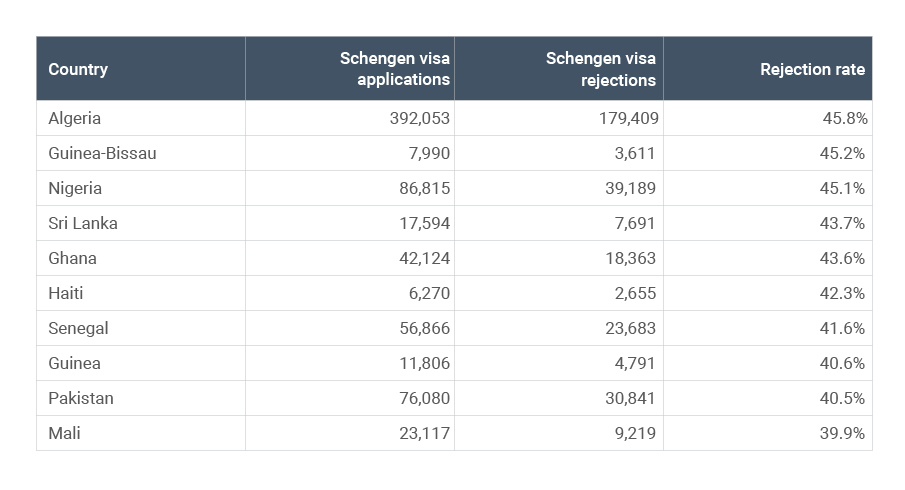
According to a new report by migration consultancy firm Henley & Partners, out of a total of 42,124 Ghanaians who applied for a Schengen Visa in 2022, 18,363 (43.6 per cent) were rejected.
Ranked 5th, Ghana comes after Algeria, Guinea Bissau, Nigeria and Sri Lanka.
The number of applications for Europe’s Schengen Area visas has been declining over the years as rejection rates have surged.
While restrictive for all applications, the European visa regime is notably more stringent towards African visa applicants than those from other regions.
Addressing these issues would signal Europe's commitment to actively engage in business and strengthen trade relations between Africa and Europe.
African visa applicants face more severe restrictions compared to applicants from other regions, resulting in a disproportionately high rejection rate.
In 2022, Africa topped the list of rejections with 30% or one in three of all processed applications being turned down, even though it had the lowest number of visa applications per capita.
This was 12.5% higher than the global average.
The rejection rates for African applicants for Schengen visas are generally 10% higher than the global average, three times higher than the highest rejection rate, and ten times higher than for Americans.
Visa rejection data and trends
Globally, the absolute number of Schengen visa applications decreased from 16.7 million in 2014 to 7.6 million in 2022, representing a decline of almost 9 million applications.
In other words, the global number of Schengen visa applications declined by nearly 54.7%. During the same period, the absolute number of Schengen visa applications in Africa decreased from 2.22 million in 2014 to 2.05 million in 2022, a decrease of almost 171,000 applications or 7.7%.
Africa accounted for seven of the top 10 countries with the highest Schengen visa rejection rates in 2022: Algeria (45.8%), Guinea-Bissau (45.2%), Nigeria (45.1%), Ghana (43.6%), Senegal (41.6%), Guinea (40.6%), and Mali (39.9%).
By contrast, only one in 25 applicants residing in the US, Canada, or the UK were rejected, and one in 10 from Russia.
As per illustration, Algerians face a rejection rate that is ten times greater than that of those applying in Canada, while Ghanaians are four times more likely to be rejected than Russians.
Nigerians face almost three times the rejection rate of applicants in Turkey (15.5) and twice that of Iranians (23.7)
Latest Stories
-
NPP’s new executives will not alter our 2028 preparations – Tanko-Computer
30 minutes -
Tema East MP urges men to take active role in breast cancer awareness
35 minutes -
Hawa Koomson vows to bring experience and maturity to NPP women’s wing
39 minutes -
Opare Addo cautions NDC against adopting NPP’s aggressive politics
41 minutes -
NPP has 35 months to prepare for 2028 after early reorganisation – Political strategist
46 minutes -
All six passengers presumed dead after plane went missing off US coast
57 minutes -
Teachers’ promotion arrears to be paid by Oct. 30 – Education Minister
1 hour -
Stop talking too much on stage – Kafui Dey warns MCs
1 hour -
Government has Ho, Volta Region at Heart — Warlord of Asogli
1 hour -
Mahama reaffirms commitment to Volta development at Asogli Te Za
1 hour -
REGSEC orders immediate demolition of fire-ravaged building at Koforidua Jackson Park
2 hours -
Ambassador Boateng congratulates new NPP leadership, urges reconciliation, rebuilding
2 hours -
50 vetted to contest Effutu NDC executive positions
2 hours -
GACL enhances security screening at Accra International Airport
2 hours -
COCOBOD raises GH¢3.39bn at 11% in first Commercial Paper tranche
2 hours