

Audio By Carbonatix
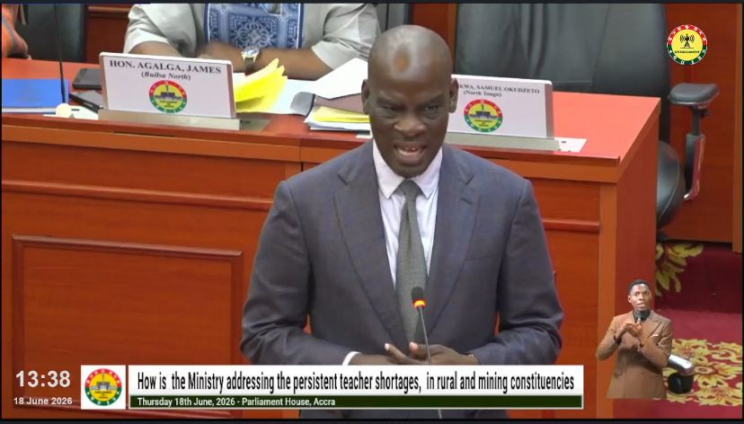
Education Minister Haruna Iddrisu has revealed that Ghana’s education sector is facing a teacher deficit of between 50,000 and 90,000, citing budgetary constraints as a major obstacle to recruiting the number of teachers needed across the country.
Addressing Parliament on Thursday, June 18, Mr Iddrisu disclosed that while the country requires tens of thousands of additional teachers, available financial resources have limited recruitment efforts.
The Minister for Education says the government is unable to recruit enough teachers to meet the growing staffing needs of schools despite a significant shortfall in the sector.
According to him, Ghana’s education reforms have expanded the demand for teachers, requiring government to deploy newly recruited personnel across multiple institutions within the sector.
“The country has evolved and we have undertaken reforms that will benefit education in the foreseeable future.
We now have the Commission for Technical and Vocational Education and Training and the Ghana Education Service, and so when we are recruiting, we allocate teachers for TVET and GES,” he said.
Mr Iddrisu explained that there is a significant gap between the actual staffing needs of the education sector and the number of recruits government is financially cleared to employ.
“There is a difference between need and what I have budgetary approval for. My need for teachers is between 50,000 and 90,000, but I had clearance for 7,000, and that is what I am making do with,” he stated.
His comments provide further explanation for the government's decision to recruit only 7,000 teachers, a move that sparked concerns among education stakeholders and unemployed trained teachers.
Many graduates from the country's colleges of education have argued that the limited recruitment exercise falls far short of addressing the growing number of qualified but unemployed teachers.
The Minister, however, maintained that recruitment levels must be guided by available budgetary allocations, even as government continues to grapple with increasing demand for teachers across basic, secondary and technical and vocational institutions.
Latest Stories
-
NPP election: We thank NDC for making the attempt; we never expected them to show up – Karbo says after boycott
3 minutes -
Tennessee prison chief to resign after Christa Pike’s failed execution
29 minutes -
Free SHS suffering under NDC gov’t- Dr Bawumia
47 minutes -
NSA cannot manage all Ghana’s sports facilities alone – Ampofo Ankrah
49 minutes -
MoH announces mop-up recruitment for health professionals
51 minutes -
Turn Saltpond history into economic opportunity – Stakeholders
51 minutes -
Ampofo Ankrah opens up on ‘constant and unrelenting’ pressure at NSA
1 hour -
I expect to win NPP Vice Chairman race – Nana B
1 hour -
NDC’s failed 24-Hour Economy has become 24-Hour demolition – Dr. Bawumia
1 hour -
Stampede at NPP conference leaves three injured in Kumasi
2 hours -
Use power to serve Ghanaians, not to intimidate – Okoe Boye to NDC
2 hours -
“I’ll have no honour if your arrears are not paid by October 30,” Haruna Iddrisu tells teachers
2 hours -
Billboard collapses at NPP delegates conference, 4 vehicles damaged
2 hours -
NPP Delegates Congress: The 14 approved constitutional amendments
2 hours -
EOCO’s handling of arrests could cost NDC power – Kpebu
2 hours