

Audio By Carbonatix
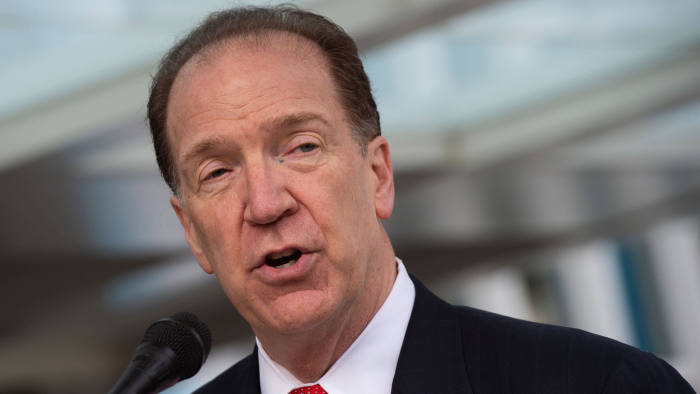
The World Bank Group President, David Malpass, has expressed disappointment over Ghana and Nigeria’s decision not to sign up for the Debt Service Suspension Initiative (DSSI).
Established in May 2020, the DSSI expired at the end of December 2021.
The DSSI, put together by the International Monetary Fund (IMF) and World Bank offered countries an opportunity to freeze debt servicing, whiles they concentrate on using their minimum funds to deal with other commitments.
Mr. Malpass was responding to questions at a programme in Washington DC, on suggestions that the Bretton Wood institutions are not doing enough to help cancel the debts of some African countries in distress.
But reacting to the question, he pointed out that Ghana and Nigeria failed to apply for the DSSI, which would have provided some financial space for the repayment of loans.
“Kristalina (IMF Boss) and I were talking yesterday with the Group about the Common Framework. If countries could have a situation where the common framework clause allow the country to have a standstill on debt, that would help the country choose their path forward on debts restructuring. That would mean they would get a break on debt repayment while they work on debt restructuring,” he explained.
Mr. Malpass stated that such initiatives are designed to help reduce the impact of economic hardship on developing countries.
He, however pointed out that some developing countries refused to take advantage of the initiative to minimise the impact of the current global hardship on their citizens.
“Nigeria and Ghana both, did not ask for the common framework treatment”, he said, adding that the situation has made it difficult for such countries to overcome the negative impact of current global economic hardship on trade and currencies of developing countries.
Debt to GDP to hit 90.7% - IMF
The International Monetary Fund (IMF) had already projected that Ghana will end 2022 with a debt-to-Gross Domestic Product of 90.7%.
This was captured in its Fiscal Outlook Report released on the sidelines of the on-going IMF/World Bank Annual meetings in Washington DC, USA.
The report, also forecasts that the debt–to-GDP could reduce to 87.8% in 2023.
According to the IMF, revenue expressed as a ratio of GDP could also hit 14.1% at the end of 2022.
It will subsequently increase to 14.7% in 2023 and 15.4% in 2024”, the report said, classifying Ghana as a Low Income Developing Country.
Latest Stories
-
Tyson Fury dominates Makhmudov, calls out Joshua next
7 minutes -
I have supported highway authority financially to fix roads in my constituency – A Plus
1 hour -
US, Iran fail to reach peace agreement after marathon talks in Pakistan
2 hours -
ECG kicks off Phase Two of transformer upgrades at Lashibi; brief outages expected
2 hours -
Port crises loom as 11,000 drivers threaten four-day strike
3 hours -
A source of excellence across generations – Vice President Opoku-Agyemang lauds Mfantsipim
4 hours -
(Photos) Mfantsipim School launches historic 150th anniversary
4 hours -
Knights and Ladies of Marshall group backs Catholic Bishops’ stance on anti-LGBTQ+
5 hours -
Bright Simons writes: All the Filla in the Ibrahim Mahama/E&P – Gold Fields Saga
6 hours -
Monetise Idiocy In Ghana
6 hours -
The Ghanaian prophet and the mysterious death of his scottish wife Charmain Speirs
6 hours -
Nearly 400 sentenced in Nigeria for links to militant Islamists
7 hours -
Ghana’s recovery supported by gold strength despite global oil price pressures – Standard Bank Research
7 hours -
Methodist Church hails Mfantsipim@150; calls for “fresh consecration” to excellence
7 hours -
‘Excellence is our inheritance’ – Nana Sam Brew-Butler hails Mfantsipim’s 150-year reign in leadership
7 hours