

Audio By Carbonatix
Vice President Dr. Mahamudu Bawumia has indicated that Ghana’s debt to Gross Domestic Product (GDP) would have be within the sustainable threshold of some 68%, instead of the 76.6% at the end of 2021, if the ¢54 billion debt for the three exceptional items (Covid-19, financial sector and energy sector) were not included.
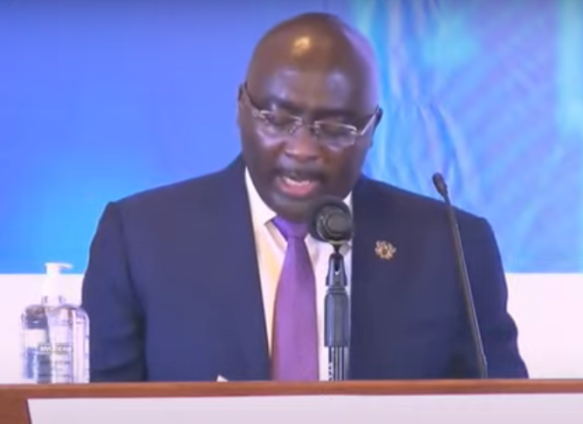
Speaking at a lecture at the Accra Business School, Dr. Bawumia said Ghana has been hit by a quadruple whammy in the last few years which has impacted negatively on the economy.
“If you take the fiscal impact of this quadruple whammy, Ghana will not be going to the IMF for support because our fiscal, debt and balance of payments outlook would be sustainable”. Of the four factors, two (Covid-19 and the Russian-Ukraine war) were external and the two (the banking sector clean-up and the excess capacity payments) were the result of policies of the previous government”.
“Without ¢54 billion debt for the three exceptional items (Covid-19, financial sector and energy sector), Ghana’s debt to GDP would be within the sustainable threshold of some 68% instead of the 76.6% at the end of 2021”.
Expenditure on key flagship programmes over five years amounted to ¢15.62 billion, compared to ¢54 billion expenditure on three exceptional items
The annual interest cost for the three exceptional items, according to Dr Bawumia, will pay for double the annual cost of all flagship programmes.
Explaining further, the Vice President said “it is important to take decisions that will inure to the benefit of Ghana regardless of whether we are going to IMF for a progarmme or not. The immediate task is to restore fiscal and debt sustainability”.
The Vice President also said the rising food prices, inflation, devaluation of currencies, increasing fiscal deficits and debts are as a result of global phenomenon.
He noted that the way forward is to take strategic decisions such as the acquisition of gold reserves by the Bank of Ghana, as well as energy sector reforms, which will help stabilise the cedi in the long term.
“Notwithstanding Ghana being one of the big gold producers in the world, Ghana’s reserves of gold at the Central Bank at end of 2021 was only 8.7 kilogrammes. Future borrowing and currency would be backed by gold. This will stabilise the cedi in the long term”.
“We are also poised for a major reform of the energy sector. The reforms will make the sector more market based”, Dr. Bawumia said.
“Digitalisation is the key to our participation in the fourth industrial revolution and we must therefore deepen the digitalization of the economy”, he concluded.
Latest Stories
-
US, Iran fail to reach peace agreement after marathon talks in Pakistan
12 minutes -
ECG kicks off Phase Two of transformer upgrades at Lashibi; brief outages expected
46 minutes -
Port crises loom as 11,000 drivers threaten four-day strike
2 hours -
A source of excellence across generations – Vice President Opoku-Agyemang lauds Mfantsipim
2 hours -
(Photos) Mfantsipim School launches historic 150th anniversary
3 hours -
Knights and Ladies of Marshall group backs Catholic Bishops’ stance on anti-LGBTQ+
4 hours -
Bright Simons writes: All the Filla in the Ibrahim Mahama/E&P – Gold Fields Saga
4 hours -
Monetise Idiocy In Ghana
4 hours -
The Ghanaian prophet and the mysterious death of his scottish wife Charmain Speirs
5 hours -
Nearly 400 sentenced in Nigeria for links to militant Islamists
5 hours -
Ghana’s recovery supported by gold strength despite global oil price pressures – Standard Bank Research
6 hours -
Methodist Church hails Mfantsipim@150; calls for “fresh consecration” to excellence
6 hours -
‘Excellence is our inheritance’ – Nana Sam Brew-Butler hails Mfantsipim’s 150-year reign in leadership
6 hours -
Kwaku Azar writes: A-G vs OSP
6 hours -
Mfantsipim–Adisadel rivalry built excellence, not division – Sam Jonah
7 hours