

Audio By Carbonatix
Ghana's university libraries must do more than preserve books and provide access to information if they are to remain central to teaching, research and learning in a rapidly changing academic environment, senior university leaders and librarians have said.
They say the growing influence of digital technology, artificial intelligence, open access and changing expectations from students and researchers requires academic libraries to rethink their traditional role.
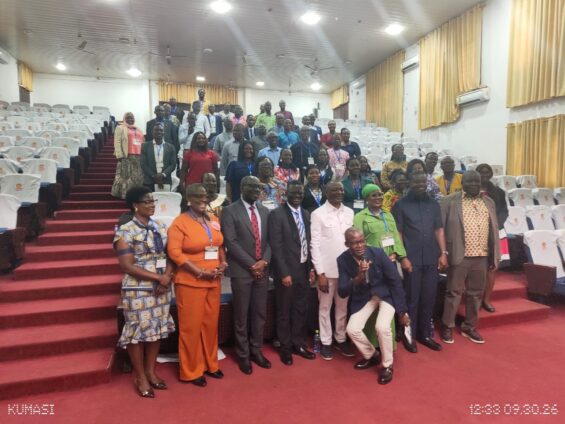
The call was made at the 42nd Annual General Meeting and Conference of University Librarians Ghana (ULG), hosted by the University of Skills Training and Entrepreneurial Development (USTED) in Kumasi from 30 September to 1 October 2026.
The conference brought together university librarians, researchers and higher-education leaders under the theme: “Leading the Change: Developing Resilient Library Leaders for a Transforming Academic Landscape.” The programme included discussions on open access, research communication and widening public access to knowledge.
For Professor Isaac Boateng, Pro-Vice Chancellor of USTED, the challenge facing libraries is not simply how to acquire new technology, but how to adapt it intelligently to local circumstances.
“Change is already here. The question is not whether our libraries will change. They must. The real question is whether we will lead the change or merely respond to it,” he told the gathering.
Professor Boateng argued that the explosion of information made the role of libraries more important, rather than less important.
The challenge, he said, was increasingly about helping people distinguish between information, knowledge, understanding and wisdom.
“The library of the future cannot simply be a place where information is stored. It must be a place where knowledge is trusted, ideas are cultivated, scholarship is protected and minds are liberated,” he said.
He said libraries needed leaders who understood emerging technologies, including artificial intelligence, while remaining committed to intellectual freedom, academic integrity and the human purpose of education.
For him, digital transformation should not mean simply copying models developed elsewhere. He used Ghana's supermarket industry to illustrate his point.
He contrasted the fortunes of Laba and Melcom, arguing that businesses that adapt to changing environments are better placed to remain relevant.
He also pointed to the different approaches taken by Shoprite and Game when they entered Ghana's retail market. The lesson, he said, was applicable to university libraries.
“Can we simply do everything that European or Western libraries are doing and expect our institutions to survive and thrive? Probably not. We need to adapt,” he stated.
That adaptation, he said, should include bringing local content into the digital environment and ensuring that libraries respond to the needs of Ghanaian students, researchers, academics and communities.
The library as the university's memory
Professor Boateng warned that institutions that refuse to evolve could eventually become “museums of their own past”.
Universities are changing, he said, while students, researchers, technology and the economics of higher education are also changing.
“Therefore, library leadership must change as well,” he said.
But he stressed that change alone was not enough. Libraries also needed resilience, the ability to respond to disruption without abandoning their professional identity or purpose. He described resilient leaders as people who could turn challenges into opportunities to innovate.
“Leadership is not about occupying an office. Leadership is about creating a future that is better than the present,” he said.
He called for a new generation of library leaders who could become “architects of knowledge ecosystems” rather than simply administrators of collections.
Such leaders, he said, should understand artificial intelligence and its ethical implications, promote open access while protecting quality and academic integrity, and understand data without losing sight of the people represented by it.
“The library is central to the university's intellectual mission,” he said.
Making knowledge more accessible
For Dr Theresa Adu, University Librarian at the University of Health and Allied Sciences, collaboration among academic libraries is essential because many of the resources required for teaching, learning and research are expensive.
She said University Librarians Ghana works closely with the Consortium of Academic and Research Libraries in Ghana, which helps universities obtain electronic resources through collective arrangements.
“Electronic resources are very expensive, yet teaching, learning and research depend heavily on access to resources,” she said.
According to Dr Adu, collaboration has helped make electronic resources available across Ghana's university system at a more affordable cost to participating institutions.
But she said the direction of travel should go further, towards open science, open access and Open Educational Resources.
“Without access to information, there is no future,” she said.
Open access, she explained, can help remove some of the barriers created when academic information is placed behind paywalls.
Open Educational Resources can also provide teaching and learning materials to lecturers and students without requiring institutions or individuals to purchase every resource.
Showing the value of libraries
Dr Adu said another issue requiring attention was the visibility of the work librarians do. Libraries contribute significantly to universities, she said, but much of that work is not always visible to the wider public.
She cited an African proverb about the lizard that falls from a high iroko tree and praises itself when nobody else does.
Her message was that librarians must be prepared to demonstrate their impact. “If we do not tell people about our work and its impact, nobody else will do it for us,” she said.
That, she suggested, means libraries need to communicate more clearly how their services contribute to research, teaching, learning and the wider academic mission.
Succession planning was another concern raised by Dr Adu. She said academic librarians needed to identify and develop future leaders before existing leaders moved on.
The presence of new faces at professional gatherings, she said, was a reminder that people were constantly moving through and out of different positions. As they do, new leaders must be ready to take over.
“These new leaders should not simply come in without knowing what to do. They must be properly prepared, equipped with the necessary skills and knowledge, and able to perform their responsibilities effectively,” she said.
Resilience beyond the library
Chairman of University Librarians Ghana and University Librarian at USTED, Dr Christopher M. Owusu-Ansah, said the conference was an opportunity for the professional body to examine its work, identify weaknesses and plan for the future.
“We put up this meeting to evaluate our activities,” he said.
The organisation brings together university librarians from Ghana's public universities, including traditional and technical universities.
Dr Owusu-Ansah said the conference was intended to leave members with a renewed sense of purpose and a stronger capacity to withstand challenges.
“We want them to return with a resilient mentality and attitude — one that does not yield in the face of challenges,” he said.
He said challenges were inevitable, but librarians had the capacity to overcome them.
The experience of the Covid-19 pandemic, he noted, had demonstrated the importance of university libraries to academic continuity.
When teaching and learning moved online, libraries continued providing resources that supported teaching, learning and research.
“We expect our members to go back and do even more,” he said.
But resilience, he argued, should not be limited to institutional performance. University librarians also need to pay attention to their physical and mental wellbeing, financial planning, budgeting and strategic management.
The objective, he said, was to ensure that the libraries they lead could continue to function and that their staff were empowered to contribute to the wider mandates of their universities.
Leading rather than following
The discussions point to a changing understanding of what an academic library should be. It is no longer enough to ask how many books are on a shelf or how many electronic databases a university can access.
The bigger questions concern how libraries help universities navigate an age of information abundance, digital disruption and rapidly changing research practices.
Professor Boateng said the future would ultimately depend less on the technologies libraries adopt than on how intelligently they adapt those technologies to their own circumstances. The responsibility, he said, also extends beyond individual institutions.
University libraries are custodians of Ghana's intellectual heritage, facilitators of research and partners in teaching and learning.
They are also increasingly being called upon to help protect the integrity of knowledge at a time when the volume of information available to the public is expanding rapidly.
“The future of our libraries will not be determined simply by the technologies we adopt. It will be determined by how intelligently we adapt them to our context, how effectively we protect our values, and how courageously we lead our institutions through change,” he said.
Latest Stories
-
Health sovereignty a priority for 1.4b Africans – President Mahama declares
10 minutes -
NACOC begins pre-screening checks at Accra International Airport
14 minutes -
‘I was stepping up into an alliance’ – Sammy Crabbe clarifies John Boadu backing
16 minutes -
Turn CSIR research into commercially viable products for national dev’t – Dr Agyeman-Rawlings
38 minutes -
Baffour Awuah thanks Bawumia, NPP supporters after GH¢10m bail
40 minutes -
Ghana gaining notoriety for drugs – Bawumia demands bipartisan probe
56 minutes -
Government urges SMEs to embrace digitalisation for growth and job creation
59 minutes -
Ghana’s university libraries urged to lead change in digital age
1 hour -
NPP National Delegates Conference: Nhyiaeso MP calls for unity and peace
1 hour -
Cargill Ghana renovates, equips ICT laboratory for Ahmadiyya Basic School
1 hour -
GH¢6,500 cocoa promise has turned out to be a scam – Bawumia
1 hour -
Firefighters battle blaze behind Amasaman China Mall
1 hour -
We’ll pursue accountability despite intimidation – Afenyo-Markin
1 hour -
‘Ghana Jollof’: Restoring the flavor
2 hours -
SSNIT outlines plans to transform Labadi beachfront into tourism hub
2 hours