

Audio By Carbonatix
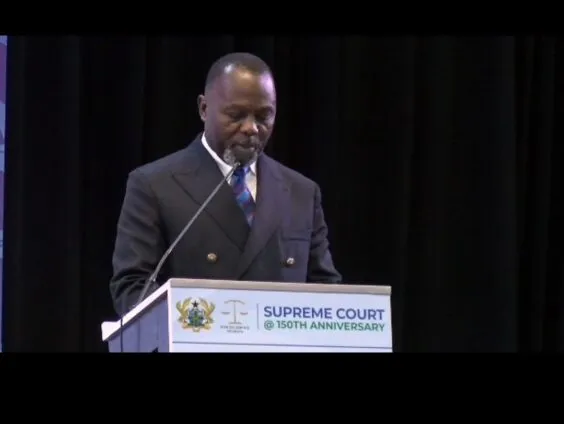
Attorney General and Minister for Justice, Dominic Ayine, has announced that the government has accepted a recommendation to abolish the death penalty in Ghana, paving the way for persons convicted of offences that previously attracted capital punishment to serve life imprisonment instead.
Speaking at a press briefing on government’s position on the final recommendations of the Constitutional Review Committee, the Attorney-General said the proposed amendment would affect the relevant provisions of Article 13 of the 1992 Constitution, which currently provides for the death penalty in certain circumstances.
"The government has accepted the recommendations to abolish the death penalty. That is already underway in Parliament with the Honourable Member for Madina, the Honourable Francis-Xavier Sosu, leading the charge," the Attorney-General said.
He explained that although the issue is already being considered by Parliament, the Constitutional Review Committee also made a recommendation on the matter, which government has now accepted.
"The relevant provisions of Article 13 will be amended accordingly, and offences that previously attracted the death penalty will attract life imprisonment," he stated.
The Attorney-General said the decision is based on the belief that capital punishment is inconsistent with Ghana’s constitutional commitment to protecting the right to life.
"The death penalty is inconsistent with the constitutional right to life and with Ghana’s international human rights obligations under the United Nations conventions to which we are parties," he said.
Ghana has not carried out a death sentence since 1993, although courts have continued to impose death sentences, with many later being commuted to life imprisonment.
The proposed reform forms part of a broader review of Ghana’s human rights framework under the Constitutional Review Committee’s recommendations.
The Attorney-General said the government has also accepted proposals to expand fundamental rights protections through the introduction of a comprehensive Human Rights Act.
He explained that the proposed legislation would provide additional protection for categories of rights, including economic, social and cultural rights, as well as rights relating to women, children, persons with disabilities, older persons and young people.
"The Human Rights Act will elaborate on the rights already guaranteed, extend protection to the new categories of rights identified by the committee, incorporate Ghana’s obligations under international covenants, and provide detailed enforcement mechanisms," he said.
According to the Attorney-General, the proposed Human Rights Act would allow individuals to seek redress at the High Court when their fundamental rights are violated.
He added that the legislation would be protected against easy repeal by future governments, with a constitutional safeguard requiring a 75 per cent parliamentary majority before it can be repealed.
"Constitutional reform is not a single event, but a continuing process. The Constitution must remain a living document that responds to the needs and aspirations of each generation of Ghanaians," he said.
The Constitutional Review Committee, chaired by Professor H. Kwesi Prempeh, submitted its final report containing 206 proposed amendments, including reforms to Ghana’s human rights protections, governance structures and public accountability systems.
Latest Stories
-
Dorimon Naa, Wa West DCE lead massive clean-up exercise; threaten sanctions against recalcitrant residents
16 minutes -
Photos From Adom FM Y2K Jam
19 minutes -
Praye Tiatia steals the show at Adom FM Y2K Jam [Watch]
28 minutes -
Boakye Agyarko congratulates John Boadu, pledges support for NPP leadership
40 minutes -
Antwi HiMight thrills fans with Antwi ne Antwi hits at Adom FM’s Y2K Jam [Video]
53 minutes -
Amb. Edward Boateng congratulates Boadu, Kodua on election wins
1 hour -
John Boadu pledges to rebuild NPP from grassroots and restore ‘winning machinery’
1 hour -
Ashaiman Assembly deploys monitoring system to curb dumping in storm drain
2 hours -
John Boadu must rebuild, unite NPP for 2028 – Edward Boateng
2 hours -
Executive intimidation of opposition undermines separation of powers – Prof Oquaye
2 hours -
I have no issue with John Boadu; we’ll work together – Justin Kodua
3 hours -
Adom FM Y2K Jam delivers a night of music, fashion and nostalgia
3 hours -
Lawrence Kobena Nsarko Otoo, Esq
4 hours -
Bel-Aqua intensifies mental well-being campaign ahead of 15th anniversary
4 hours -
From banking to party finances: Alfred Kwadwo Thompson elected NPP Treasurer
5 hours