

Audio By Carbonatix
The government of Ghana is currently working on to deploy ‘Big Data’ to rationalise the collection, processing, storing and sharing of data among government agencies.
This is expected to be the next major jump in the journey to completely digitise the Ghanaian economy.
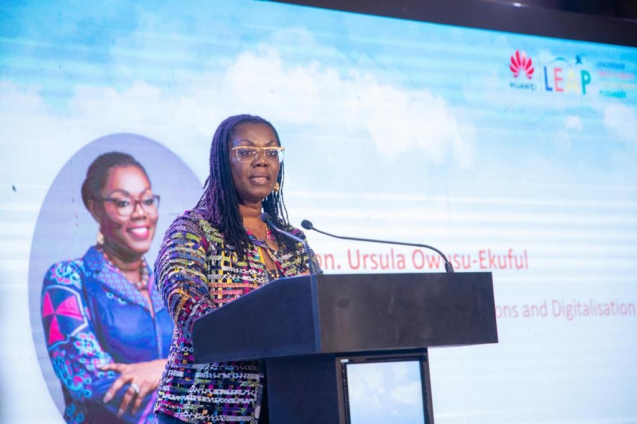
According to Minister of Communications and Digitalisation, Ursula Owusu-Ekuful, ‘Big Data’ is expected to come with the needed data analytics platform which will help make proper sense of all the data being mined across government.
It will also help government track trends across the ecosystem, make projections based on data modelling techniques that will be critical for decision making across the spectrum.
Speaking at the World Development Report by the World Bank, Mrs. Ursula-Ekuful said ‘Big Data’ architecture also takes into consideration the data generated and stored within the private sector to ensure that there is seamless sharing of data across both private and public sectors.
She explained further that the ‘Big Data’ regime is expected to bring transparency and efficiency in the way data is utilized.
“The built-in artificial intelligence component will ensure real time update of the different models for different stakeholders. Government will then be able to make policy decision based on data science and communicate effectively to citizens who would have access to the same data. This should improve on the trust relationship between government and citizenry”.
“One of the most important outlooks of this initiative is the real and accurate information to the business community from the staples of government. The business community can make targeted investments in critical, high growth sectors of the economy where return on investment is high to enable economic growth”, she added.
Some identified sectorial models for the Big Data programme include Big Data for Healthcare, Big Data for Agriculture, and Big Data for Governance, Big Data for Trade and Bid Data for Security. Other are Big Data for Education, Big Data for Finance, big Data for Disaster Management and Big Data for recreation.
Sharing of real time information is also expected to improve security across the country as the security and intelligence agencies can target scarce resources to where it is needed most based on timely and accurate data.
Ursula Owusu-Ekuful said the partnership between development partners, civil societies and government is expected to improve as there will be more reliable and uniform data across all sectors of the economy readily available in the governance process.
On the commercial side, she pointed out government is looking to model a regulated commercial framework around big data.
This will encourage institutions, both private and public, to generate more data.
The Data Exchange Hub: will provide the infrastructure, protocols and framework for data sharing across public and private sectors. It will provide the needed APIs to integrate with critical government systems to provide data input in real time, the cost of data (hits) and the use of the data that is accessed will be managed through the data governance framework to minimise data abuse and privacy issues.
Data Governance Framework: The Big Data initiatives is expected to be deployed with a data governance framework which will define data value, data exchange protocols, security channels and protocols, data governance hierarchy, data exchange dispute resolution protocols, etc.
Rural Telephony Project for Connectivity: The underlying infrastructure to ensure that government get more value out of this data ecosystem it is building. GIFEC through the rural telephony project is extending connectivity to the most rural part of the communities with shared community base stations to allow all telco providers to be able to provide services to the rural folks without the CAPEX overhead on the part of the telco providers. This will facilitate access to the data ecosystem.
Ghana Card Integration for Identity of Persons and Corporates: The ongoing integration of the Ghana Card as the identity platform for persons across the ecosystem is part of the effort to sanitise, standardise and share data across the ecosystem. The Ghana Card is providing single identity services to persons whiles RGD is expected to provide single identity to institutions and companies across the ecosystem to build trust. This government believes will help in the standardisation of data across all platforms.
Latest Stories
-
Zambia elevates tourism education to national priority as President Hichilema backs continental summit
17 minutes -
Activa promotes credit insurance to boost SME export growth
17 minutes -
ILTM Africa 2026 opens doors to inbound and outbound luxury travel in Cape Town
22 minutes -
“BP Soul Travel and Tours scored the highest marks” – Sports Minister Kofi Adams endorses agency for World Cup travel
25 minutes -
‘At the age of 12, I was teaching people and collecting money from them’ – Forty Under 40 Awards
2 hours -
I broke my virginity at the age of 26 after university – Richard Abbey Jnr.
3 hours -
Sacked for fees, saved by faith: The untold story of Forty Under 40 Awards founder Richard Abbey Jnr
3 hours -
GCB Bank surges GH¢0.45, ETI gains GH¢0.06 as GSE ends week higher
4 hours -
Two teens jailed 55 years for robbery
4 hours -
UDS demands apology for MPhil student wrongly branded as Tamale robber
5 hours -
“We don’t sell fish!” – Tema Shipyard CEO hits back over dead fish discovery
5 hours -
Sam George defends anti-LGBTQ+ Bill as ‘national priority’ amid debate over gov’t focus
6 hours -
Artemis II astronauts safely back on Earth after trip around moon
6 hours -
Sam George unveils massive 1,150-cell site rollout to end network woes
7 hours -
This Saturday on Prime Insight: Fuel levy suspension, LGBTQ+ legislation, and Damang Mine controversy
7 hours