

Audio By Carbonatix
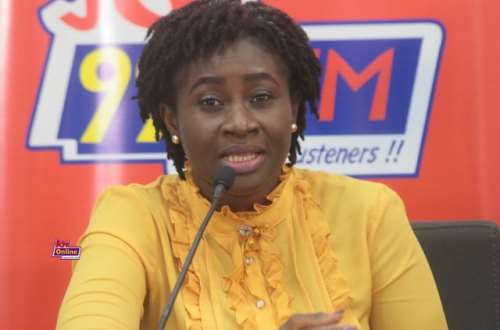
Senior Lecturer at the University of Ghana’s Department of Economics, Dr. Priscilla Twumasi Baffour says the economic hardship of the Covid-19 pandemic has been exacerbated by the government’s ambitious spending prior to the pandemic.
According to her, the Akufo-Addo government which had fortunately inherited a lot of resources had gone ahead to roll out a massive social expenditure scheme in the form of the Free Senior High School Policy which had taken a huge chunk of the available resources.
She says this, coupled with the unexpected Covid-19 pandemic had thus left the government with a dwindling resource pool to work with, occasioning the hardship the country currently suffers.
Speaking on JoyNews’ Newsfile Saturday, she explains that “on that scale, you see that yes, government was quite ambitious on the estimation of revenue that was to come in and based on that there has also been the argument of the free SHS.
“Because when you look at the data you see that capital expenditure in recent times have been dwindling and as a developing country we need that capital expenditure, so the argument has been should we include expenditure on free shs as a capital expenditure element because we’re investing in human capital that is something we can debate about.”
She added that “But the reality is that yes government was a bit ambitious in terms of the expectations of revenue and for that matter rolled out expenditures that are also quite ambitious. And based on all this without anticipating any significant negative shock that explains quite the position we’re in.”
Dr. Twumasi Baffour further stated that the blow the pandemic dealt the private sector has further exacerbated the economic hardship in the country.
She explained that the private sector which is still recuperating from the Covid-19 pandemic is unable to hire new employees and in some instance have laid off some workers thus contributing to unemployment in the country.
“And when you look at the unemployment situation we see that yes, our government is struggling because the private sector that is supposed to drive that agenda based on prudent economic management is also struggling to find its feet because of some of the negative effects that the pandemic has had on them,” she said.
Latest Stories
-
Tarkwa court jails labourer for three years over GH¢123,000 theft
37 minutes -
GAEC must retain nuclear scientists for Ghana’s nuclear ambitions – Minister
1 hour -
Man reportedly mistaken for game and shot by hunter dead in forest
1 hour -
19-year-old mason jailed 15 years for defiling seven-year-old pupil
1 hour -
Ghana’s banking sector assets rise 20.47% to GH¢500.2bn – BoG Governor
1 hour -
22 injured as Sprinter bus overturns at Sege after tyre burst
1 hour -
UN housing expert urges Ghana to strengthen Rent Control Department amid housing affordability concerns
1 hour -
Delta-BCI partnership reaches 166,000 people with breast cancer education
2 hours -
Power restoration fault suspected in Kumasi Central Market fire
7 hours -
The 7-foot giant of Ngleshie Amanfro: Seven-foot Ghanaian Ephraim Saawa dreams of joining the national basketball team
7 hours -
Government promises support for Kumasi Central Market fire victims
8 hours -
Vibes The Movie: Big Ghun’s Ghanaian film earns five nominations at 2026 REFFA
8 hours -
‘I’m a fulfilled man’—Justice Korbieh on missing out on Supreme Court despite two nominations
8 hours -
MamaCare CEO warns unresolved conflicts among health workers could undermine maternal and neonatal care
8 hours -
Health professionals urged to translate medical knowledge into practice to save mothers
9 hours