

Audio By Carbonatix
The Ghana Science Association has called for stronger integration of climate science, artificial intelligence, and environmental stewardship to address growing resource management challenges in Ghana and the rest of Africa.
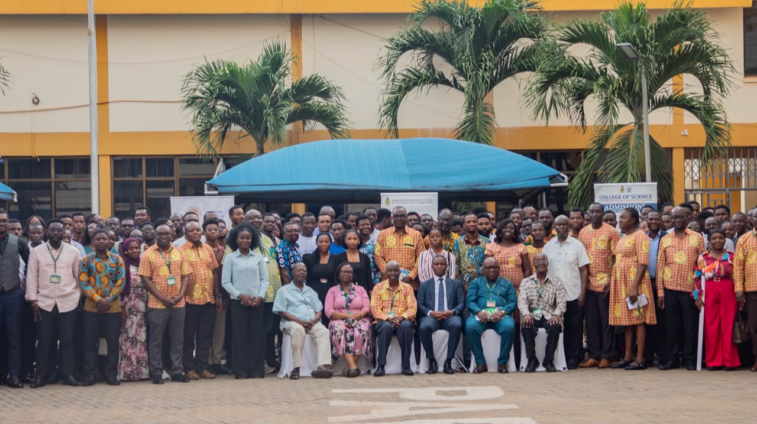
The call was made at the opening of the 2026 Annual Science Conference of the College of Science, KNUST, being held from September 16 to 17.
The conference, organised in collaboration with the Ghana Science Association (GSA), Kumasi Branch, is being held on the theme "Integrating Climate Science, Artificial Intelligence, and Environmental Stewardship for Sustainable Resource Management in a Changing World.”
The event brought together academics, researchers, postgraduate students, industry partners, policymakers, and other stakeholders to examine how scientific innovation and emerging technologies can be deployed to respond to pressing environmental challenges.
Provost of the College of Science, KNUST, Prof. Philip Antwi Agyei, said the theme was particularly relevant at a time when the world is experiencing significant environmental and technological changes.
He noted that climate change is altering rainfall patterns, increasing temperatures, and contributing to extreme weather events, while placing growing pressure on food systems, water resources, ecosystems, and livelihoods.
According to him, rising sea levels, biodiversity loss, population growth, urbanisation and increasing consumption are also putting natural resources under increasing pressure.
At the same time, he said the rapid development of artificial intelligence, big data, machine learning, remote sensing, and computational technologies presents new opportunities for scientists to understand and respond to these challenges.
Prof. Antwi Agyei explained that AI could help researchers analyse huge datasets, improve climate modelling, predict environmental changes, identify emerging risks, and support more informed decision-making.
However, he stressed that technological advancement must be accompanied by responsible governance.
“We must therefore ask not only what AI can do, but also what it should do, for whom, and under whose direction.”
He said questions surrounding ethics, equity, data ownership, privacy, access, and accountability must form part of discussions on the future application of artificial intelligence.
For Prof. Antwi Agyei, the challenge goes beyond determining whether climate science, AI, and environmental stewardship are connected.
He said the focus should now be on how these disciplines can be integrated to generate solutions relevant to African societies.
He challenged African scientists to move from simply observing developments in science and technology elsewhere to actively shaping the direction of those developments.
“How do we shape this integration rather than simply observe technological and scientific developments taking place elsewhere?” he asked.
He encouraged participants to explore how climate science can inform AI, how AI can improve climate prediction and environmental management, and how environmental stewardship can guide technological innovation.
He further urged researchers to move beyond discussions and identify solutions that can be developed, tested and scaled.
Prof. Antwi Agyei also drew attention to the disproportionate impact of climate change on Africa.
He noted that although Africa contributes less than four per cent of global carbon emissions, the continent is projected to face some of the severe consequences of climate change.
He described this as a major scientific challenge that requires research, data, and solutions developed with African realities in mind.
“This is a profound injustice, and it is a scientific challenge that demands research, data, and solutions by Africans for Africa,” he noted.
Climate change, artificial intelligence and environmental stewardship
President of the Ghana Science Association, Prof. Alexander Kwarteng, said Ghana possesses significant scientific talent but must strengthen the systems required to translate that talent into impact.
He identified research infrastructure, funding, actionable policies, and a culture of collaboration as key requirements for advancing science and innovation in the country.
Prof. Kwarteng said climate change, artificial intelligence, and environmental stewardship could no longer be treated as separate areas of discussion.
He described the convergence of the three fields as increasingly important to the way countries and institutions respond to future challenges.
According to him, institutions that understand this convergence and act on it will be better positioned to shape future scientific and technological developments.
Prof. Kwarteng also stressed the importance of collaboration among researchers and institutions.
He said science does not advance in isolation but through the sharing of findings, constructive criticism, and the ability of researchers to build on one another’s work.
He encouraged participants at the conference to use the platform to identify potential collaborators, exchange contacts, and explore opportunities for joint research.
The GSA, he said, remains ready to support cross-institutional and cross-disciplinary initiatives emerging from the conference.
Both speakers highlighted the importance of young scientists and postgraduate researchers in shaping the future of science in Ghana and Africa.
The two-day conference is expected to provide a platform for discussions on climate resilience, sustainable resource management, artificial intelligence, and responsible technological governance.
For the College of Science, the convergence of environmental urgency and technological capability presents an opportunity for African scientists to contribute to solutions that can have an impact beyond the academic environment.
Prof. Antwi Agyei urged participants to take the knowledge and partnerships developed during the conference into their laboratories, classrooms, industries, and communities.
He expressed hope that the conference would result in new partnerships, scientific breakthroughs, and practical solutions for Ghana, Africa, and the wider world.
Latest Stories
-
Asos hackers took more personal details than first revealed, BBC finds
32 minutes -
Fort Hood shooter’s execution by firing squad will be livestreamed, Pentagon says
41 minutes -
Chrysler Building to get its crown restored after being sold
51 minutes -
Infantino re-election boost as Concacaf chief will not stand
1 hour -
Everton’s Sherif fined for breaching betting rules
1 hour -
Suspended fine for Xhaka over Covid-19 certificate
1 hour -
Businessman dragged to court over GH¢480,000 fraud
1 hour -
Pregnant woman and husband found dead in a room at Anloga-Kportorgboe
2 hours -
Man, 87, jailed 20 years for defiling nine-year-old girl at Ofankor
2 hours -
Maresca says ‘feeling is fantastic’ among Man City squad
2 hours -
Sam George warns FBI Director against taking sole credit for Ghana cybercrime operation
2 hours -
Foreign capital no passport to Ghana’s informal retail market – GIPA CEO
2 hours -
E&P model should be seen as a blueprint for building local mining giants – GIPA Boss
2 hours -
Govt’s decision to reduce nurse training long overdue – GRNMA
2 hours -
Ghana needs emergency health fund to respond swiftly to outbreaks – SEND Ghana
2 hours