

Audio By Carbonatix
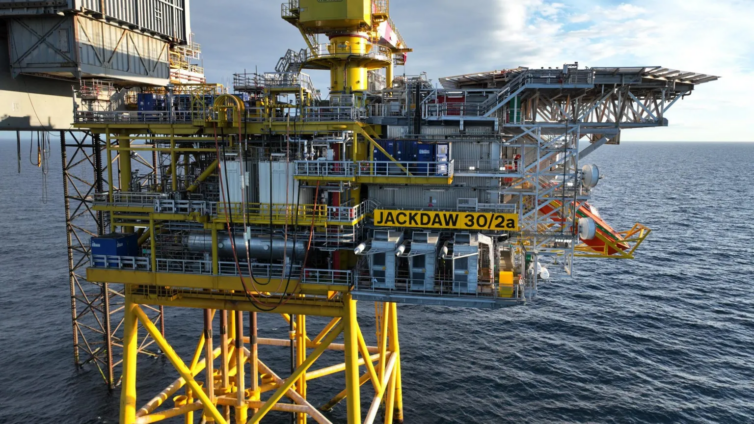
Emissions from the controversial Jackdaw gas field in the North Sea will "not materially influence" global warming, according to a new report from its owner.
Adura's updated Environmental Impact Assessment (EIA) said the project would account for less than 0.02% of annual global greenhouse gases during its lifetime.
The new assessment was required by the industry regulator, after it found several areas had not been adequately addressed in a previous submission.
The report was ordered by a judge who ruled that ministerial consent for Jackdaw was unlawful, following a legal challenge from environmental groups.
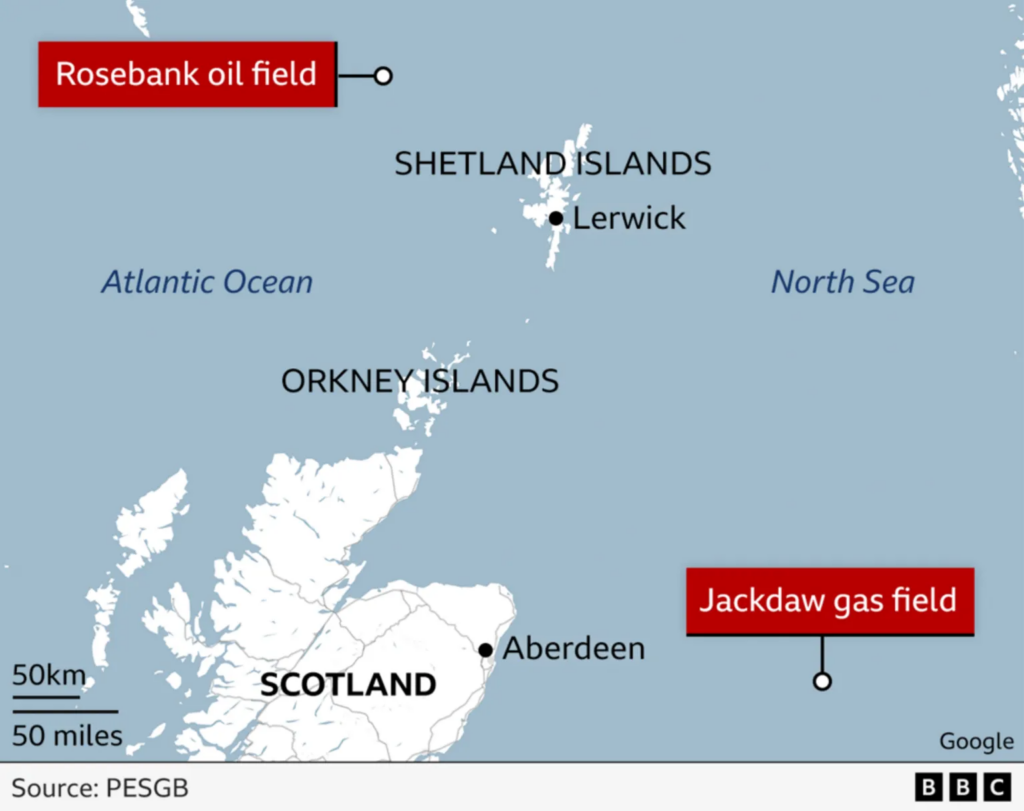
Campaigners had called on the UK government to reject both the Jackdaw gas field and the Rosebank oil field developments.
The previous revised EIA - submitted in November - said the Jackdaw field could produce up to 35.8 million tonnes of carbon dioxide emissions or equivalent during its lifetime, which is around 90% of Scotland's total emissions.
The updated assessment, requested by the Offshore Petroleum Regulator for Environment and Decommissioning (Opred), required Adura to provide additional context on how emissions would affect global ambitions to limit climate change.
Adura is a joint venture between UK energy giant Shell and Norwegian firm Equinor.
Its 159-page submission said that displacing imported liquified nature gas (LNG) from the United States with gas from the Jackdaw field would save the equivalent of four million tonnes of CO2 equivalent.
It says that could result in around 20% more emissions from imports compared with gas produced domestically.
Those "losses" would principally come from eliminating the need to liquify, transport and then regasify the imported product.
It also said the climate effects would be "minor" because the UK has a "well-regulated industry, with targets and commitments that are aligned with the expectations of the Paris Agreement", a legally binding commitment to limit global warming to between 1.5 and 2C.
Last year, the Court of Session in Edinburgh ruled that both Jackdaw and Rosebank had been unlawfully approved, because the government failed to take into account the climate impact of burning extracted oil and gas from the fields.
The legal case had been brought by environmental groups Uplift and Greenpeace.
In his judgement, Lord Ericht required a more detailed climate assessment and fresh approval from the UK government before production could begin.
Latest Stories
-
AFCON 2027Q: ‘You can’t build a winning team if you change every call-up’ – Carlos Quieroz
2 minutes -
Teachers’ strike: All outstanding issues to be addressed at meeting – Education Ministry assures
4 minutes -
AFCON 2027Q: ‘I was not happy that Ghana lost to Côte d’Ivoire’ – Carlos Queiroz
11 minutes -
GPL Matchweek: Aduana’s Osei Kufuor, 8 others win TV sets as NASCO Men of the Match
12 minutes -
Ghana urged to harness AI to transform tourism
15 minutes -
Four killed in Accra-Kumasi Highway crash at Anyinasin Junction
16 minutes -
Jetour set for wider presence in Ghana as Swiss Group plans more showrooms and workshops
17 minutes -
Tinting front windscreens is illegal – ACP Alexander warns motorists
23 minutes -
Your HR Department already has the answer. The problem is finding it
24 minutes -
AFCON 2027Q:‘Qualifying for one or two tournaments is not a sign of success’ – Carlos Queiroz
27 minutes -
Baffour Awuah sues Akwatia MP, Blakk Rasta over alleged false statements
30 minutes -
AFCON 2027Q: Alexander Djiku ruled out of Gambia game with injury
35 minutes -
AFCON 2027Q: The god of football is results – Carlos Queiroz
38 minutes -
Africa will not be forced to choose sides in global power rivalry – Ablakwa
41 minutes -
NPP demands review of GH¢2,650 cocoa price, questions statutory calculation
43 minutes