

Audio By Carbonatix
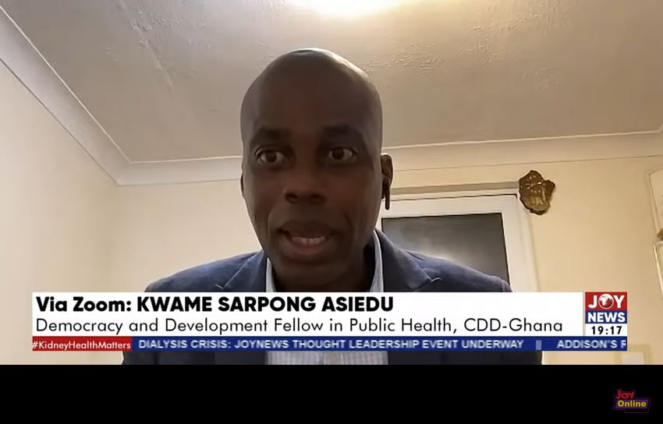
A Democracy and Development Fellow in Health at the Centre for Democratic Development (CDD-Ghana), Dr Kwame Asiedu Sarpong, has criticised the persistent neglect of Ghana’s healthcare system, insisting that the crisis extends far beyond bed shortages and reflects a fundamental breakdown of the entire system.
Speaking on Joy FM’s Super Morning Show on 24 February 2026, Dr Sarpong said both citizens and political leaders have repeatedly ignored warnings about the deteriorating state of the health sector.
Background
His comments follow the tragic death of 29-year-old engineer Charles Amissah, who reportedly died after being transferred between three major hospitals in Accra. He was allegedly turned away from each facility due to a lack of available beds. The incident has sparked public outrage and renewed scrutiny of Ghana’s healthcare infrastructure and governing policies.
In response, Dr Sarpong referenced key reports, including the 2023 Health Harmonisation Assessment and a 2011 policy document, both of which highlighted the urgent need for reforms.
According to him, despite repeated diagnoses of the system’s weaknesses, there has been little meaningful intervention.
“The problem is not a bed problem. It’s a systems and people’s problem. We’ve diagnosed the issues, but we’ve refused to intervene,” he stated.
Dr Sarpong stressed that in healthcare, diagnosis must be followed by decisive action. However, although several reports have flagged deep structural flaws, the necessary reforms have not been implemented.
“The Health Harmonisation Assessment Report was a diagnosis of the health of our health system. When the diagnosis told us our health system was very, very sick, we did nothing about it,” he said.
He further criticised the failure to act on recommendations calling for a comprehensive retooling of the sector.
“We needed retooling of our health system since 2014, but we haven’t done it. That’s a fact of our health system, and it’s why we’re still in crisis today,” Dr Sarpong added.
He emphasised that the issue is not merely about bed availability but about resources and medical expertise at each facility.
“It’s not just about where the beds are. It’s about the resources and the right medical expertise at each facility. If a hospital has a bed but lacks the proper expertise or equipment, sending a patient there is as dangerous as not having a bed at all,” he explained.
While acknowledging disciplinary action taken against healthcare workers in the recent case, Dr Sarpong argued that the focus should be on systemic reform rather than individual blame.
“For me, this needs to be investigated thoroughly again. And this time, the findings do not need to be shelved. We can’t keep sweeping these problems under the rug. If we don’t address the root causes, the cycle will repeat itself,” he cautioned.
He also expressed concern about the slow pace of technological integration within the health system, particularly the absence of a real-time bed availability dashboard — a solution he said he has advocated since 2019.
“It shouldn’t be the responsibility of patients or their families to track bed availability. This should be accessible to health managers and emergency services to ensure patients are sent to the right facilities. We’ve talked about this for years — why is it still not in place?” he asked.
According to Dr Sarpong, the lack of a centralised system to monitor available beds is not merely an inconvenience but a life-and-death issue, contributing to avoidable deaths when patients are directed to ill-equipped facilities.
“We have known what’s wrong with the system for years. Yet every time a tragedy happens, we react as if this is the first time we’re hearing about it. This must change. Until we address the root causes, more people will die unnecessarily. We must act now — before it’s too late,” he warned.
Although he acknowledged positive statements from the Ministry of Health and the Minister, Dr Sarpong stressed that rhetoric must give way to implementation.
“I hear the noises being made by the Ministry of Health and the Minister, and they are good noises. But at this point, these things have to happen quickly. No more delays. We can’t afford to wait any longer. These are not just policy recommendations; they are urgent needs,” he said.
He concluded by describing the crisis as a collective failure involving policymakers, health administrators and citizens alike.
“We have mutual negligence at all levels — politicians, health managers and even the citizens. Everyone is turning a blind eye, and people are dying as a result. We need to stop looking for someone to blame and start fixing the system,” he stated.
Latest Stories
-
Conflicts among care providers linked to maternal, neonatal deaths – Expert
9 minutes -
GIS marks 10th TIME conference, champions improved teaching practices
16 minutes -
BRICS Or Balance? What Ghana’s bid really means
42 minutes -
GPRTU wants full TRAFFITECH-GH implementation to start in 2027
1 hour -
Mahama announces plans to import electric wheelchairs for PWDs
1 hour -
KGL U17 Colts 2026: Western beat Prempeh Elite Academy to set up final final with Greater Accra Region
1 hour -
Late Solanke strike salvages 10-man Spurs draw at Man United
2 hours -
Gender Ministry to monitor welfare of Nana Akua Addo’s children amid domestic violence case
2 hours -
Benedict Okyere Yeboah: Ghana’s football problem goes beyond sacking a coach
2 hours -
GPL 2026/27: Darkwah Wiafe’s winner sees All Blacks beat Kotoko
2 hours -
ITF World Tour : Patel Wins Boys’ Singles Final at J100 Accra
2 hours -
Ghana must pursue BRICS partnership if it brings economic benefits – Kpebu
2 hours -
Success and Wright Claims J100 Accra Girls’ Doubles Championship
2 hours -
ITF J100: America’s Wright wins J100 Accra Girls’ Singles Title
2 hours -
Expedition hopes to find aviator Amelia Earhart’s plane on remote island
2 hours