

Audio By Carbonatix
Books by pro-democracy figures have been removed from public libraries in Hong Kong in the wake of controversial new security law.
The works will be reviewed to see if they violate the new law, the authority which runs the libraries said.
The legislation targets secession, subversion and terrorism with punishments of up to life in prison.
Opponents say it erodes the territory's freedoms as a semi-autonomous region of China. Beijing rejects this.
Hong Kong's sovereignty was handed back to China by Britain in 1997 and certain rights were supposed to be guaranteed for at least 50 years under the "one country, two systems" agreement.
Since the security law came into effect on Tuesday, several leading pro-democracy activists have stepped down from their roles. One of them - one-time student leader and local legislator Nathan Law - has fled the territory.
At least nine books have become unavailable or marked as "under review", according to the South China Morning Post newspaper. They include books authored or co-authored by Joshua Wong, a prominent pro-democracy activist, and pro-democracy politician Tanya Chan.
On Saturday, Mr Wong tweeted that the new law "imposes a mainland-style censorship regime" on Hong Kong, calling it "one step away from ... actual book banning".
1/ More than just punitive measures, the national security law also imposes a mainland-style censorship regime upon this international financial city. Although my books are published years before Hong Kong's anti-extradition movement, they are now prone to book censorship. https://t.co/2fbyvtcH95
— Joshua Wong 黃之鋒 😷 (@joshuawongcf) July 4, 2020
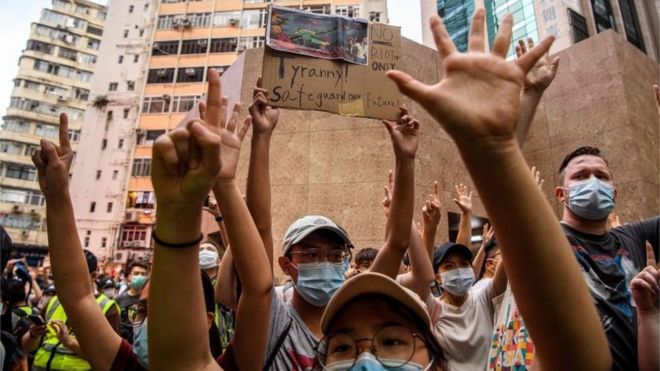
Beijing has dismissed criticism of the law, saying it is necessary to stop the type of mass pro-democracy protests seen in Hong Kong during much of 2019, which at times exploded into very violent clashes between protesters and police.
It has rejected complaints by the UK and other Western nations that it is in breach of guarantees it made to protect Hong Kong's unique freedoms as interference in its internal affairs.
What is the security law?
The law is wide-ranging, and gives Beijing powers to shape life in Hong Kong that it has never had before. The law makes inciting hatred of China's central government and Hong Kong's regional government offences.
It also allows for closed-door trials, wire-tapping of suspects and the potential for suspects to be tried on the Chinese mainland.
Acts including damaging public transport facilities - which often happened during the 2019 protests - can be considered terrorism.
There are also concerns over online freedom as internet providers might have to hand over data if requested by police.
Latest Stories
-
Power restoration fault suspected in Kumasi Central Market fire
3 hours -
The 7-foot giant of Ngleshie Amanfro: Seven-foot Ghanaian Ephraim Saawa dreams of joining the national basketball team
4 hours -
Government promises support for Kumasi Central Market fire victims
4 hours -
Vibes The Movie: Big Ghun’s Ghanaian film earns five nominations at 2026 REFFA
4 hours -
MamaCare CEO warns unresolved conflicts among health workers could undermine maternal and neonatal care
5 hours -
Health professionals urged to translate medical knowledge into practice to save mothers
5 hours -
Conflicts among care providers linked to maternal, neonatal deaths – Expert
6 hours -
GIS marks 10th TIME conference, champions improved teaching practices
6 hours -
BRICS Or Balance? What Ghana’s bid really means
7 hours -
GPRTU wants full TRAFFITECH-GH implementation to start in 2027
7 hours -
Mahama announces plans to import electric wheelchairs for PWDs
7 hours -
KGL U17 Colts 2026: Western beat Prempeh Elite Academy to set up final final with Greater Accra Region
8 hours -
Late Solanke strike salvages 10-man Spurs draw at Man United
8 hours -
Gender Ministry to monitor welfare of Nana Akua Addo’s children amid domestic violence case
8 hours -
Benedict Okyere Yeboah: Ghana’s football problem goes beyond sacking a coach
8 hours