

Audio By Carbonatix
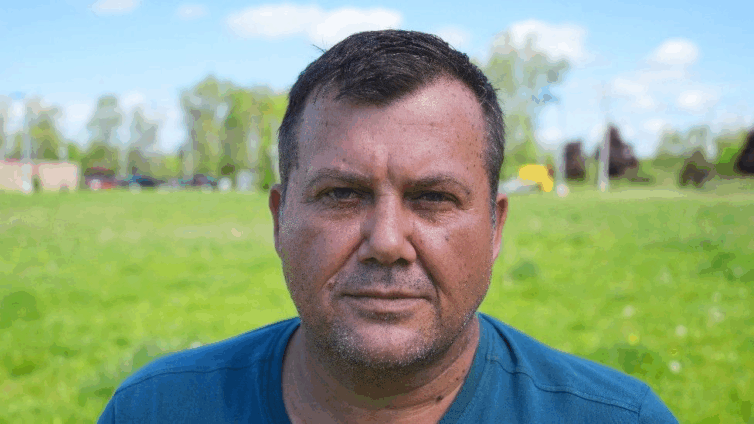
Last week, 46-year-old Charl Kleinhaus was living on his family farm in Mpumalanga province, South Africa. With its scenic beauty, wildlife and deep canyons, it's known as "the place where the sun rises".
His new home - for now - is a budget hotel near an American highway.
He and dozens of other white South Africans were moved to the US under President Donald Trump's controversial policy to protect them from the discrimination he alleges they are facing - an accusation that South Africa rejects.
Mr Kleinhaus defends the US president, telling the BBC he left his homeland after receiving death threats in WhatsApp messages.
"I had to leave a five-bedroom house, which I will lose now," Mr Kleinhaus tells the BBC, adding that he also left behind his car, his dogs and even his mother. "I didn't come here for fun," he adds.
The contrast in homes couldn't be more stark. But for Mr Kleinhaus, his situation in Buffalo, New York, is already a better one. "My children are safe," says Mr Kleinhaus, whose wife died in a road accident in 2006.
The status of white South African farmers has long been a rallying cry on the right and far-right of American politics.
Trump and his close ally, South Africa-born billionaire Elon Musk, have even argued that there has been a "genocide" of white farmers in South Africa - a claim that has been widely discredited.
In February, Trump signed an executive order granting refugee status to Afrikaners, such as Mr Kleinhaus, who he said were being persecuted.
Mr Kleinhaus is one of a group of 59 who arrived on Tuesday at Dulles airport, near Washington DC, after Trump's administration fast-tracked their applications.
He admits he was surprised at how quickly he got to the US, and that he is grateful to Trump. "I felt finally somebody in this world is seeing what's going on," he says.
As he and his family arrived with others at the airport they were greeted with red, white and blue balloons. He describes the pomp and ceremony as "overwhelming".
Afrikaners are a white ethnic minority who ran South Africa during the apartheid era, implementing racist policies of segregation in the country until the regime was officially abolished in 1994.
But more than 30 years on, black farmers own only a small fraction of the country's best farmland, with the majority still in white hands.
That has led to anger over the slow pace of change. Mr Kleinhaus acknowledges that black South Africans have suffered as well as him.
But he says: "I had nothing to do with apartheid. Nothing, nothing, nothing."
In January, South African President Cyril Ramaphosa signed a controversial law allowing the government to seize privately owned land without compensation - in certain circumstances, when it is deemed "equitable and in the public interest".
The South African government says no land has yet been seized. But Mr Kleinhaus says once there is a government claim on your land - as he says is the case with his - it becomes impossible to function.
"Your land becomes worthless - the land expropriation has gone too far," he says. "People are scared of that. Other Afrikaners who criticise us live in a bubble."
Some fellow Afrikaners have described Mr Kleinhaus and the group as opportunists, and that being a victim of crime is not equivalent to the type of persecution that deserves refugee status.
Mr Kleinhaus acknowledges that the murder rate of farmers is low in South Africa, but says he does not want to be a victim. "There are people in my area who were shot and killed," he says.
He says he received threats from members of the local community: "I'd regularly get messages on WhatsApp saying, 'we'll get rid of you, you're on my land'."
Mr Kleinhaus says he received one message before he left for the US, which read: "We are coming for you, you better be awake."
He also says his farming machinery was damaged, and that local police failed to act on his reports.
Ramaphosa has called the group who travelled to the US "cowards", saying they do not want to address the inequities of the apartheid era.
"As South Africans, we are resilient," he said earlier this week. "We don't run away from our problems. We must stay here and solve our problems."
What makes the resettlement of the Afrikaners to the US particularly controversial is that other refugees have been banned, including Afghans who, earlier this wee,k had their Temporary Protected Status removed.
The Department of Homeland Security (DHS) said that move was justified because the security and economic situation in Afghanistan had improved - despite criticism from opposition lawmakers and rights groups.
Mr Kleinhaus says he is sympathetic: "I mean, I feel sorry for the Afghans that they can't get here. But I know there's a process there. And I know when and if you are approved for the process, they take care of you."
Does he worry he's being used as a political pawn by Trump? And that another president could potentially reverse this decision in four years' time?
Mr Kleinhaus pauses, and says: "Yeah, it is scary, but I am a religious person. Just to be in this first group is an act of God, I believe, because there was a 0.0 something per cent chance that you were selected for the first call."
Questions over refugees' vetting
Mr Kleinhaus has come under scrutiny for antisemitic posts on social media, which have since been deleted.
Discussing one of these, he says he copied and pasted someone else's thoughts, and that he was being administered morphine as part of medical treatment at the time - though he admits this was not an excuse.
The 2023 post was made in a moment of anger, he adds, after he saw a video - not verified by the BBC - which purported to show some Jews spitting at Christians in Israel.
Mr Kleinhaus insists the comments were specific to one moment, and not a wider comment about Jewish people. "Even now, if I see any person going against my religion, I will speak up against it," he said.
The US government is facing questions about the vetting process for those being resettled. The UN's refugee agency told the BBC it was not involved in the screening process for the Afrikaners as it normally would be for refugees heading to the US.
The Department of Homeland Security (DHS) has previously stated it is screening immigrants' social media activity for antisemitism and using it as a reason for denying applicants.
The Trump administration has been citing allegations of antisemitism as its officials have in recent months ,arrested and tried to deport pro-Palestinian activists.
In a statement to the BBC, a senior DHS official said: "The Department of Homeland Security vets all refugee applicants. Any claims of misconduct are thoroughly investigated, and appropriate action will be taken as necessary. DHS does not comment on individual application status."
Since returning to office, Trump has launched a crackdown to reduce immigration more broadly. So, is Mr Kleinhaus concerned about any backlash to his group being offered entry to the US?
"People must not think we are just taking advantage of this," he says. "We come here to make a contribution to the country.
"I'm not worried it'll fall apart because I believe this is God's plan for me.
"My life is in his hands. And if if he didn't want me to come, I wouldn't be here."
Latest Stories
-
Insults generally are not crimes, but some may be criminal under the law – Samson Lardy Anyenini
4 minutes -
IGP deploys specialised police team, armoured vehicle to strengthen security in Nkwanta
4 minutes -
Dr Bawumia advocates solar power, access to credit, training and certification for artisans
6 minutes -
Trade Minister engages Russia, UAE and UNDP to boost trade, investment
8 minutes -
7 best foods to help keep blood sugar levels steady
11 minutes -
Ghana to host signing of UN trade convention to modernise global cargo documentation on October 26
26 minutes -
Family announces memorial mass for Nana Konadu Agyeman-Rawlings
30 minutes -
Mahama, Trade Minister, tours Afienya and Tema factories, schedules meeting on Free Zones incentives
34 minutes -
Gyakie and FlipTheMusic unveil ‘Your Body’ following a new distribution deal with Warner Music Africa
35 minutes -
Stop looking down on new media practitioners as if they don’t matter – New Media President
37 minutes -
Ghana’s BRICS partnership bid aimed at broadening development opportunities – Mahama
42 minutes -
Fiabci-Ghana inaugurated to promote professionalism and global collaboration in real estate sector
1 hour -
‘No flying in just for matches’ – Kofi Adams sets conditions for next Black Stars coach
1 hour -
Ghana and BRICS: Strategic opportunity, economic imperative or geopolitical gamble?
1 hour -
SML vs GRA: Court grants preservation order in dispute over US$500 million investment
1 hour