

Audio By Carbonatix
Striga, a destructive parasitic weed that severely reduces crop yields, particularly in legumes and cereals, is being tackled through a new initiative led by the International Atomic Energy Agency (IAEA) in partnership with the Food and Agriculture Organization (FAO).
Known scientifically as Striga hermonthica, the weed remains one of the most serious threats to food production across sub-Saharan Africa, affecting staple crops such as maize and sorghum.
In Ghana, where cereals play a critical role in food security and livelihoods, farmers who engage in production of such crops, continue to experience significant yield losses due to infestations of the parasitic plant.
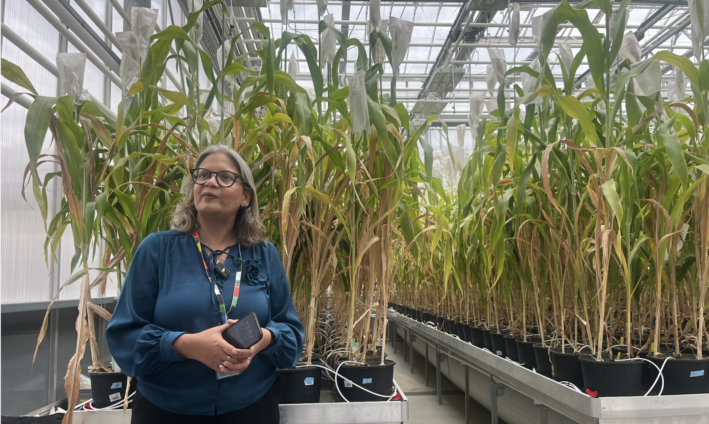
Speaking in an interview with the Ghana News Agency, Dr Pooja Bhatnagar-Mathur, Section Head of the Plant Breeding and Genetics Section at the Joint FAO/IAEA Centre under the Department of Nuclear Sciences and Applications, said the agency was applying advanced plant breeding techniques to develop sorghum varieties capable of resisting the parasite.
She explained that the initiative focuses on mutation breeding, a scientific approach used to create genetic variation in crops to identify desirable traits such as disease and pest resistance.
“We are doing mutation breeding to improve sorghum genotypes for addressing the menace of Striga hermantica, which is the major parasitic weed in sub-Saharan Africa,” she said.
According to her, Striga can contribute to crop losses of up to 100 per cent under severe infestations, making it one of the most devastating constraints to agricultural productivity in affected regions.
The research team is using physical mutagenesis to identify genes responsible for resistance to the parasitic weed and incorporate those traits into improved sorghum lines.
Dr Bhatnagar-Mathur noted that scientists had already identified promising genetic materials and were now moving into the next stage of seed multiplication.
“We have identified some of the genes that are responsible for resistance to Striga hermantica and now we are multiplying the material for future testing in multi-location trials with our African counterparts,” she said.
The upcoming trials would allow researchers and partner institutions across Africa to evaluate the performance of the improved sorghum varieties under real farming conditions and different ecological settings.
Dr Bhatnagar-Mathur indicated that seed multiplication was currently underway and that experimental field testing could begin next year.
If successful, the initiative is expected to provide farmers in Ghana and across sub-Saharan Africa with more resilient sorghum varieties, improve yields and strengthen food security, while reducing losses caused by the persistent agricultural threat.
Latest Stories
-
I have no issue with John Boadu; we’ll work together – Justin Kodua
1 hour -
Adom FM Y2K Jam delivers a night of music, fashion and nostalgia
2 hours -
Lawrence Kobena Nsarko Otoo, Esq
3 hours -
Bel-Aqua intensifies mental well-being campaign ahead of 15th anniversary
3 hours -
From banking to party finances: Alfred Kwadwo Thompson elected NPP Treasurer
3 hours -
George Christian Papa Mends
3 hours -
Ali Suraj elected NPP NASARA Coordinator
3 hours -
Mustapha Hamid misses out on NPP Vice Chairmanship by 31 votes despite early poll lead
3 hours -
Kojo Bamba, Henry Nana Boakye and Nana Akomea elected NPP Vice Chairmen
4 hours -
From Delta Force to NPP First Vice Chairman – Kojo Bamba’s political journey
4 hours -
Police restore calm at Larteh following Odwira festival disturbance
5 hours -
‘All the camps will dissolve’ – Bawumia demands one NPP for 2028
5 hours -
There is no time to waste – Bawumia orders NPP to begin 2028 work
5 hours -
Sarkodie visits MobileMoney Fintech LTD
5 hours -
John Boadu unveils new NPP strategy to win back youth and modernise party
5 hours