

Audio By Carbonatix
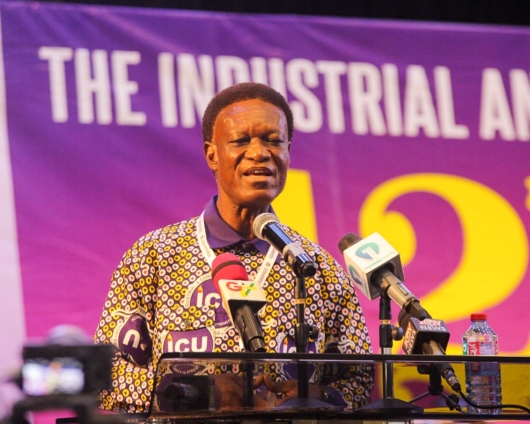
As the world observes Precarious Work Day today, the Industrial and Commercial Workers’ Union (ICU), Ghana has joined global labour partners in solidarity to condemn the increasing prevalence of precarious work.
The day, marked annually on 7th October since its institution in 2008 as the World Day for Decent Work, serves as a rallying point for millions around the globe to advocate for decent working conditions.
This year, ICU-Ghana is amplifying its call on political authorities to prioritise policies and programmes that promote decent work, ensuring that working people can labour in dignity and reap the fruits of their hard work, even into retirement.
Precarious work, which manifests in substandard employment arrangements such as outsourcing, casual work, and fixed-term contracts, has become a widespread feature of the modern labour landscape, especially within transnational and multinational corporations.
According to the General Secretary of ICU-Ghana, Morgan Ayawine, it is a grave injustice to see young citizens working as casual employees for more than five years, with no hope of permanent employment and no access to the benefits associated with decent work.
While the union welcomes the investments and job opportunities created by international companies, it maintains that it will not tolerate the trampling of workers’ rights through exploitative employment practices that prioritise profit over people.
“The vexed issue is that outsourcing deprives employees of decent work benefits such as the right to unionise, fair wages, safe working conditions, social protection, paid leave, retirement plans, and opportunities for personal development,” Mr. Morgan noted in a statement issued on Tuesday to mark the celebration.
“Outsourced workers perform the same tasks and work the same hours as their permanent counterparts, yet are denied these fundamental rights. This is not only unfair — it is outright exploitation,” he added.
The union decried the deepening discrimination within workplaces, where two employees doing identical jobs receive vastly different treatment: one enjoys social protection and benefits, while the other remains unprotected and insecure.
This, ICU-Ghana insists, undermines the core principles of the International Labour Organisation’s (ILO) Convention on Decent Work and debases workers’ dignity.
ICU-Ghana is calling for renewed commitment from all social partners to address this growing menace.
“Precarious work must be condemned in no uncertain terms,” Mr. Morgan emphasised. “Unbridled outsourcing is eroding worker protections at an alarming pace. The time has come for decisive action to restore dignity to labour.”
Latest Stories
-
Power restoration fault suspected in Kumasi Central Market fire
2 hours -
The 7-foot giant of Ngleshie Amanfro: Seven-foot Ghanaian Ephraim Saawa dreams of joining the national basketball team
3 hours -
Government promises support for Kumasi Central Market fire victims
3 hours -
Vibes The Movie: Big Ghun’s Ghanaian film earns five nominations at 2026 REFFA
3 hours -
MamaCare CEO warns unresolved conflicts among health workers could undermine maternal and neonatal care
4 hours -
Health professionals urged to translate medical knowledge into practice to save mothers
4 hours -
Conflicts among care providers linked to maternal, neonatal deaths – Expert
5 hours -
GIS marks 10th TIME conference, champions improved teaching practices
5 hours -
BRICS Or Balance? What Ghana’s bid really means
6 hours -
GPRTU wants full TRAFFITECH-GH implementation to start in 2027
6 hours -
Mahama announces plans to import electric wheelchairs for PWDs
6 hours -
KGL U17 Colts 2026: Western beat Prempeh Elite Academy to set up final final with Greater Accra Region
7 hours -
Late Solanke strike salvages 10-man Spurs draw at Man United
7 hours -
Gender Ministry to monitor welfare of Nana Akua Addo’s children amid domestic violence case
7 hours -
Benedict Okyere Yeboah: Ghana’s football problem goes beyond sacking a coach
7 hours