

Audio By Carbonatix
The illegal global trade in ivory has shrunk while the trafficking of pangolins has soared, a U.N. report on wildlife crime based on four years’ data said on Friday.
National bans on selling ivory, particularly China’s in 2017, appear to have helped further erode ivory trafficking after it peaked around 2011-2013, the United Nations Office on Drugs and Crime (UNODC) said in its World Wildlife Crime Report, which was last published in 2016.
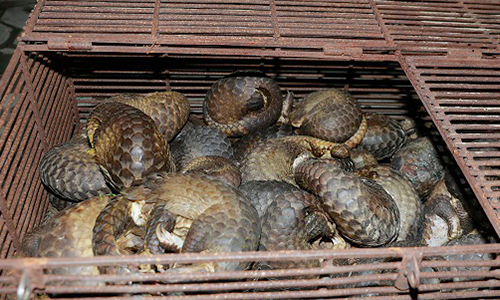
At the same time, the trafficking of pangolins - a reclusive, nocturnal mammal covered in scales that are used in traditional Chinese medicine, has surged, the UNODC said.
“The World Wildlife Crime Report 2020 has some good news and some bad news,” UNODC research chief Angela Me told Reuters.
“We see some shrinking in some markets, particularly the ivory and the rhino (horn) market, but we actually see huge increases in other markets, like the market of illicit trafficking of pangolins, in European eels but also in tiger parts and also in rosewood,” she added.
The causes of these shifts are likely multiple and the UNODC was guarded in identifying the forces behind illegal trades that are opaque by definition, often involving poaching in Africa and smuggling to Asia, where China is the biggest market.
For ivory, a supply glut combined with a shift in attitudes because of the Chinese and other bans may be among the factors that contributed to the fall in poaching and prices, the UNODC said, adding that the price of illegal ivory in China fell by more than half between 2014 and 2018.
The UNODC estimates the annual income generated by ivory trafficking between 2016 and 2018 at $400 million.
Seizures of pangolin scales, mainly sourced in Africa, increased tenfold between 2014 and 2018 as trafficking moved away from pangolin meat, which was mainly seized in Asia. In that time 185 tons of scales were seized, for which roughly 370,000 animals would have been killed, the UNODC said.
“They are now arguably the most heavily trafficked wild mammal in the world,” it said of the scaly creatures.
Latest Stories
-
Mobile Money Fintech LTD, UMB train hairdressers and beauticians
3 hours -
Asylum votes show people want help, says Kemi Badenoch
4 hours -
Badenoch welcomes expanded grooming gangs inquiry
4 hours -
GACL MD sues Samuel Buabeng over alleged Facebook defamation
4 hours -
Christa Pike in critical condition after surviving two lethal injections, lawyer says
4 hours -
Kemi Badenoch backs face covering ban at protest
4 hours -
Man City not ‘above the rules’, says No 10 after backlash to Burnham remarks
4 hours -
Real Madrid submit ‘substantial’ dossier in Barca payments case
4 hours -
Messi completes purchase of second Spanish club
4 hours -
Government must engage horticulturists on tomato crisis – GhIH
5 hours -
King Promise’s ‘Can’t Tame Us’ becomes official Chelsea anthem
5 hours -
Afenyo-Markin demands Baffour Awuah’s release from EOCO’s custody, end to alleged political intimidation
5 hours -
Rapper Rick Ross arrested on domestic violence charges
5 hours -
Minority demands security review of Ghana-Colombia visa waiver and port deals
5 hours -
Pursue drug kingpins, not persecute political opponents – Afenyo-Markin tells EOCO
5 hours