

Audio By Carbonatix
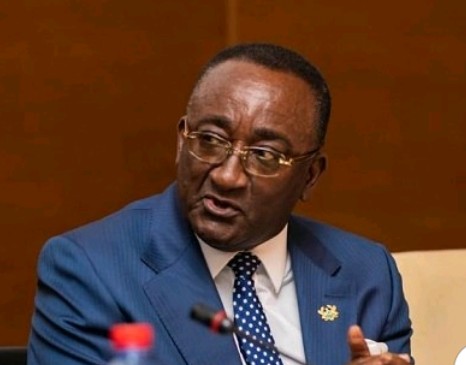
Minister for Food and Agriculture, Dr. Owusu Afriyie Akoto, has said that harmful chemicals used in illegal mining is the greatest threat to cocoa production in the country.
The Minister is worried that cyanide and other chemicals used in water bodies in cocoa farming areas are endangering the country’s cocoa sector.
He said the practice could lead to a ban of Ghana's cocoa beans on the international market, with an adverse effect on the country’s economy.
Currently in Europe, there is new legislation that could soon make Ghana’s cocoa and coffee unexportable to many foreign countries.
Speaking to LUV News, Dr. Owusu Afriyie Akoto noted that the issue must be addressed urgently to safeguard the country’s export of cocoa.
“It is very important. It is the water pollution, cyanide and other chemicals, mercury that go into the food chain and ends up in our stomachs. To me, that is the most dangerous part, it is not the quantity but it is the negative environmental impact…If we send a consignment of cocoa to say Belgium and they tested and find any trace, they could ban our cocoa exports.
“So it is not so much the impact of the production as to endangering our international trade, and the only thing we have is cocoa. Immediately, the danger of these cyanides and these very dangerous chemicals going into our products, which we send abroad, will endanger our export earnings which for me is the biggest concern,” he stated.
Meanwhile, the European Union has threatened to impose restrictions on Ghana and Cote D’Ivoire with regard to cocoa exportation into ports of their member countries if the destruction that is being caused by illegal mining is not dealt with.
Deputy CEO of COCOBOD, Dr. Emmanuel Agyeman Dwomoh, revealed this during the national Consultative Dialogue on Small Scale Mining in April last year.
The EU also believes growing of cocoa in the thick forest might be one of the driving forces.
“As we speak, EU is threatening to impose restrictions on the importation of cocoa from Ghana and Côte d’Ivoire to their ports.”
He added, “When you take the satellite images, you will see those places in red. The EU thinks that all those places are red because cocoa is causing land degradation [in Ghana]. Meanwhile, it is as a result of the galamsey activities.”
Ghana exports 80% of its cocoa into the European Union market, according to COCOBOD. Stakeholders are therefore worried about the impact of the galamsey menace on the finances of the country and the cocoa sector.
Latest Stories
-
For President Mahama, every mother must live. What about you?
54 seconds -
OMCs commence fuel price reviews; Star Oil sells petrol at GH¢14.97, diesel kept at GH¢16.97
35 minutes -
Residents of Brekusu-Kwabenya-Kitase protest over deplorable roads
44 minutes -
Genser Energy secures 456m euros to accelerate next phase of growth across West Africa
49 minutes -
COKA visits Kokofu after Ashanti NPP win, calls for unity ahead of 2028
52 minutes -
Bono East crowns Kintampo SHS, Gyarko Community Day SHS for national public speaking finals
1 hour -
GRIDCo completes initial repair works on Ashaiman transmission line
1 hour -
Egyapa Mercer donates hairdryers to graduating hairdressers in Sekondi
1 hour -
Health Ministry hands over 30 ambulances to National Security for refurbishment
2 hours -
Republic Bank deepens commitment to homeownership with nationwide JoyNews Habitat Fair partnership
2 hours -
Archbishop Duncan-Williams links galamsey to Ghana’s wider culture of indiscipline
2 hours -
India’s clean energy leadership in green hydrogen
2 hours -
Ghana’s Road Safety Crisis: We must move from reaction to prevention
2 hours -
Duncan-Williams urges Church to educate Ghanaians on dangers of galamsey and gold smuggling
2 hours -
New Defence Minister pledges technology-led defence posture
2 hours