

Audio By Carbonatix
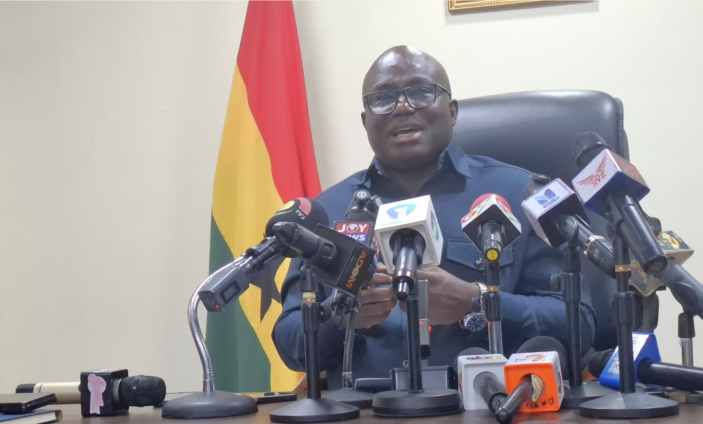
Minister of Food and Agriculture, Eric Opoku, on Wednesday assured the public that Ghana will not face a tomato shortage despite an export ban by Burkina Faso.
He said the Government was rolling out measures to boost yields, cut post-harvest losses and expand irrigation-backed production to stabilise supply.
Addressing a press conference in Accra, Mr Opoku said the immediate response centred on developing high-yielding seed varieties, scaling up irrigation schemes and linking farmers directly to ready markets to reduce waste.
He said collaboration with the West Africa Centre for Crop Improvement would deliver improved tomato seeds capable of raising yields to at least 15 metric tonnes per hectare within months.
In addition, he said government was expanding irrigation under the Vegetable Development Project, including cluster farming in Ahafo and Fanteakwa, drilling 250 boreholes across the northern regions, and securing hundreds of hectares under existing irrigation systems for immediate tomato cultivation.
“We have been importing tomatoes from Burkina Faso to supplement local production… a clear indication that if we don’t put in place the right mechanisms to increase production, we are likely to run into challenges,” Mr Opoku noted.
Ghana’s annual tomato demand stands at about 805,000 metric tonnes, while current production is estimated at 510,000 metric tonnes, leaving a deficit of nearly 300,000 metric tonnes.
The Minister said about 30 per cent of local production- approximately 153,000 metric tonnes – was lost post-harvest.
Reducing the losses could significantly close the supply gap, he said, adding that: “It is not about increasing the size of the land under cultivation. It is about developing the right variety and creating the conditions to maximise output.”
Under the Vegetable Development Project, Mr Opoku said farmers were being supported with improved seeds, fertilisers and technical guidance, alongside irrigation infrastructure to ensure year-round production.
He noted that 60 hectares each had been developed in Ahafo and Fanteakwa with mechanisation and water supply systems, while additional sites were being prepared for expansion.
A rehabilitated irrigation scheme had made 500 hectares available for immediate tomato production after agreements were reached to connect farmers with buyers to guarantee off-take, he added.
One hundred hectares had also been secured at Akumadan to further scale up production.
The Minister said ongoing interventions to improve productivity, reduce waste and strengthen market systems would stabilise supply and enhance food security in the long term.
Latest Stories
-
The 7-foot giant of Ngleshie Amanfro: Seven-foot Ghanaian Ephraim Saawa dreams of joining the national basketball team
21 minutes -
Government promises support for Kumasi Central Market fire victims
27 minutes -
Vibes The Movie: Big Ghun’s Ghanaian film earns five nominations at 2026 REFFA
58 minutes -
MamaCare CEO warns unresolved conflicts among health workers could undermine maternal and neonatal care
1 hour -
Health professionals urged to translate medical knowledge into practice to save mothers
1 hour -
Conflicts among care providers linked to maternal, neonatal deaths – Expert
3 hours -
GIS marks 10th TIME conference, champions improved teaching practices
3 hours -
BRICS Or Balance? What Ghana’s bid really means
4 hours -
GPRTU wants full TRAFFITECH-GH implementation to start in 2027
4 hours -
Mahama announces plans to import electric wheelchairs for PWDs
4 hours -
KGL U17 Colts 2026: Western beat Prempeh Elite Academy to set up final final with Greater Accra Region
4 hours -
Late Solanke strike salvages 10-man Spurs draw at Man United
4 hours -
Gender Ministry to monitor welfare of Nana Akua Addo’s children amid domestic violence case
5 hours -
Benedict Okyere Yeboah: Ghana’s football problem goes beyond sacking a coach
5 hours -
GPL 2026/27: Darkwah Wiafe’s winner sees All Blacks beat Kotoko
5 hours