

Audio By Carbonatix
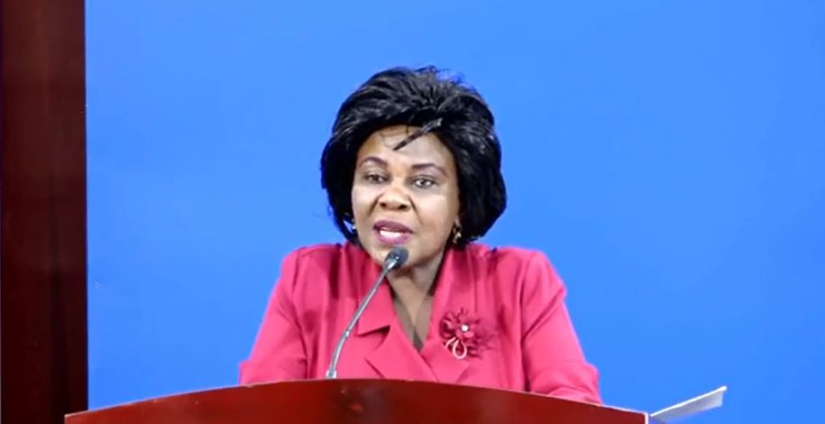
The Sanitation and Water Resources Minister, Cecilia Abena Dapaah, has stated that the activities of illegal miners in river bodies continue to be a major challenge to the distribution of safe water in the country.
She said the phenomenon, in addition to other human activities, has led to a deficit in water production and poor water quality, which is affecting government’s efforts to embark on certain projects to improve water supply.
Speaking at a Ministry of Information press briefing on Monday, Mrs. Cecilia Dapaah observed that illegal miners dump solid and liquid wastes into rivers, thereby blocking machines that pump water.
“I must say the biggest and the most serious challenge is this phenomenon of galamsey or illegal mining in our river bodies. This has created huge problems for our water systems and our concern, I must stress, is that, if we are borrowing close to $1 billion to do projects and the raw water sources are contaminated, polluted and the machines will be drawing in mud, where are we going and what do we want to do with our water bodies?
“We have our own people mining in the river bodies and in the buffer areas and this must stop. I am told and briefed that Regional Security Council (REGSEC), they are on top of this issue; very soon we would take some of you [journalists] with us to go and find out the progress of work but this needs to stop,” she said.
Other challenges facing the Ministry
She admitted that there are still barriers to access to safe water; however, the government is working to identify and solve all such challenges in the water distribution system.
According to her, the phenomenon of non-revenue water was as high as 54% in 2017 but has been reduced to 45% through interventions made by the Ghana Water Company Limited (GWCL).
“We also have the challenge of intermittent water supply and this is because any time the power is off, our machines go off and it takes us time to also get to work when the power is restored. We have obsolete electro-mechanical equipment that we are trying to replace and work on them.
“Old distribution and transmission pipelines; for those of us who are younger than 60 years, some of these pipelines were laid 65 years ago and we need to replace them. We have old metres that give us wrong readings; now we have installed bulk metres to give us the quantum of water we produce so that we can account for.
“We also have the challenge of illegal connections and this is a very serious issue. Just yesterday, a resident of East Legon was caught red-handed; he had connected two big pipes into our main lines and had denied the whole area of water. When he was apprehended and the pipes were disconnected, immediately, water started flowing in people’s homes,” she stated.
Latest Stories
-
Imagination Africa, Mentors Chess Academy to host second African Genius Chess Championship at Ghud Park
1 hour -
Nana B passport claims a diversionary tactic — Abu Jinapor
2 hours -
Pope Leo diagnosed with cancer as doctors remove lobe of lung, Vatican says
2 hours -
Legal Aid Commission takes free legal services to Techiman main lorry terminal
2 hours -
Nana B denies seeking passport favour, accuses Ablakwa of failing to account for GH¢16.4m
2 hours -
Young girls demand climate action, stronger protection against child marriage
2 hours -
Ex-gang boss sentenced to 40 years for orchestrating Tupac Shakur’s murder
3 hours -
From near-deferral to three awards: UMaT graduate’s academic journey
3 hours -
Atta Akyea denies seeking presidential pardon for Wontumi in galamsey case
3 hours -
Photos: Mahama commissions 85-bed Police Hospital ward, donates two ambulances
3 hours -
GTEC directs Ghana’s public universities to reopen by October 16 and begin lectures on October 19
3 hours -
Star Oil donates GH¢1million towards construction of new CID facility
3 hours -
Court hands Adjetey Sowah, two others lifetime bans after Amputee Football legal dispute
4 hours -
NDC appoints Julius Kwame Anthony as a Deputy Communications Director
4 hours -
Ghana repatriates 120 Nigerians rescued from suspected cybercrime centres
4 hours