

Audio By Carbonatix
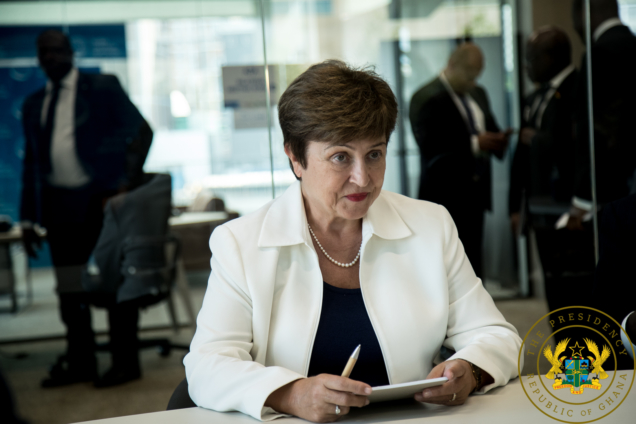
International Monetary Fund (IMF) chief Kristalina Georgieva said she told China’s new top economic official, Li Qiang, they must accelerate work to reach debt restructuring agreements for countries like Zambia, Ghana and Ethiopia.
Georgieva, who met with Li and other top Chinese officials during a visit to China last month, said on Thursday she found Li very approachable and pragmatic.
She said he assured her that he wants China to play a constructive role in resolving debt relief cases.
“The truth is, and I was ... very straightforward on that, it takes far too long for that (debt) resolution,” she told an event hosted by Meridian House and Politico.
“Yes, China has multiple institutions that deal with that, that makes it complicated domestically, but they have to speed up their participation.”
The United States and other Western countries have faulted China for causing delays in setting up restructuring agreements for heavily indebted countries that have asked for help under the Common Framework set up by the Group of 20 major economies.
Georgieva noted China had been helpful in reaching a debt relief deal for Chad, and also Sri Lanka, a middle-income country that was not eligible for help under the G20 framework, and she encouraged China to show progress on other cases.
About 60% of low-income countries are already in or at risk of debt distress, and about 25% of emerging economies are at high risk and facing “default-like” borrowing spreads, Georgieva said.
Georgieva said that during her visit Chinese officials underscored their commitment to multilateralism, opening up China’s economy for more trade, and debt restructuring.
The IMF this week said rising geopolitical tensions and the resulting fragmentation of the global economy could increase financial stability risks, reducing cross-border investments, asset prices, payment systems and banks’ ability to lend.
The global lender has long warned of increased costs, economic friction and GDP output losses associated with the global economy’s fragmenting into geopolitical blocs, with U.S.-led democracies on one side and China and other autocratic states on another. Those concerns have been heightened since Russia’s invasion of Ukraine.
Georgieva said Chinese officials also worried about fragmentation, but their foremost concern was securing jobs at home, with a target of creating 12 million jobs this year.
Latest Stories
-
(Photos) Mfantsipim School launches historic 150th anniversary
22 minutes -
Knights and Ladies of Marshall group backs Catholic Bishops’ stance on anti-LGBTQ+
1 hour -
Bright Simons writes: All the Filla in the Ibrahim Mahama/E&P – Gold Fields Saga
2 hours -
Monetise Idiocy In Ghana
2 hours -
The Ghanaian prophet and the mysterious death of his scottish wife Charmain Speirs
3 hours -
Nearly 400 sentenced in Nigeria for links to militant Islamists
3 hours -
Ghana’s recovery supported by gold strength despite global oil price pressures – Standard Bank Research
3 hours -
Methodist Church hails Mfantsipim@150; calls for “fresh consecration” to excellence
3 hours -
‘Excellence is our inheritance’ – Nana Sam Brew-Butler hails Mfantsipim’s 150-year reign in leadership
4 hours -
Kwaku Azar writes: A-G vs OSP
4 hours -
Mfantsipim–Adisadel rivalry built excellence, not division – Sam Jonah
4 hours -
Vice President launches Mfantsipim’s 150 years of shaping Ghana’s greatest mind
4 hours -
I assure Otumfuo, Mahama will join him to commission KNUST Teaching Hospital by end of this year – Haruna Iddrisu
5 hours -
Barcelona dominate derby to extend La Liga lead
5 hours -
Gov’t to roll out free special education for persons with disabilities from July 1 – Education Minister
5 hours