

Audio By Carbonatix
Co-Founder and Executive Partner of Arthur Energy Africa, Harriette Amissah-Arthur, has attributed Ghana’s recurring power sector crisis to longstanding inaction and poor accountability rather than solely financial constraints.
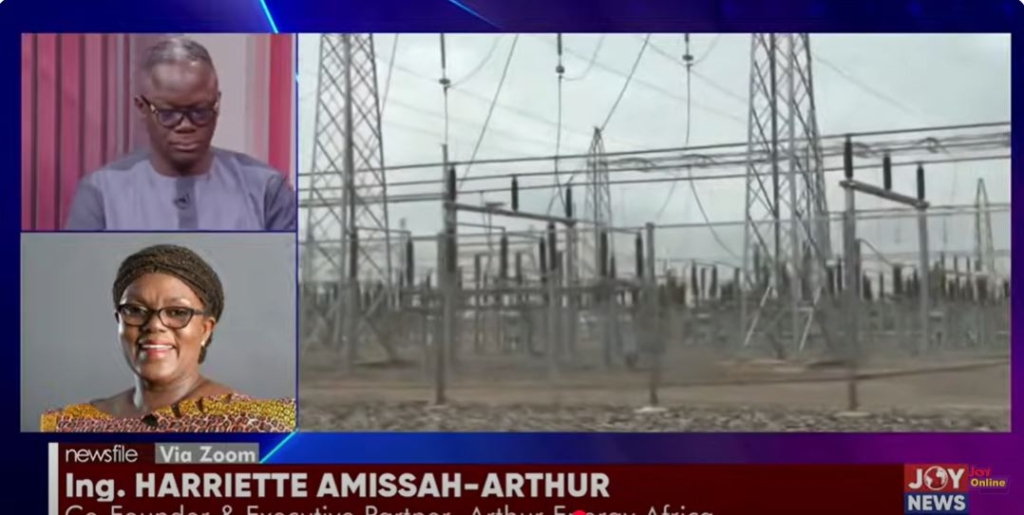
Speaking in an interview on JoyNews' Newsfile on Saturday, May 17, the expert stressed that the root of the energy sector’s problems lies in a failure to take deliberate, structured action over the years.
"I think that if you look at what has been happening over the decades now, the problems we're facing with our power sector are a combination of inaction on our part as Ghanaians," she noted.
Her comment comes after the Energy Minister John Jinapor warned of an imminent nationwide power crisis, revealing that Ghana has less than three days of liquid fuel left to operate its power plants.
Appearing before Parliament’s Energy Committee, he stated that the country urgently requires over GH¢1.1 billion to procure fuel and settle a $1.7 billion debt owed to Independent Power Producers (IPPs). He also noted that Karpower, a key power provider, has threatened to halt operations if payments are not made promptly.
According to Madam Amissah-Arthur, the energy sector has operated with a flawed model that neglects basic business principles, such as cost recovery and accountability.
She criticised the current system, which fails to track energy consumption across sectors or quantify subsidies for critical public services like hospitals and educational institutions.
Madam Amissah-Arthur argued for intentional policy decisions where such facilities are clearly identified and the cost of subsidising them is shared transparently among other consumers.
“Every unit of power must be accounted for,” she insisted. “Operators should be able to tell us how much power goes into street lighting, educational institutions, or hospitals, and how much is lost due to non-payment or technical issues. Right now, everything is lumped together, and we’re just guessing.”
The Co-Founder and Executive Partner of Arthur Energy Africa also highlighted overlooked areas of loss in the sector, such as inefficiencies in procurement and the purchase of power capacity at costs above international benchmarks.
“Globally, we have benchmarks for power procurement. If we're paying above that, we need to justify it with clear reasons,” she added.
Latest Stories
-
Anti-LGBTQ Bill: Forget the rumour mongers, I’m a man of action, and will pass the bill – Speaker
20 minutes -
Women and children among those killed in Sudanese army shelling of wedding celebration
23 minutes -
President Mahama is not sincere with Ghanaians on LGBTQ bill matter – Hassan Tampuli
41 minutes -
Gov’t to establish Prison Industrial Hub to equip inmates with income-generating skills – Prison Service boss
60 minutes -
Alhassan Tampuli donates cement, roofing sheets to support storm victims in Gushegu
1 hour -
Alhassan Tampuli appeals for urgent support for storm victims in Gushegu
1 hour -
The hypocrisy must stop; pass Anti-LGBTQ+ Bill now – Alhassan Tampuli to Mahama
1 hour -
Imprisonment should be rehabilitative, not punitive – Ghana Prisons boss at UNGA
1 hour -
Ga Adangbe traditional priests petition Mahama over McDan aviation licence revocation
2 hours -
Anti-LGBTQ Bill: NDC’s arrogance is worrying – Hassan Tampuli
2 hours -
Let’s give OSP time to mature, not to scrap it – Hassan Tampuli
2 hours -
Nigeria convicts 386 Islamist militants in mass trials
2 hours -
Djibouti president wins election with 97.8% of vote, state media says
2 hours -
We don’t have mandate to deduct tax from rent allowance of security services personnel – Interior Ministry clarifies
2 hours -
Ablakwa receives Presidential Special Envoy on Reparations to advance global agenda
3 hours