

Audio By Carbonatix
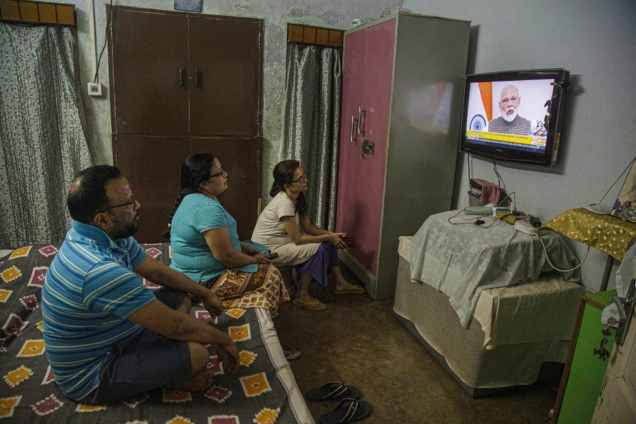
Prime Minister Narendra Modi has imposed a three-week long nationwide lockdown and allocated an extra $1.97 billion for health care to contain the spread of coronavirus infections which are now spiking in the South Asian nation.
“If we listen to the health experts we know that 21 days are crucial to break the cycle of transmission,” Modi said in his televised address to the nation on Tuesday. “For a few days forget what it means to go out. Today’s decision of a nationwide lockdown draws a line outside your home.”
India is struggling to contain the economic and health fallout of the spreading coronavirus outbreak that has so far infected 519 in India and killed 10 people. Ashish Chauhan, CEO at Bombay Stock Exchange, said the bourse will remain remain open through the lockdown.
World’s Biggest Lockdown Prompts Tycoons to Seek India Rate Cuts
India’s rupee weakened offshore during Modi’s address, which was after local markets had shut. The one-month non-deliverable forward was trading at 77.63 a dollar, versus 77.32 before the speech. The SGX Nifty Futures for March delivery slumped more than 3%.
In the last week, the government implemented a near complete lockdown of its major cities and suspended train, flight and long distance bus services.
“It’s a war of survival between us and the virus,” said Suresh Kumar Rathi, associate professor at the Public Health Foundation of India and an epidemiologist. “Three weeks of complete lockdown is critical for India because it has a high density of population and limited resources.”
Shielding Economy
The biggest challenge for Modi will be to curb the spread of the virus in a country of 1.3 billion and shield an economy that’s set to expand at the slowest pace in more than a decade. But experts say the country could be on the same trajectory as Italy, where the outbreak quickly escalated, causing hospitals to overflow.
In his speech which lasted half-an-hour, Modi said the amount set aside to fight coronavirus will be used for adding testing facilities, purchasing personal protective equipment for health workers and expanding isolation beds, ventilators and other important equipment.
India Lockdown May Be ‘Too Slow’ to Stop Millions of Infections
State governments will ensure essential services and supplies including hospitals, medical shops and establishments engaged in manufacturing of medicines, vaccines, sanitizers, masks and medical devices will remain open, according to the statement.
The allocation for health comes at a time when the government’s income is already under pressure with falling tax collections. Global economic uncertainty is expected to derail plans to sell state-owned companies and supply chain disruptions may affect trade.
Oxford Economics has slashed India’s growth forecast for the first quarter of 2020 to 3%, a number not seen even during the worst of the global financial crisis. Meanwhile, the central bank last week announced measures to boost liquidity while holding back from following global peers with a rate cut.
Latest Stories
-
Mr President, Ghana was mentioned at the UN; why aren’t we talking about it?
4 hours -
Accra to convene Africa’s regulators and markets on tokenisation at AVAS 2026
4 hours -
The Paradox of Plenty — When every smartphone becomes a newsroom
4 hours -
GTA sensitises taxi drivers in ‘Know Ghana’ tourism campaign
5 hours -
Archbishop Agyinasare calls for responsible speech amid growing social media abuse
6 hours -
‘It will be inexcusable for gov’t not to honour payment of teachers’ arrears by 30th October’ – Haruna Iddrisu
6 hours -
Forbes’ World’s Best Employers 2026: No Ghanaian firm ranked among 900 companies
6 hours -
Electronic processing of teachers’ data: ‘The decision is the Controller’s’ – GES boss
6 hours -
Teachers’ Strike: Haruna Iddrisu questions paper-based processing of promoted teachers’ data
6 hours -
Savannah Region: Kunfusi bridge collapses again, leaving nearly 4,000 residents cut off
6 hours -
Teachers’ strike: GES targets Monday deadline to submit promotion data to Controller
6 hours -
Inflation to average 11.3% in 2027 – Fitch Solutions
7 hours -
‘I didn’t campaign for NDC to come and do this nonsense’ – Kpebu on EOCO’s conduct
7 hours -
Fitch Solutions maintains policy rate forecast of 14% by December 2026
7 hours -
Diaspora Nasara Caucus congratulates Mohammed Ali Suraj, new NPP executives
8 hours