

Audio By Carbonatix
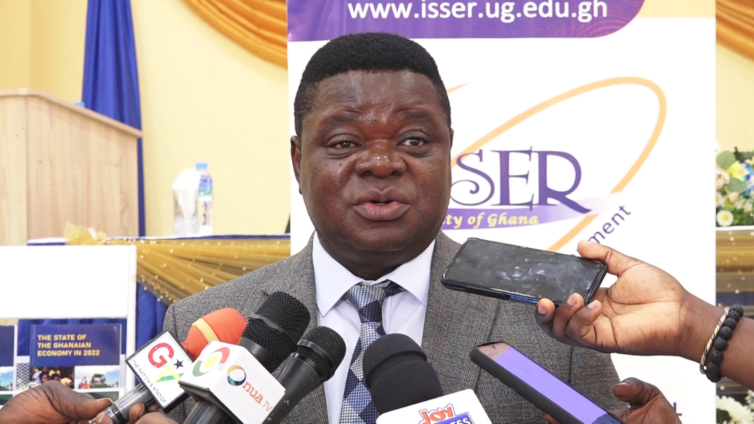
The Institute of Statistical, Social and Economic Research (ISSER) at the University of Ghana has underscored the pivotal nature of the 2024 budget, presenting it as a test case for the nation's financial stability.
The review emphasises that prudent financial management will build upon the relative stability recorded in 2023.
Conversely, ISSER warns that excessive spending in the upcoming year could usher in dire consequences for the economy, impacting variables such as the exchange rate, inflation, and more.
With the majority of the 2024 budget allocated to public sector wages, debt payments, and statutory funds, ISSER's analysis raises concerns about the limited fiscal space available for crucial infrastructure development and service provision.
The allocation of over 90% of domestic revenue to these areas leaves less than 10% to cover essential components like capital expenditures and other government services.
Professor Quartey, the director at ISSER, has called for a careful examination of government spending, emphasizing the importance of value for money in major public procurement contracts.
He further advised the government to actively negotiate with external creditors to restructure debt payments, freeing up fiscal space for vital development projects and service enhancement.
As the 2024 budget projects a fiscal deficit of 4.8% of GDP, Professor Quartey remains optimistic, provided the government adheres to the targets set under the International Monetary Fund (IMF) program.
However, ISSER's warning about the consequences of excessive spending serves as a stark reminder that the decisions made in this crucial year will have lasting implications for the nation's economic stability.
The ISSER review positions 2024 as a decisive period, urging for prudent financial management to capitalize on the groundwork laid in 2023.
Conversely, it serves as a cautionary note, signalling that unbridled spending could lead to detrimental consequences, making it imperative for the government to strike a delicate balance between immediate financial obligations and the long-term economic health of the nation.
Latest Stories
-
Young woman found dead at Kasoa Peace Town
3 minutes -
Livestream: The Law examines lawful arrest in Ghana
27 minutes -
Mahama urges African governments to treat healthcare as an investment, not budget cost
1 hour -
Bawumia congratulates John Boadu and new NPP executives, pledges support ahead of 2028
1 hour -
‘No talent should be left out’ – Bawumia pledges inclusive NPP campaign for 2028
1 hour -
Prof. Mike Oquaye recounts how he blocked Special Prosecutor’s attempt to arrest Bawku Central MP
1 hour -
Make health sovereignty a priority for Africa – Mahama
2 hours -
Dorimon Naa, Wa West DCE lead massive clean-up exercise; threaten sanctions against recalcitrant residents
2 hours -
Photos from Adom FM Y2K Jam
2 hours -
Praye Tiatia steals the show at Adom FM Y2K Jam [Watch]
2 hours -
Boakye Agyarko congratulates John Boadu, pledges support for NPP leadership
2 hours -
Antwi HiMight thrills fans with Antwi ne Antwi hits at Adom FM’s Y2K Jam [Video]
3 hours -
Amb. Edward Boateng congratulates Boadu, Kodua on election wins
3 hours -
John Boadu pledges to rebuild NPP from grassroots and restore ‘winning machinery’
3 hours -
Ashaiman Assembly deploys monitoring system to curb dumping in storm drain
3 hours