

Audio By Carbonatix
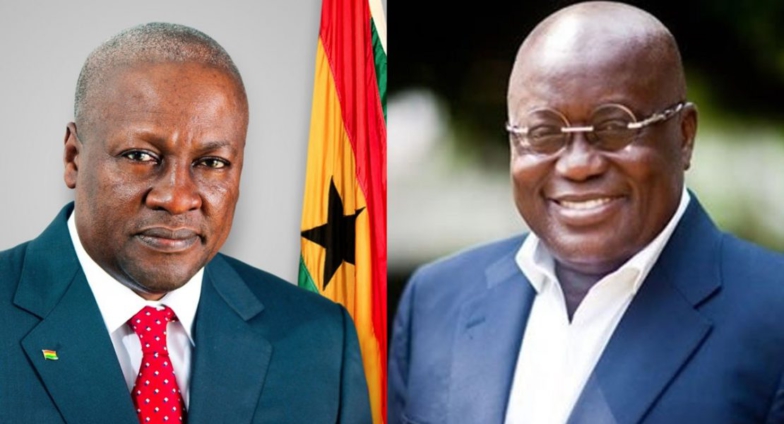
On December 7, 2020, Ghanaians will go to the polls to elect a new president and a new parliament. The two leading presidential candidates are Nana Akuffo Addo, the current president who defeated the former president, John Dramani Mahama in the 2016 elections by a landslide.
This election will be the third time these two leading candidates have competed against each other. In this campaign, unlike the two previous ones, both candidates have records from their time in office for the electorate to assess and to determine which one of them can be trusted to competently manage the country.
So, while competency is a major issue in this campaign, more than that is on the line: this election will be a referendum on both President Akuffo Addo’s and former President Mahama’s performance in terms of proving themselves worthy of the public trust. This editorial explores the candidates’ ability to win voters’ trust on the central issue of competency to secure victory on December 7, 2020.
In the 2016 rematch, former President John Mahama was projected as a youthful and charismatic communicator whose charm, it was argued, would appeal to voters, and help him to mobilise people behind his vision for the country. Indeed, “John,” as he is affectionately called by his friends, is known to be pleasant, extroverted, generous, and outgoing.
In fact, he is still the darling of a significant segment of social elites in the country. That winning combination of charm and persuasiveness has been “John’s” asset throughout his political career. His ability to relate to ordinary people is another strength that propelled him to the presidency.
Charm and charisma may be the greatest weapons in former President Mahama’s political arsenal, but in this election, it is President Akuffo Addo’s emphasis on competency and trust that has defined and shaped the political discourse. Why should trust and competency become the central issues in this campaign?
The answer is simple. President Mahama was the immediate past president of the country with a record in government spanning over a decade. Therefore, how former President Mahama’s record stacks up against the current President’s will determine which candidate can be trusted to competently manage the country.
The trouble for former President Mahama is that, in this election cycle, Ghanaians do not want to elect a president based on charm alone. Instead, they want to choose a leader who shares their values, has the competency to solve problems and to deliver on campaign promises. They are looking for a competent leader who can adopt a holistic approach to governance: a visionary and a proven leader, a trustworthy president who understands the big picture and has the competency to achieve the desired outcomes.
Thus far, President Akuffo Addo has fulfilled his key campaign promises in 2016 and earned the trust of the people. His accomplishments dwarf that of former President Mahama’s. For example, President Akuffo Addo has kept his promises of free SHS and “one ambulance,one constituency,” and he is building infrastructure such as railways, roads, hospitals, and factories.
Above all, he has ended “dumsor,” which has, in turn, curtailed the economic and social decay that arose from the erratic power supply. In effect, he has proven that he is a leader who can manage complex tasks that require multiple forms of intelligence and innovative strategies to accomplish the desired outcomes.
Supported by his Vice-President, Dr Bawumia, a bona fide intellectual, hardworking, and detail-oriented leader, the President has successfully revamped the economy and insulated the country from the worst effects of the Covid-19 pandemic. A typical left-brained thinker —data-driven, logical, and organized -- Vice President Bawumia is modernizing the economy through digitisation and institutional reforms that are paying dividends and protecting the national purse.
For example, through the Vice President’s leadership and focus on value for money, the Mobile Money Payment Interoperability Service, which allows direct and seamless transfer of funds from one mobile money wallet to another across different networks, the government saved taxpayers millions of dollars compared to the over-inflated cost estimates of the Mahama led government.
Notwithstanding the significant achievements of President Akuffo Addo, he must still work to retain the trust of the people because the electorate has become more discerning, sophisticated and are diligently deconstructing the rhetoric and the campaign slogans to make an informed decision about whom they can trust to bestmanage the country.
Similarly, despite the power of former President Mahama’s personal appeal, charm, and financial resources, he must overcome his record of incompetency and corruption in order to regain the people’s trust. In other words, the challenge for former President Mahama is that he has a trust deficit due to his abysmal record in government.
The electorate understandably has difficulty trusting the former president because his campaign messages are incongruent with his record. For example, while he is desperately trying to use the resignation of the Special Prosecutor to tag President Akuffo Addo as corrupt, the Special Prosecutor has identified him as the “government official #1” who took bribes in the airbus scandal. This kind of hypocrisy is what makes it difficult for people to trust him.
To reboot his campaign, he must find a message that resonates with the people and hope that President Akuffo Addo stumbles in the final week of the campaign. In an effort to shift the scrutiny from his conduct to his rival’s, he has launched a relentless attack on President Akuffo Addo as “corrupt.”
The trouble for him, however, is that the GYEEDA, SADA, AMERI, WOYOME and AIRBUS scandals are an albatross hanging around his neck, only highlighting his hypocrisy and projection when he tries to label the current President as corrupt. In conclusion, insofar as “past is prelude” and “history repeats itself,” former President Mahama cannot be trusted to run a government that is any different from his previous administration, which the country cannot afford.
****
The writer of is a lawyer based in Canada.
Latest Stories
-
Mr President, Ghana was mentioned at the UN; why aren’t we talking about it?
3 hours -
Accra to convene Africa’s regulators and markets on tokenisation at AVAS 2026
3 hours -
The Paradox of Plenty — When every smartphone becomes a newsroom
4 hours -
GTA sensitises taxi drivers in ‘Know Ghana’ tourism campaign
5 hours -
Archbishop Agyinasare calls for responsible speech amid growing social media abuse
5 hours -
‘It will be inexcusable for gov’t not to honour payment of teachers’ arrears by 30th October’ – Haruna Iddrisu
5 hours -
Forbes’ World’s Best Employers 2026: No Ghanaian firm ranked among 900 companies
5 hours -
Electronic processing of teachers’ data: ‘The decision is the Controller’s’ – GES boss
6 hours -
Teachers’ Strike: Haruna Iddrisu questions paper-based processing of promoted teachers’ data
6 hours -
Savannah Region: Kunfusi bridge collapses again, leaving nearly 4,000 residents cut off
6 hours -
Teachers’ strike: GES targets Monday deadline to submit promotion data to Controller
6 hours -
Inflation to average 11.3% in 2027 – Fitch Solutions
6 hours -
‘I didn’t campaign for NDC to come and do this nonsense’ – Kpebu on EOCO’s conduct
6 hours -
Fitch Solutions maintains policy rate forecast of 14% by December 2026
7 hours -
Diaspora Nasara Caucus congratulates Mohammed Ali Suraj, new NPP executives
8 hours