

Audio By Carbonatix
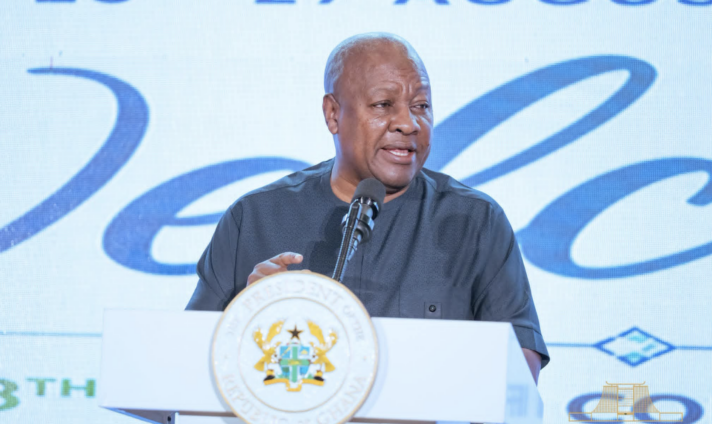
President John Dramani Mahama on Monday opened the 28th Annual Conference of the Association of Medical Councils of Africa (AMCOA) in Accra with a call on African nations to take charge of and protect their own healthcare systems.
The five-day Conference, themed “Responsive Regulation for Safer Communities Towards Universal Health Coverage,” seeks to address the critical role of effective and adaptive healthcare regulation in achieving Universal Health Coverage (UHC) across Africa.
The President said investments in Artificial Intelligence and modern technology must guide new standards for online medical consultations, adding that strong medical regulations were necessary to keep patients safe and maintain high professional standards
The President, who offered seven points of reflection for the Conference, said they must first strengthen regulatory harmonisation through deeper cooperation, reliable verification, and appropriate recognition of qualifications without lowering standards.
Secondly, they must invest in regulatory science to ensure decisions are informed by evidence and that regulators have the skills to respond to new technologies, changing workforce patterns, and emerging risks.
Thirdly, they must build secure data-exchange systems that support timely information sharing while respecting privacy and ensuring proper data governance.
The President said fourthly, the must protect the integrity of health professional education.
He said the quality of tomorrow’s healthcare depends on the quality of the training we provide today; declaring that accreditation, assessments, internship, continuing professional development and ethical formation must therefore remain central to the training of health professionals.
President Mahama said, fifthly, they must develop practical frameworks for humanitarian and fragile settings, enabling rapid emergency response while preserving standards and accountability during times of crisis.
With regard to the sixth point, he noted that they must regulate digital health and Artificial Intelligence with urgency, wisdom, and a clear commitment to equity.
Concerning the seventh point, the President asked them to place the patient and the public at the centre of every regulatory decision we take.
He said the true measure of a regulator was not how many licences it issued, but how effectively it protects people and patients.
“Universal health coverage cannot exist without universal health confidence. Citizens must know that whether they enter a clinic, hospital, theatre or digital platform, the professionals attending them are competent, ethical, and accountable,” he said.
He said the Conference must therefore move beyond discussion and produce practical outcomes, stronger collaborations, implementable policy recommendations, capacity-building plans, improved information sharing and a renewed continental commitment to high standards.
“Let this conference mark a new phase in African health professional regulation. Let it be remembered as the gathering at which regulators embraced not only their national mandates but also a shared continental responsibility,” he said.
“Let us affirm that patient safety has no borders and that every African deserves safe, ethical and quality healthcare wherever that care is received.”
Mr Kwabena Mintah Akandoh, the Minister of Health, said the Government of President John Dramani Mahama was expanding Ghana’s continuum of care, from Free Primary Healthcare, which focuses on the prevention of diseases and the provision of essential services, to the Ghana Medical Trust Fund, which supports specialised and high-cost care for chronic conditions.
Dr Anarfi-Asamoah Baah, a former Deputy Director-General of the World Health Organisation (WHO), who delivered the keynote address, reiterated that the time had come for African countries to increase domestic health spending to safeguard their people's health.
Prof Joel Okullo, the President of AMCOA and the Chairman of the Uganda Medical and Dental Practitioners Council, said health regulation must be recognised as a central pillar for universal health coverage.
Latest Stories
-
Mr President, Ghana was mentioned at the UN; why aren’t we talking about it?
2 hours -
Accra to convene Africa’s regulators and markets on tokenisation at AVAS 2026
2 hours -
The Paradox of Plenty — When every smartphone becomes a newsroom
2 hours -
GTA sensitises taxi drivers in ‘Know Ghana’ tourism campaign
4 hours -
Archbishop Agyinasare calls for responsible speech amid growing social media abuse
4 hours -
‘It will be inexcusable for gov’t not to honour payment of teachers’ arrears by 30th October’ – Haruna Iddrisu
4 hours -
Forbes’ World’s Best Employers 2026: No Ghanaian firm ranked among 900 companies
4 hours -
Electronic processing of teachers’ data: ‘The decision is the Controller’s’ – GES boss
4 hours -
Teachers’ Strike: Haruna Iddrisu questions paper-based processing of promoted teachers’ data
4 hours -
Savannah Region: Kunfusi bridge collapses again, leaving nearly 4,000 residents cut off
4 hours -
Teachers’ strike: GES targets Monday deadline to submit promotion data to Controller
4 hours -
Inflation to average 11.3% in 2027 – Fitch Solutions
5 hours -
‘I didn’t campaign for NDC to come and do this nonsense’ – Kpebu on EOCO’s conduct
5 hours -
Fitch Solutions maintains policy rate forecast of 14% by December 2026
5 hours -
Diaspora Nasara Caucus congratulates Mohammed Ali Suraj, new NPP executives
7 hours