

Audio By Carbonatix
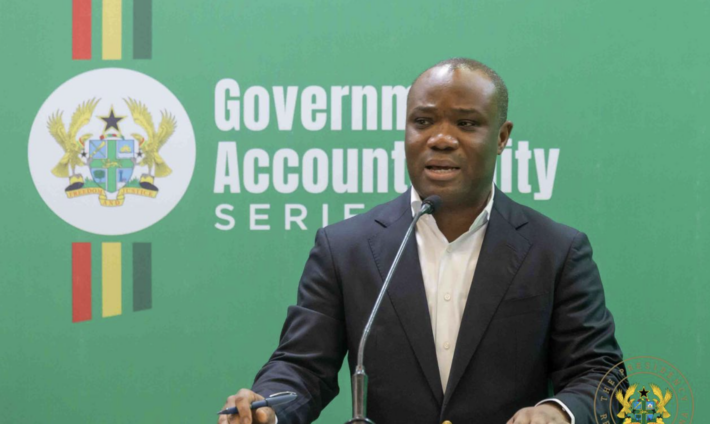
Felix Kwakye Ofosu, the Presidential Spokesman and Minister of State in-charge of Government Communications, has reiterated that media freedom is a security strategy, not a security threat.
He therefore called for strong media-national security cooperation to protect citizenry.
Mr Ofosu said this in a statement read on his behalf by Hajia Shamima Muslim, the Deputy Presidential Spokesperson at a Capacity-Building Workshop on Responsible Security Reporting for Members of the Private Newspapers and Online News Publishers Association of Ghana (PRINPAG) in Accra.
The workshop was on the “Media as a Strategic Partner in Preventive Security and Early Warning in Ghana”.
“Some security actors see a free press as a nuisance. They are wrong. Ghana’s stability in a region of coups is not because we are censored, but because we are allowed,” he said.
“A free press is a pressure valve. When citizens can complain in Daily Guide and Ghanaian Chronicle, they don’t need to riot.
A government committed to democracy must not fear scrutiny.”
Mr Ofosu reiterated that his duty as Minister for Government Communications was not to fear the media headlines, but to ensure they had accurate information to write them.
This, he said means that responsible security reporting was not the media’s burden alone.
He said the Government and the security institutions must communicate in a timely, credible, and coordinated manner and when accurate official information was unnecessarily delayed, speculation filled the vacuum, stating that where operational details could not immediately be disclosed, authorities should explain those limitations honestly and provide verified updates as circumstances permit.
The Minister underscored that contradictory official statements weakened confidence now of trust was most needed.
“Trust cannot be demanded during a crisis if it has not been cultivated before the crisis; it must be built through consistent truthfulness, institutional competence and respect for the public’s right to know.”
The Minister said in security reporting, speed kills, declaring that ethics must be the anchor.
He noted that in crime reporting, the old rule was “If it bleeds, it leads”, however, in security reporting, “that rule can bleed the nation”.
“I appeal to you: Let TikTok be first. Let PRINPAG be right. Before you publish that security alert, ask four questions,” Mr Ofosu said.
He said firstly, “Have I verified with at least two independent sources, one official?”
Secondly, “Does this endanger troops, victims, or ongoing operations?”
Thirdly, “Does it give tactical information to extremists? And fourthly, “Does it inflame ethnic or religious tension beyond facts?”
Mr Ofosu said when anyone could publish a scare, their power must be the ability to be trusted to de-escalate.
He said information integrity was now a national imperative and that there could be no meaningful national reset without peace, stability, and information integrity.
“A country cannot rebuild confidence while falsehood is allowed to inflame communities, weaken institutions and turn legitimate disagreement into hostility.”
Mr Ofosu said President John Dramani Mahama had repeatedly stressed that development could not take place without peace.
The Minister said protecting that peace requires more than responding after violence occurs and that it requires early warning, community engagement, credible public communication and a media that could identify danger without magnifying panic.
He said responsible journalism was therefore not peripheral to the Resetting Ghana Agenda, adding that it was one of its democratic foundations.
The Minister said exposing wrongdoing, amplifying neglected grievances, resisting disinformation and holding institutions accountable; the media helps rebuild the relationship between citizens and the state.
“The Resetting Ghana Agenda does not ask the media to protect the Government from criticism. It asks all of us Government, media, security institutions and citizens to protect Ghana from falsehood, division, insecurity and institutional decay,” he said.
“The government must be accountable. The media must be responsible. Security institutions must be professional. Citizens must be vigilant. But Print has a new role: to be the authenticator.”
Mr David Tamakloe, PRINPAG President advocated collaboration between the media and national security institutions to promote accurate and responsible journalism in the country.
Latest Stories
-
Court hands Adjetey Sowah, two others lifetime bans after Amputee Football legal dispute
4 minutes -
NDC appoints Julius Kwame Anthony as a Deputy Communications Director
5 minutes -
Ghana repatriates 120 Nigerians rescued from suspected cybercrime centres
9 minutes -
NPP rejects Emelia Agbenyo’s appointment as Deputy EC Chair, demands withdrawal
14 minutes -
EOCO grants Suame MP John Darko enquiry bail in GH¢27m SIC investigation
17 minutes -
NPP cannot question EC appointment after appointing own people to Commission – Kwakye Ofosu
23 minutes -
BoG deepens public trust with regional stakeholder forum in Techiman
32 minutes -
‘We have turned the tide’ – Ato Forson says Ghana is ready to take off
37 minutes -
Police arrest man captured in viral video assaulting wife in Agona Nkwanta
39 minutes -
KATH Mother and Baby Unit construction stalled for 14 months over unpaid contractor arrears
53 minutes -
Government wanted to ‘tilt the balance’ with new EC appointments – Kwakye Ofosu
59 minutes -
Angry Tema Community 25 residents threaten to sleep at GWL over water shortage
1 hour -
BoG takes financial literacy drive to Techiman, vows to protect depositors
1 hour -
‘Stop the distractions’ – Akosua Manu demands answers over GH¢49.7m South Africa evacuation cost
1 hour -
Formula 1 to return to Africa with Rwanda Grand Prix in early 2030s
1 hour