

Audio By Carbonatix
In Ghana, where fish is a staple in nearly every household, the aquaculture sector plays a critical role in national food security.
Despite producing over 89,000 metric tonnes of fish in 2023, mostly tilapia and catfish, Ghana still imports more than 60% of the fish consumed locally.
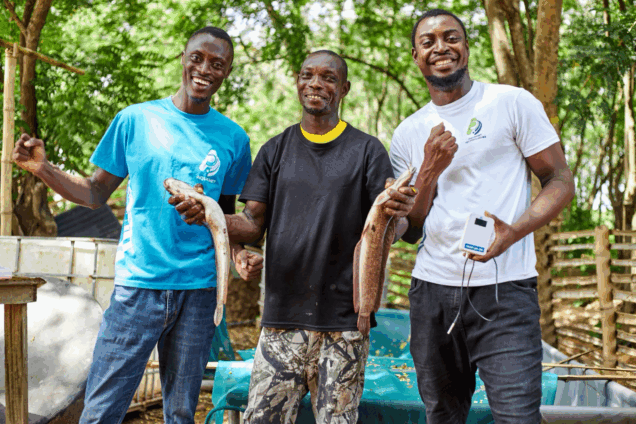
Aquamet Technologies is a Ghanaian aquatech startup supported by Kosmos Innovation Center (KIC) to play a critical role in national food security by supporting smallholder fish farmers grappling with challenges like poor water quality, disease outbreaks, and high feed costs.
On a mission to meet supply chain gaps with cutting-edge but affordable technology designed specifically for the realities of local fish farmers, Aquamet uses a smart water quality probe that monitors essential parameters such as temperature, dissolved oxygen, and pH levels.
Unlike traditional solutions, the device provides real-time alerts via SMS and a mobile app, ensuring farmers, even in remote areas, can respond swiftly to changing water conditions and prevent fish loss.
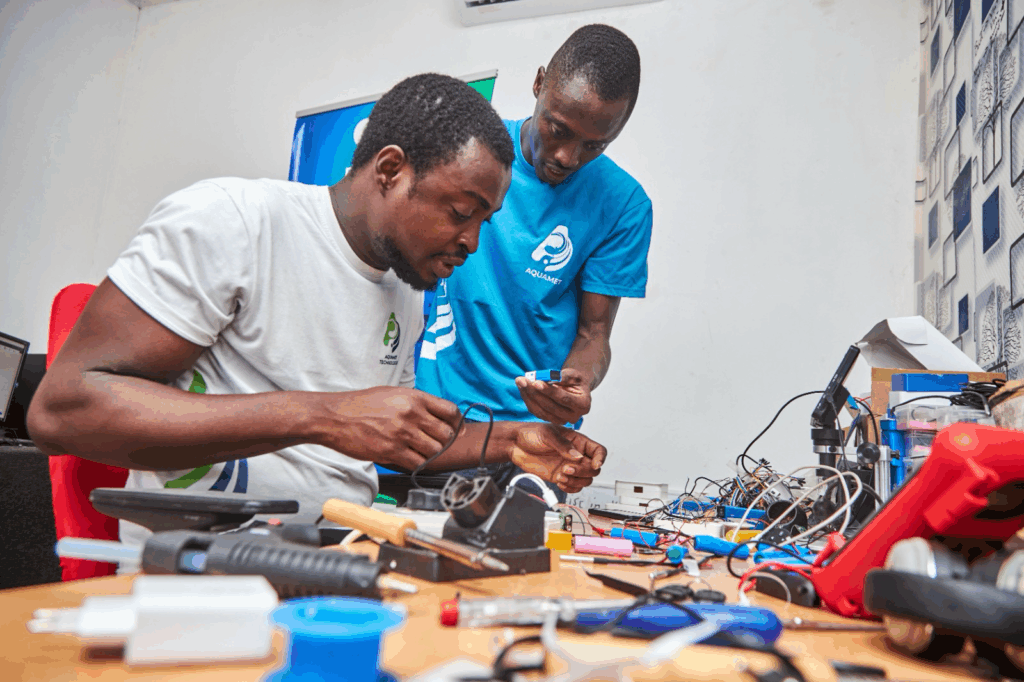
Since launching, Aquamet has positively impacted over 145 farmers across the Volta, Eastern, Ashanti, and Greater Accra regions of Ghana.
As Ghana works towards its national goal of producing 200,000 metric tonnes of farmed fish by 2030, Aquamet is emerging as a key player in accelerating this vision and advancing the country’s blue economy.
In addition to the hardware innovations, Aquamet offers a comprehensive farm management app featuring a feeding estimator, robust inventory tools, digital record keeping, and on-demand expert support.
These tools enable farmers to reduce feed waste and fish mortality by up to 25% while increasing productivity and efficiency across their operations.
“With Aquamet, solutions are locally built, farmer-tested, and focused on empowering the next generation of aquaculture entrepreneurs across Africa.” Frank Owusu, co-founder of Aquamet Technologies, highlights.
Looking ahead, Aquamet Technologies plans to reach over 100,000 fish farmers across the continent within the next decade, contributing significantly to sustainable food systems and rural livelihoods.
Latest Stories
-
Imprisonment should be rehabilitative, not punitive – Ghana Prisons boss at UNGA
19 minutes -
Ga Adangbe traditional priests petition Mahama over McDan aviation licence revocation
30 minutes -
Anti-LGBTQ Bill: NDC’s arrogance is worrying – Hassan Tampuli
41 minutes -
Let’s give OSP time to mature, not to scrap it – Hassan Tampuli
45 minutes -
Nigeria convicts 386 Islamist militants in mass trials
50 minutes -
Djibouti president wins election with 97.8% of vote, state media says
54 minutes -
We don’t have mandate to deduct tax from rent allowance of security services personnel – Interior Ministry clarifies
1 hour -
Ablakwa receives Presidential Special Envoy on Reparations to advance global agenda
1 hour -
Christina Koch becomes first woman to travel around the moon on Artemis II
2 hours -
Epstein survivors’ calls to meet King Charles and Queen harder to ignore as US visit approaches
2 hours -
UN Secretary-General names Ghana’s Anita Kiki Gbeho as South Sudan envoy
2 hours -
Mali withdraws recognition of Sahrawi Republic, backs Morocco’s autonomy plan
2 hours -
Gov’t distributes over 8,500 laptops to One Million Coders project
2 hours -
Julius Debrah, ‘man to beat’ as NDC’s James Agbey dismisses Musah Dankwah’s polls
2 hours -
GPRTU in Savannah Region to protest alleged eviction in Damongo
2 hours