

Audio By Carbonatix
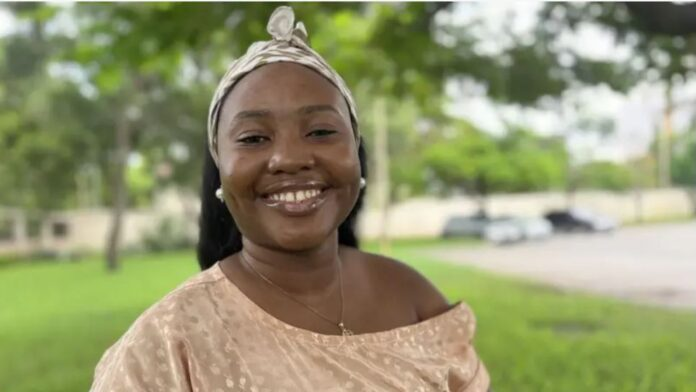
At just 24 years old, Ewurabena Quartey has chosen a profession that many people her age and gender would hesitate to pursue.
She works as a mortician and hearse driver, a career she says is not as frightening as most people imagine.
Speaking in an interview with BBC News Pidgin, Ewurabena revealed that she studied Hospitality Management at the tertiary level before deciding to follow in her parents’ footsteps and join the funeral industry.
Believed to be the youngest hearse driver in Ghana’s Central Region, she has spent the past seven years working with the dead, driven by a simple mission: helping families give their loved ones a dignified farewell.
“People die at any time. When they do, families are often too afraid to keep the body at home until morning. So around midnight or 2am, someone can knock on your door to say they have brought a body,” she explained.
She, however, admitted that some aspects of the job can be unsettling.
“Sometimes people arrive with their eyes open because their families were too afraid to close them. Others come with their mouths still open. That is the scary part. Apart from that, you do not really see anything disturbing,” she said.
For Ewurabena, the mortuary is more than a workplace; it is also her home. She disclosed that her bedroom is just about seven steps away from where bodies are kept, yet she lives comfortably without fear.
Despite her dedication to the profession, she says one of her biggest challenges is societal stigma. Some people question why her friends associate with her, while others are surprised to discover that she is well-educated, speaks good English, and is fashionable.
“You can be a mortician and smell nice. You can be a mortician and speak good English. People think those of us who work in the mortuary have no right to dress well or present ourselves properly. But we have every right to do everything that everyone else does,” she said.
She added, “Sometimes when someone asks if I am in a relationship and I say yes, the reaction they give me suggests they feel I have no right to have one.”
However, she says she is fortunate to have supportive people around her who appreciate and respect her work.
“Fortunately, I have genuine people around me who stick by me. Some even want to learn about what I do and tell me to rest while they take over. So there is fun in it, and it is a good life,” she added.
Respect for the dead
Ewurabena reveals that one of the practices she considers important in her work is knocking before entering the room where a body is kept as a sign of respect to the dead.
“In Ghana, before you enter someone’s house, you knock, and they respond. So when we knock on their door, it is not because we expect a response. We know they are no longer alive. We knock to maintain the respect they had when they were alive. We should not discard that respect simply because they have passed,” she explained.
She said respect for the dead extends beyond knocking.
“If you accidentally step on them, you say sorry. If you are bathing them or turning them and you make a mistake, you say, "Sorry," because you must treat them with respect.
“I believe they protect me and mean me well because I do not disrupt them and they do not disrupt me,” she said.
She revealed that though she believes in the existence of ghosts, she has never encountered one, even in the line of duty.
“Sometimes you go to pick up a body and transport it somewhere, and you find no place to sleep, so you end up sleeping in the car. You will not see any ghosts. I am not saying ghosts do not exist. I believe they do, but I have never seen one.
“I sleep well, I wake well, and nothing happens to me. When I undertake, I do not see them in my dreams. I make sure they look elegant and presentable, and I cannot even remember the faces I have seen,” she said.
Like many other professions, Ewurabena indicated that there are good days when she handles more than five bodies in a week, and there are times when she goes a whole month without receiving a single body.
“It fluctuates. It is not stable,” she said.
Watch Ewurabena’s interview below:
@bbcnewspidgin ‘Why we dey knock bifor we enta dead bodis room’ Ewurabena Quartey (@Winifred 😍) na Ghanaian mortician and hearse driver wey her profession dey inspire pipo especially young women. Di 24-year-old lady tell BBC News Pidgin why dem dey knock bifor dem enta dead bodis room and oda tins wey involve her profession. Producer: @Tunde Ososanya Edit: @TemFilms #bbcnewspidgin #accra #ghana #ghanatiktok🇬🇭 #inspire ♬ original sound - BBC News Pidgin
Latest Stories
-
T-bills auction: Demand improves as government exceeds target by about 76%; interest rates soften
4 minutes -
Ziope undertakes initiative to build a technologically inclined community, commissions self-help ICT lab
28 minutes -
ECG announces power outage in parts of Tema, Central Region due to network fault, maintenance
55 minutes -
When the Gospel Becomes a Weapon: The church, blackmail and the abuse of faith
1 hour -
JoyNews’ Jacqueline Ansomah Yeboah selected for UK Media Excellence for Emerging Technology Fellowship
2 hours -
Mental Health Alliance urges government to operationalise Mental Health Fund
2 hours -
Ghana–Holy See agreement heads to Parliament after Cabinet approval
2 hours -
Luv FM Corporate Games 2026: Kumasi Central Prisons, Amanfiman Bank win big amid fun
2 hours -
WAFU B U17: Ghana top Group A after win over Togo
3 hours -
Ho Central Mosque reopens amid unresolved leadership dispute that led to closure
4 hours -
Minority caucus questions GH¢16.4m in Ablakwa’s SA evacuation spending, demands independent audit
4 hours -
Gender Ministry meets Nana Akua Addo’s husband over domestic violence after hospital discharge
5 hours -
UG Vice-Chancellor urges swift operationalisation of National Research Fund
5 hours -
Pope Leo to have surgery after lump found in lung
5 hours -
Joseph Cudjoe writes: Ghana must break free from the dangerous mindset that natural resources are the foundation for wealth
6 hours