

Audio By Carbonatix
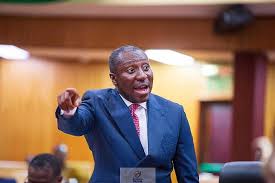
Minority Leader Alexander Afenyo-Markin has accused the government and the Koforidua High Court of colluding to harass the Member of Parliament for Akwatia, Ernest Yaw Kumi, following his conviction for contempt.
Mr. Kumi was found guilty after presenting himself for swearing-in, despite a court injunction barring him from doing so. In response, the Koforidua High Court issued a bench warrant for Kumi's arrest, which led to National Security operatives being deployed to enforce the warrant.
Mr Afenyo-Markin has criticised both the government's actions and the role of the Koforidua High Court, describing it as an unlawful act of harassment.
"The attempt to arrest Ernest Yaw Kumi is a clear example of collusion between the government and the Koforidua High Court," Afenyo-Markin stated. "It is troubling that the Interior Minister, Muntaka Mubarak, would justify the actions of the National Investigations Bureau (NIB) in this case."
On Tuesday, Minister Muntaka Mubarak defended the National Security operatives, insisting that they were simply following the law.
However, Mr Afenyo-Markin has disputed this claim, arguing that the enforcement of court orders must follow proper legal processes.
"When a court issues an order, it is the registrar's responsibility to assign a bailiff to enforce it, not National Security operatives," Afenyo-Markin explained. "In this case, the Supreme Court had already frozen the enforcement of that order."
The Majority Leader expressed concern over the fact that, even after the Supreme Court ruling, state security forces were sent to harass the MP in his constituency.
"For a week after the ruling, it is deeply concerning that National Security operatives continued to pursue the MP," he added.
The Minority Leader also recounted how, had it not been for the intervention of Mr. Kumi’s constituents, the National Security operatives armed with pick-up vehicles, would have forcibly detained the MP.
"They even pulled out weapons and pistols, trying to intimidate him into getting into the vehicle," he added.
Afenyo-Markin emphasised the importance of upholding the rule of law and vowed to challenge the actions taken by the government.
"The NDC government must understand that this country is governed by the rule of law," Afenyo-Markin declared. "We will be filing a formal request for the Attorney General to explain the circumstances that led to the judiciary in the Eastern Region and the Koforidua High Court colluding with the National Security Coordinator."
The Minority Leader concluded by stating his commitment to ensuring justice is served, asserting that his side will use all available legal avenues to challenge the actions taken against Mr Kumi and protect the rule of law.
Latest Stories
-
Hawa Koomson pledges experienced and mature leadership of NPP women’s wing
32 minutes -
Young woman found dead at Kasoa Peace Town
1 hour -
Playback: The Law examined lawful arrest in Ghana
1 hour -
Mahama urges African governments to treat healthcare as an investment, not budget cost
2 hours -
Bawumia congratulates John Boadu and new NPP executives, pledges support ahead of 2028
2 hours -
‘No talent should be left out’ – Bawumia pledges inclusive NPP campaign for 2028
2 hours -
Prof. Mike Oquaye recounts how he blocked the Special Prosecutor’s attempt to arrest Bawku Central MP
2 hours -
Make health sovereignty a priority for Africa – Mahama
3 hours -
Dorimon Naa, Wa West DCE lead massive clean-up exercise; threaten sanctions against recalcitrant residents
3 hours -
Photos from Adom FM Y2K Jam
3 hours -
Praye Tiatia steals the show at Adom FM Y2K Jam [Watch]
3 hours -
Boakye Agyarko congratulates John Boadu, pledges support for NPP leadership
3 hours -
Antwi HiMight thrills fans with Antwi ne Antwi hits at Adom FM’s Y2K Jam [Video]
4 hours -
Amb. Edward Boateng congratulates Boadu, Kodua on election wins
4 hours -
John Boadu pledges to rebuild NPP from grassroots and restore ‘winning machinery’
4 hours