

Audio By Carbonatix
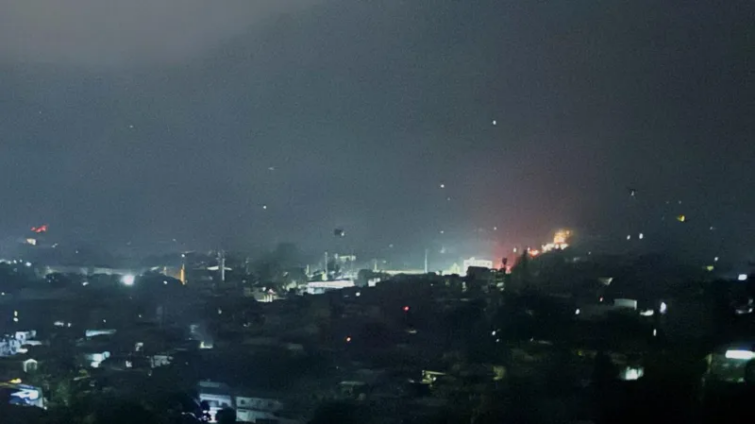
Two weeks after a deadly militant attack on tourists in Indian-administered Kashmir, India has launched a series of strikes on sites in Pakistan and Pakistan-administered Kashmir.
The Indian defence ministry said the strikes - named "Operation Sindoor" - were part of a "commitment" to hold those responsible for the 22 April attack which left 25 Indians and one Nepali national dead "accountable".
But Pakistan, which has denied any involvement in last month's attack, has described the strikes as "unprovoked", with Prime Minister Shehbaz Sharif saying the "heinous act of aggression will not go unpunished".
Pakistan's military says it has shot down five Indian aircraft and a drone. India has yet to respond to these claims.
Pakistan's military spokesperson Lt Gen Ahmed Sharif Chaudhry said at least 26 people were killed and 46 injured. India's army said at least 10 civilians were killed by Pakistani shelling on its side of the de facto border.
Where did India hit?
Delhi said in the early hours of Wednesday morning that nine different locations had been targeted in both Pakistan-administered Kashmir and Pakistan.
It said these sites were "terrorist infrastructure" - places where attacks were "planned and directed".
It emphasised that it had not hit any Pakistani military facilities, saying its "actions have been focused, measured and non-escalatory in nature".
According to Pakistan, three different areas were hit: Muzaffarabad and Kotli in Pakistan-administered Kashmir, and Bahawalpur in the Pakistani province of Punjab.
Pakistan's Defence Minister Khawaja Asif told GeoTV that the strikes hit civilian areas, adding that India's claim of "targeting terrorist camps" is false.
Why did India launch the attack?
The strikes come after weeks of rising tension between the nuclear-armed neighbours over the shootings in the picturesque resort town of Pahalgam.
The 22 April attack by a group of militants saw 26 people killed, with survivors saying the militants were singling out Hindu men.
It was the worst attack on civilians in the region in two decades, and the first major attack on civilians since India revoked Article 370, which gave Kashmir semi-autonomous status in 2019.
Following the decision, the region saw protests but also witnessed militancy wane and a huge increase in the number of tourists visiting the region.
The killings have sparked widespread anger in India, with Prime Minister Narendra Modi said the country would hunt the suspects "till the ends of the Earth" and that those who planned and carried it out "will be punished beyond their imagination".
However, India has not named any group it suspects carried out the attack in Pahalgam and it remains unclear who did it.
But Indian police have alleged two of the attackers were Pakistani nationals, with Delhi accusing Pakistan of supporting militants - a charge Islamabad denies. It says it has nothing to do with the 22 April attacks.
In the two weeks since, both sides had taken tit-for-tat measures against each other - including expelling diplomats, suspending visas and closing border crossings.
But many expected it would escalate to some sort of cross-border strike - as seen after the Pulwama attacks which left 40 Indian paramilitary personnel dead in 2019.
Why is Kashmir a flashpoint between India and Pakistan?
Kashmir is claimed in full by India and Pakistan, but administered only in part by each since they were partitioned following independence from Britain in 1947.
The countries have fought two wars over it.
But more recently, it has been attacked by militants which have brought the two countries to the brink. Indian-administered Kashmir has seen an armed insurgency against Indian rule since 1989, with militants targeting security forces and civilians alike.
In 2016, after 19 Indian soldiers were killed in Uri, India launched "surgical strikes" across the Line of Control – the de facto border between India and Pakistan - targeting militant bases.
In 2019, the Pulwama bombing, which left 40 Indian paramilitary personnel dead, prompted airstrikes deep into Balakot - the first such action inside Pakistan since 1971 - sparking retaliatory raids and an aerial dogfight.
Neither spiralled, but the wider world remains alert to the danger of what could happen if it did. Attempts have been made by various nations and diplomats around the world to prevent this.
UN chief Antonio Guterres quickly called for "maximum restraint" - a sentiment echoed by the European Union and numerous countries, including Bangladesh.
British Prime Minister Keir Starmer urged "dialogue" and "de-escalation".
US President Donald Trump - who was one of the first to respond - told reporters at the White House that he hoped the fighting "ends very quickly". US Secretary of State Marco Rubio, meanwhile, said he was keeping a close eye on developments.
Latest Stories
-
Asos confirms hackers sent ‘unauthorised’ notification to app users
7 minutes -
White House defends Trump comment to let Iran ‘take out’ LA and San Diego
15 minutes -
US televangelist Jim Bakker, disgraced from sex scandal and fraud, dies at 86
17 minutes -
Congolese-born golfer to represent Ghana at Turkish Airlines World Cup grand final
22 minutes -
Amazon wins global rights to stream Emmys in six-year deal
23 minutes -
European Film Festival returns to Ghana after a 5-year break
28 minutes -
PTA backs teachers’ strike, threatens street protest if gov’t misses October 30 deadline
31 minutes -
Paramount takes over Warner Bros in $110bn Hollywood merger
32 minutes -
Suspend offshore gold exploration licence – NAFAG urges gov’t
33 minutes -
Investigators meet family, community over deaths of 3 children found in car trunk
41 minutes -
Teacher strike: FWSC blames new allowance demand for deadlock with teacher unions
1 hour -
Aboboyaa Company Ltd CEO donates 5 tricycles to Ghana Prisons Service
1 hour -
National Cathedral: ‘There’s no clarity as to what they want to use the site for’ – Afenyo-Markin on site’s future
1 hour -
Investigators meet family, community over deaths of 3 children found in car trunk
1 hour -
Teachers have legitimate concerns, but prolonged strike will affect pupils – Joseph Kumah
2 hours