

Audio By Carbonatix
School children in Mozambique are facing what a senior United Nations and World Bank official in the southern African country are calling “catastrophic outcomes” from the COVID-19 pandemic.
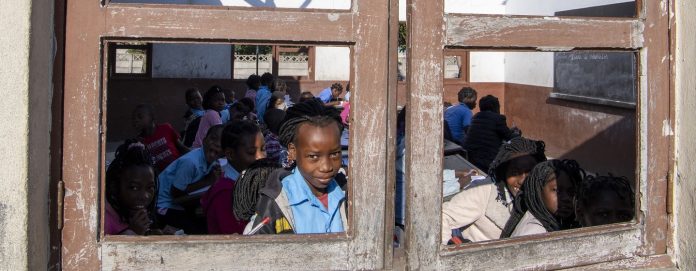
For 13-year-old Rafina from Beira, one of Mozambique’s largest cities, the feeling seems familiar; her school is, once again, closed. Only one year has passed since Cyclone Idai devastated the country affecting 1.85 million people, damaging 90 per cent of Beira’s infrastructure.
This time, however, there are no collapsing buildings, flooded streets and desperate people.
The novel coronavirus (COVID-19) sneaked into Mozambique in silence, yet it might have a far more devastating impact on Rafina’s life, and the life of all Mozambican children, than any previous disaster.
As in 191 countries worldwide, where 1.57 billion learners are affected, nearly 15,000 schools and universities in Mozambique have been closed since March 23, affecting more than 8.5 million students. It is a necessary decision that will most likely save thousands of lives, but it comes at a heavy price.
Based on recent lessons learned with school closures in response to the Ebola virus in the Democratic Republic of the Congo, we know that the longer children stay away from school, the less likely they are ever to return, increasing the risk of their falling into illiteracy.
Catastrophic impact on education
In Mozambique, where already more than one-third of students drop out before Grade 3, and less than half complete primary school, the impact of the pandemic on learning outcomes could be catastrophic.
This is particularly true for girls like Rafina, whose families live in poverty. Throughout the world, the pressure on families during emergencies is often so high that many are pushed to send their children to work, as a strategy for survival, or to marry their daughters off prematurely.
As a result, childhood is cut short, schooling is abandoned, and fundamental rights are compromised. When children are out of school, they become more vulnerable and at increased risk of abuse and exploitation.
Aware of this critical context, the Ministry of Education and Human Development (MINEDH), with support from the humanitarian community, was successful after the cyclones in ensuring that classes continued in “temporary learning spaces”, by erecting school tents.
Remote learning plan
This time the nature of the emergency is unlike anything we have ever seen before, as children may not even gather in the same place. As a consequence, the response must also be very different; temporary learning spaces need to be virtual or remote.
MINEDH, with support from the Ministry of Health, is working with the United Nations, the World Bank, key bilateral agencies, and other cooperating partners, in exploring alternative and innovative ways to ensure that learning can continue remotely.
A critical task of any remote learning system is to support teachers’ ability to stay closely in touch with their students despite being physically distant. For most children, community radios, which have been successfully used in other countries, will be the most accessible means, but a variety of other complementary distance-learning opportunities – such as television, digital platforms, or catch-up and accelerated programs – could also be implemented.
To be functional, all these initiatives will require solid coordination, and effective monitoring and support systems, which will help avoid widening of inequalities in the education system.
MINEDH, along with education partners, is leading the way to ensure that the needs of the most vulnerable, such as children with disabilities or children who are displaced as a result of last year’s cyclones, are addressed.
Tailored remote learning
Remote learning programs are being tailored, so that no child is left behind. For many children like Rafina, who in normal times got their main meal at school, new ways of organizing school feeding could take away some of the economic pressure on their families and act as an incentive for children to continue their education remotely.
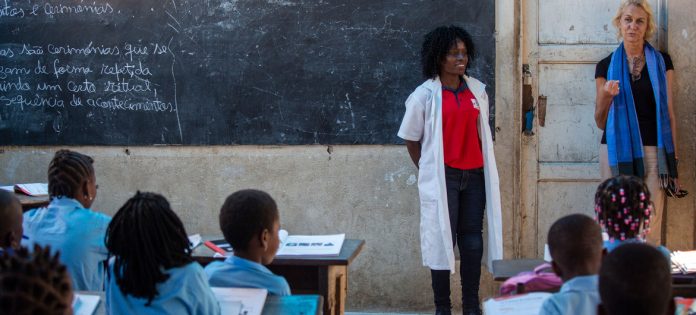
Although nobody can predict how long this situation will continue, the African Union recommends planning in advance for the eventual return to classrooms, to ensure that the reactivated schools provide a safe, clean and hygienic environment for the children to come back to.
Even at her young age, Rafina has already experienced more emergencies than many of us will be faced with during our lifetimes.
The best thing that can be done to make her and her family more resilient to future disasters, is to help her get a solid education. To this end, the United Nations and the World Bank remain committed to continuing support to MINEDH, teachers, communities, and parents.
Even at her young age, Rafina has already experienced more emergencies than many of us will be faced with during our lifetimes. The best thing that can be done to make her and her family more resilient to future disasters, is to help her get a solid education.
To this end, the United Nations and the World Bank remain committed to continuing support to MINEDH, teachers, communities, and parents.
Latest Stories
-
Dangote defends $16bn Kenya refinery as residents raise compensation, environmental concerns
30 seconds -
Work begins on 160-bed Western North Regional Referral Hospital – Kwakye Ofosu
2 minutes -
GPRTU says non-member commercial vehicles pose challenge to road safety enforcement
2 minutes -
Fuel transport licensing gaps could enable abuse and diversion – Transparency International Ghana
3 minutes -
Former Youth and Sports Minister questions Carlos Queiroz appointment process, alleges possible corruption
5 minutes -
NHIA targets 80% population coverage under 2026–2028 strategic plan
7 minutes -
MTTD must intensify enforcement against unregulated drivers – NRSA
7 minutes -
NRSA proposes separate registration and number plates for Okada riders
9 minutes -
National PTA backs striking teacher unions, urges Mahama to intervene
14 minutes -
Israel-bound flight diverted after fight between pilots
20 minutes -
EchoWave earns praise for sound quality at 10th Women in Worship
29 minutes -
Crackdown on South Africa’s unsafe streets ordered by president to keep women safe
41 minutes -
Banks are responding to improved monetary policy conditions – John Awuah
1 hour -
Judges’ conference forces further adjournment of Salomey Baffoe case to Oct. 5
1 hour -
Chorkor community joins AC4NCA clean-up to tackle marine and coastal pollution
1 hour