

Audio By Carbonatix
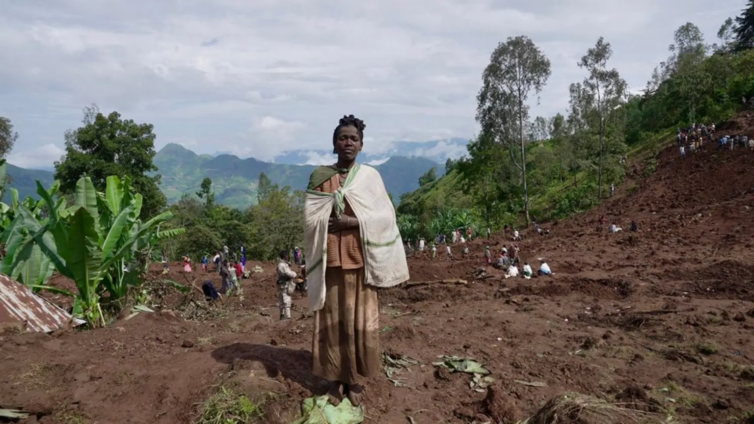
Meselesh Gosaye, a mother of six, was in her hilltop home in southern Ethiopia’s Gofa district caring for her children when she heard the landslide that left many trapped in the mud.
“There were sounds of people screaming and we rushed down the hill,” she said struggling to contain her tears as she remembered what happened on Sunday.
The locality of Kencho Satcha Gozdi, where Ms Meselech lives, has a number of small villages scattered across the hilly landscape which are at risk of floods and landslides.
The string of settlements are characterised by mud-walled, tin-roofed houses, some on or near the top of the lush slopes. Other villages - including the one buried by the landslide - are clustered at the foot of the hills.
Heavy rains had preceded Sunday’s disaster making the area’s narrow and slippery footpaths dangerous.
But Ms Meselech, her husband and some of her children did not hesitate to race towards the site of the accident.
“When we reached there, we saw the earth [had swallowed] the houses,” she told the BBC.
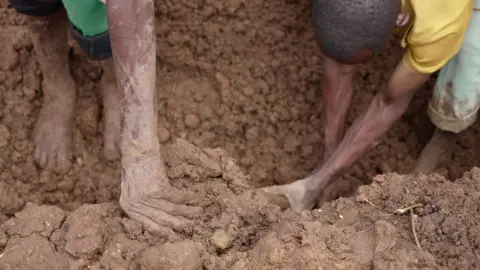
They joined a throng of villagers who similarly had arrived upon hearing the news and instinctively started digging through the dirt and mud, many of them just with their hands, hoping to rescue those buried underneath.
In the following hours many others came. But they had limited success - a few people were pulled out alive, many more remained trapped.
“It was a sad day,” Ms Meselech said.
Seeing that a lot more manpower and effort were required, officials from the locality began mobilising help.
The next day, at an emergency meeting, they told every able-bodied adult, and older children, to get any farming tools - such as shovels, axes and hoes - they could get their hands on and work in unison.
The site was inaccessible to vehicles with more heavy-duty lifting equipment.
Ms Meselech’s husband and her two eldest sons - aged 15 and 12 - immediately joined the search-and-rescue efforts. Meanwhile she returned home from the meeting to breastfeed her toddler and cook for her other children.
Then she went back downhill to offer help. But what awaited her was a different - and more tragic - scene. There had been a second landslide burying most of those involved in the rescue mission.
Unable to control her emotions, she hastened to the land that engulfed her husband and her children. But someone stopped her reminding her it was still dangerous.
“They said I still had kids at home and I had to survive for them.”
In the following hours, news of the double tragedy was heard across the villages and towns close by.
Hundreds came to help.
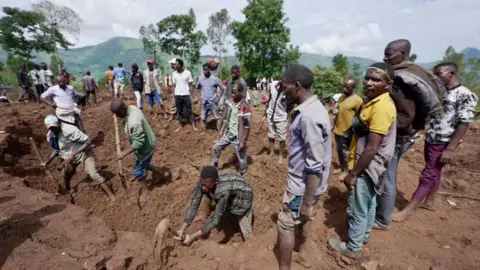
Families were scrambling looking for their missing loved ones. Some - including the head of the locality who was mobilising residents after the first landslide - were quickly confirmed dead.
At one point Ms Meselech “saw diggers pulling someone’s body out. I thought it was my husband. I started helping,” she said.
“I thought he was alive. But he had died. He was still holding on to the axe he had when he went to help [those buried in the first landslide].
"His face was unrecognisable. To be sure, I checked his chest pocket because I knew he kept his ID card there. It was him. I screamed.”
When her husband’s body - along with other recovered corpses - was being moved to somewhere safe Ms Meselech could not go along as her two sons were still missing.
“I was torn between going and remaining behind.”
Later the body of her 12-year-old son was recovered. Her 15-year-old had not been found at the time she spoke to the BBC on Thursday.
“How I [suffered] giving birth to my children, raising them, educating them. It’s so sad for me,” she said as grief overwhelmed her.
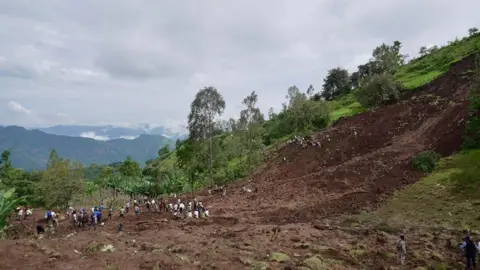
But Ms Meselech is not alone in her grief. Death has knocked on the doors of many of the families here.
Some 257 people are confirmed to have died in the two landslides. An estimate by the UN says that number could reach 500 as more mud is dug up in the coming days.
Serawit Yohannes, who has his father and half-brother still missing, told the BBC that because most people have loved ones missing or confirmed dead “not even relatives are helping us dig” as they themselves have “two or three family members they have to look for”.
According to the UN, 15,000 people will have to be relocated from these hills to avoid future disasters. That will require a lot of effort and money.
But closure for Ms Meselech will only leave when her son is found.
It will take a long time before the community starts to heal.
Latest Stories
-
I have supported highway authority financially to fix roads in my constituency – A Plus
52 minutes -
US, Iran fail to reach peace agreement after marathon talks in Pakistan
1 hour -
ECG kicks off Phase Two of transformer upgrades at Lashibi; brief outages expected
2 hours -
Port crises loom as 11,000 drivers threaten four-day strike
3 hours -
A source of excellence across generations – Vice President Opoku-Agyemang lauds Mfantsipim
4 hours -
(Photos) Mfantsipim School launches historic 150th anniversary
4 hours -
Knights and Ladies of Marshall group backs Catholic Bishops’ stance on anti-LGBTQ+
5 hours -
Bright Simons writes: All the Filla in the Ibrahim Mahama/E&P – Gold Fields Saga
5 hours -
Monetise Idiocy In Ghana
5 hours -
The Ghanaian prophet and the mysterious death of his scottish wife Charmain Speirs
6 hours -
Nearly 400 sentenced in Nigeria for links to militant Islamists
6 hours -
Ghana’s recovery supported by gold strength despite global oil price pressures – Standard Bank Research
7 hours -
Methodist Church hails Mfantsipim@150; calls for “fresh consecration” to excellence
7 hours -
‘Excellence is our inheritance’ – Nana Sam Brew-Butler hails Mfantsipim’s 150-year reign in leadership
7 hours -
Kwaku Azar writes: A-G vs OSP
7 hours