

Audio By Carbonatix
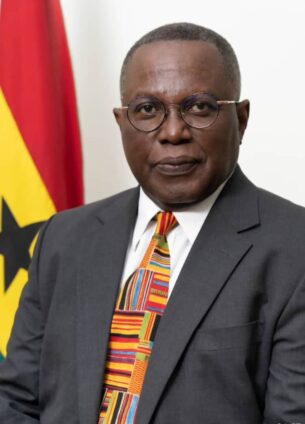
Chairman of the National Development Planning Commission (NDPC), has called for a “productivity revolution” in Ghana, warning that the country cannot generate enough government revenue to fund critical infrastructure and national development without improving productivity across all sectors of the economy.
Delivering a lecture on infrastructure and development planning at Ishmael Yamson & Associates
Business Roundtable 2026, he argued that low productivity remains one of the biggest obstacles to higher wages, business growth, increased tax revenue, and sustainable economic transformation.
According to him, Ghana’s economy is dominated by low-value informal sector activities, which account for about 92 per cent of businesses and employ nearly 80 per cent of the labour force, yet contribute only about 27 per cent of Gross Domestic Product (GDP).
He explained that the situation reflects “the paradox of so many businesses but so little business.”
Citing International Labour Organization data, he said labour productivity in Sub-Saharan Africa stood at only $5.7 per hour worked in 2025, compared to the global average of $23.3 per hour.
Ghana, he noted, recorded productivity of $11.57 per hour worked, driven largely by mining, financial services and industrial agriculture.
He stressed that the country’s low productivity directly affects wages and government revenue generation.
“We can’t pay higher wages, increase business profits and expand the tax base to raise enough revenue to finance infrastructure unless we prioritise productivity,” he stated.
He further linked Ghana’s recurring fiscal crises and repeated dependence on the International Monetary Fund (IMF) to weak productivity levels within both the private and public sectors.
The NDPC Chairman noted that Ghana’s current daily minimum wage of GH¢27.77 translates into roughly US$0.24 per hour for an eight-hour working day, describing it as inadequate for meaningful economic transformation.
Comparing Ghana to countries like South Africa and the United States, he said stronger productivity levels in those economies have translated into significantly higher wages and better living standards.
He identified efficiency in the allocation of national resources as central to improving productivity and government revenue mobilisation.
According to him, the government must critically assess how public resources are distributed between salaries, recurrent expenditure and infrastructure investment.
He also questioned the continued relevance of some state institutions, including COCOBOD, arguing that certain entities may have “outlived their usefulness” and could be restructured to improve economic efficiency.
The NDPC Chairman revealed that the Commission is shifting from measuring economic success solely through GDP growth to a broader framework that includes job creation and wage growth.
He disclosed that NDPC, in collaboration with the International Labour Organisation, is currently training analysts in labour economics to support employment-centred development planning across the country.
He expressed optimism that Ghana could redefine development by focusing on “decent work,” productivity, and broad-based economic growth.
“At the heart of a productivity revolution will be a revolution in efficiency,” he stated.
Latest Stories
-
Chrysler Building to get its crown restored after being sold
3 minutes -
Infantino re-election boost as Concacaf chief will not stand
12 minutes -
Everton’s Sherif fined for breaching betting rules
21 minutes -
Suspended fine for Xhaka over Covid-19 certificate
27 minutes -
Businessman dragged to court over GH¢480,000 fraud
36 minutes -
Pregnant woman and husband found dead in a room at Anloga-Kportorgboe
48 minutes -
Man, 87, jailed 20 years for defiling nine-year-old girl at Ofankor
58 minutes -
Maresca says ‘feeling is fantastic’ among Man City squad
1 hour -
Sam George warns FBI Director against taking sole credit for Ghana cybercrime operation
1 hour -
Foreign capital no passport to Ghana’s informal retail market – GIPA CEO
1 hour -
E&P model should be seen as a blueprint for building local mining giants – GIPA Boss
1 hour -
Govt’s decision to reduce nurse training long overdue – GRNMA
2 hours -
Ghana needs emergency health fund to respond swiftly to outbreaks – SEND Ghana
2 hours -
Gov’t must prioritise local vaccine manufacturing for future outbreaks – SEND Ghana
2 hours -
Salomey Awiti Baffoe reunites with family and colleagues after release
2 hours