

Audio By Carbonatix
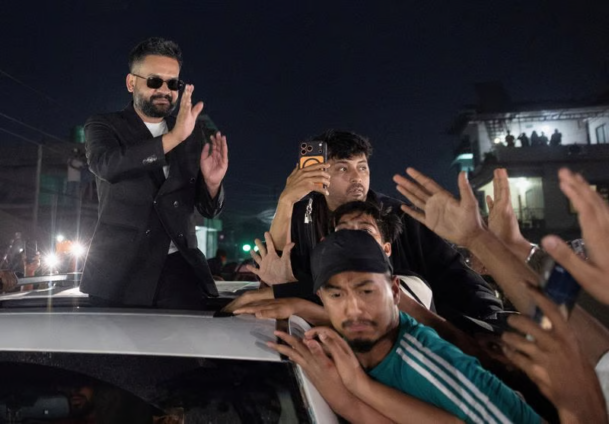
A three-year-old party won Nepal's general elections by a landslide, authorities said, positioning its candidate, Balendra Shah, to become the next prime minister, with a mandate to restore political stability.
The March 5 election was the Himalayan nation's first vote since demonstrations against corruption last September, led by Gen Z protesters that killed 77 people and toppled the government.
"If everything goes well, we can expect that it can give a stable government for five years," said constitutional expert Purna Man Shakya, referring to splits over dividing up the spoils of office that doomed prior majority governments.
Shah’s Rastriya Swatantra Party (RSP) won 182 seats in the 275-member parliament, the Election Commission said on Thursday, the largest majority of any party in more than six decades.
That holds out hope for stability in a nation that has seen 32 changes of government in the last 35 years, battering investors' confidence while crippling economic and jobs growth.
"We are encouraged by the victory," said newly-elected lawmaker Sisir Khanal, a senior leader of the winning RSP. "The mandate has made us very responsible."
The election relegated the oldest party, the Nepali Congress, to distant second place with just 38 seats, while the Communist Party of Nepal (Unified Marxist-Leninist) of former Prime Minister K.P. Sharma Oli won only 25.
Former Chief Justice Sushila Karki succeeded Oli as the interim prime minister tasked with holding the election.
The election has been dominated by Shah, the former mayor of Kathmandu, the capital, whose rap music critical of the establishment has gained him near-rockstar-like fame on social media.
He is the first politician expected to become prime minister who hails from the southern plains, known as Madhesh, where smaller regional groups failed to win a single seat.
His RSP canvassed for a programme to fight graft, create jobs , and more than double the $42 billion economy in five years.
But its firebrand leader, Ravi Lamichhane, a former television host, faces charges of misusing the funds of small savings companies. He denies the accusations and has been released on bail.
Last year's youth-led uprising in the nation of 30 million nestled between China and India followed a social media ban that drew thousands into the streets, triggering clashes and deaths that forced Oli's resignation.
Latest Stories
-
Ghana must close gaps that allow drug trafficking – Dr Pelpuo
8 minutes -
Emmanuel Osei: President Mahama, dissolve GFA and save our soul
21 minutes -
Uganda Airlines to launch direct Accra-Entebbe flights from October 27
23 minutes -
Ghana records surge in 2025 tourism receipts as Ahafo Region honors top industry players
25 minutes -
I don’t have an official car, I use my own – Pelpuo
36 minutes -
Maiden Black Star Fashion Week to highlight Ghana’s national fashion platform
36 minutes -
GPRTU has entrusted vehicle inspection responsibility to station masters – GPRTU member
36 minutes -
President Mahama to open housing finance conference in Accra on October 7
44 minutes -
Cocaine probe: Speaker is right in dismissing Minority’s motion of parliamentary inquiry – Dr Pelpuo
44 minutes -
Academic City presents cybersecurity white paper to Communications Minister
45 minutes -
Pelpuo calls for independent commission to oversee Ghana’s public sector remuneration
45 minutes -
Bekwai MP to engage Assembly over traders displaced by market redevelopment
47 minutes -
Accra-Abidjan flight relaunch will boost trade, investment and regional integration – Ambassador Alhassan Abu
48 minutes -
Mahama tasked me to identify initiatives that fit Reset Agenda – Pelpuo
49 minutes -
Makola and Abossey Okai named in crime index as fake goods trade grows
52 minutes