

Audio By Carbonatix
Heads of State and Government, ministers, diplomats, academics, civil society leaders and representatives of the African diaspora have adopted a comprehensive framework aimed at advancing reparatory justice for Africans and people of African descent worldwide.
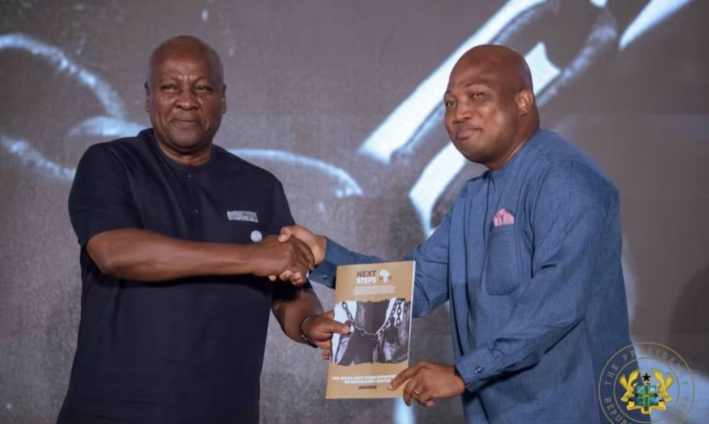
The document, christened: “Accra Next Steps Commitments on Reparatory Justice,” was adopted at the conclusion of the three-day High-Level Consultative Conference on the Next Steps to the Landmark United Nations General Assembly Resolution A/RES/80/250 in Accra.
The outcome document outlines a broad roadmap for implementing the landmark UN resolution, which declared the trafficking of enslaved Africans and the racialised chattel enslavement of Africans as the gravest crime against humanity.
Convened at the invitation of President John Dramani Mahama, in his capacity as African Union Champion on Advancing the Cause of Justice and the Payment of Reparations to Africans, the conference brought together representatives of the 123 United Nations member states that supported the resolution, alongside regional organizations, activists, scholars and civil society groups.
The Accra conference was organised following the adoption of the landmark United Nations General Assembly Resolution A/RES/80/250 in March 2026, which declared the trafficking of enslaved Africans and racialised chattel enslavement of Africans as the gravest crime against humanity.
The resolution received support from 123 member states and has been widely described as one of the most significant diplomatic victories in the global reparations movement.
The conference forms part of broader efforts by the African Union, CARICOM and other partners to move the reparations agenda beyond recognition and advocacy towards concrete implementation.
Participants drew inspiration from earlier frameworks, including the Abuja Proclamation on Reparations, the Durban Declaration and Programme of Action, the Accra Proclamation on Reparations, and the CARICOM Ten-Point Plan for Reparatory Justice.
The outcome document also aligns with the African Union’s designation of 2026-2035 as the Decade of Justice for Africans and People of African Descent through Reparations and the United Nations Second International Decade for People of African Descent.
The participants committed themselves to strengthening international cooperation, promoting historical truth, advancing legal and institutional reforms and pursuing reparatory justice through sustained global engagement.
In the document, participants acknowledged the historic significance of the UN resolution and described its adoption as evidence of a growing global consensus on the need to address and repair the enduring consequences of slavery and related historical injustices.
They noted that the legacies of slavery continue to manifest through structural inequalities, economic disparities, systemic racism, cultural erasure and development challenges affecting Africans and people of African descent globally.
The conference also recognised colonialism, apartheid, genocide and other forms of exploitation and dehumanisation as part of the broader historical injustices that continue to affect African peoples and communities of African descent around the world.
A major highlight of the outcome document is the establishment of a Global Strategic Framework for Reparatory Justice, built around several key pillars designed to guide future action.
Among the commitments is a call on states, institutions and organisations that participated in or benefited from slavery and colonial exploitation to issue full, formal and unconditional apologies for their roles in those systems.
The participants stressed that such apologies should be accompanied by guarantees of non-repetition and concrete measures aimed at reconciliation and healing.
The framework also calls for strengthened legal and institutional pathways for reparatory justice, including the use of international, regional and domestic legal mechanisms to pursue accountability and redress for historical wrongs.
Participants reaffirmed the principle that slavery and racialised chattel enslavement constituted violations of international law and generated obligations requiring fair and adequate compensation for affected peoples and communities.
The document highlights the importance of cultural restitution and calls for accelerated efforts to return cultural artefacts, human remains, archives and other heritage resources removed from Africa during slavery and colonial rule.
Delegates pledged to support cultural restoration and preservation initiatives while strengthening cooperation within UNESCO and other international bodies to facilitate the return of cultural heritage.
The conference also linked reparatory justice to broader global governance reforms.
Participants called for reforms of the United Nations Security Council, international financial institutions and global economic systems to ensure greater equity, representation and participation for Africa and the Global South in international decision-making processes.
In addition, the document advocates comprehensive debt relief, debt restructuring and debt cancellation measures for developing countries affected by the enduring socioeconomic consequences of slavery and colonialism.
It also calls for reforms to sovereign credit rating systems and stronger international support for vulnerable economies, including countries such as Haiti.
The conference recognised emerging issues such as climate justice, technology access, digital inclusion and public health as integral components of the reparatory justice agenda.
Participants argued that the enduring consequences of slavery and colonialism continue to shape vulnerabilities to climate change, health inequalities and technological exclusion, requiring targeted interventions and international cooperation.
The outcome document emphasises gender justice, acknowledging the specific and enduring impacts of slavery on African women and girls, including sexual violence, reproductive exploitation and family separation.
It calls for reparatory processes that are gender-responsive and ensure the full participation of women in decision-making and implementation.
Another major area of focus is education, historical memory and truth-telling.
Participants committed to addressing knowledge gaps and historical distortions relating to slavery and colonialism through education, research, memorialisation and public awareness initiatives.
The conference also called for the preservation of forts and castles across Africa and the Caribbean as enduring memorials to the victims of slavery and as tools for combating historical denialism.
Recognising the importance of reconnecting Africans with their descendants abroad, the document encourages African states to strengthen citizenship pathways, right-of-return programmes, cultural exchanges and diaspora engagement initiatives.
Participants described such measures as vital to restoring connections severed by centuries of enslavement and forced displacement.
To ensure implementation of the commitments, President Mahama announced the establishment of three global mechanisms: a High-Level Global Advisory Council on Reparatory Justice, a Global Expert Panel on the Restitution of Cultural Heritage, and a Global Legal Panel on Reparatory Justice.
The conference also agreed to convene annually to assess progress, review implementation and strengthen international collaboration on reparatory justice.
Latest Stories
-
Ten people linked to Kenya’s first-ever Ebola case quarantined as screening concerns grow
11 minutes -
Ghana warns medical travellers to South Africa to obtain visas for treatment beyond 90 days
18 minutes -
Canada suspends plans to expand assisted dying to people with mental illness
19 minutes -
Minority accuses Sports Ministry, NSA of creating fake portfolios for VISA applicants
20 minutes -
6th Inter Tourism Expo comes off in Cape Coast this October; register now
40 minutes -
Afenyo-Markin accuses government of diverting attention from cocaine seizures linked to Ghana
40 minutes -
GJA gives Armed Forces 14 days to account for alleged assaults on Sika Official, Bullet TV’s Philip Abutiate
42 minutes -
PAC gives CWSA 30 days to recover GH¢10m in unpaid water bills from police, army, hospitals, other public institutions
44 minutes -
Major Accra roads to get facelift ahead of Ghana’s 70th Independence anniversary – Agbodza
1 hour -
Account for GH¢650bn allocated to existing programmes before new economy – Oppong Nkrumah to gov’t
1 hour -
‘You’re an action man’ – Abena Osei-Asare hails Rent Commissioner’s hostel fee crackdown
1 hour -
Mahama directs Finance Minister to allocate GH¢1bn for Housing Fund in 2027 Budget
1 hour -
NPP celebrates Bawumia on birthday, prays for 2028 election victory
1 hour -
Mahama recounts ‘exhausting and frustrating’ struggle to find a home as a young spouse
1 hour -
‘Take damaged banknotes to commercial banks for replacement’ – BoG warns against repairing cedi notes for resale
2 hours