

Audio By Carbonatix
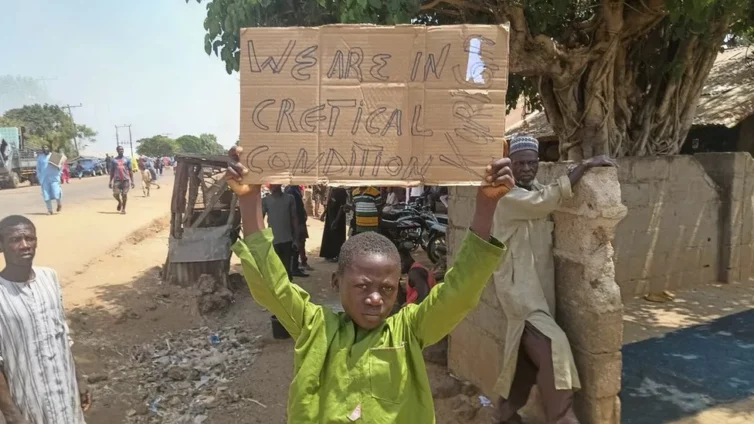
Nigeria's spate of abductions worsened on Saturday as more than a dozen students and four women were kidnapped from a school in Gada, Sokoto.
Local MP Bashir Usman Gorau told the BBC that 15 students were among those kidnapped early in the morning.
Meanwhile, the army is still searching for hundreds of schoolchildren taken in the western town of Kuriga on Thursday.
In an update, the state governor Uba Sani told the BBC that at least 28 of these children had escaped.
Thursday's kidnapping - which saw 280 students taken - was the biggest mass abduction from a school since 2021.
Gangs of armed men on motorbikes took primary and secondary school children between the ages of eight and 15, school authorities and parents said.
Nigerian troops are working with police and local search teams to comb forests within the state of Kaduna, where Kuriga is located, as well as neighbouring states.
Almost every family in the town is thought to have a child among those kidnapped.
One pupil, believed to be 14 years old, who had been shot by the gunmen and was being treated in hospital, has since died.
The kidnappings followed women and children taken from a remote town in Borno state the day before.
Mr Sani said the lack of boots on the ground was the main reason for the rise in kidnappings in the area.
Families of the abducted children have formed vigilante groups and are seeking help from neighbouring communities on the whereabouts of the children.
Nigeria's Vice President Kashim Shettima is visiting Kaduna and is due to meet the governor.
President Bola Tinubu said on social media he was confident the victims will be rescued.
He tweeted: "Nothing else is acceptable to me and the waiting family members of these abducted citizens. Justice will be decisively administered."
- Why mass abductions have returned to haunt Nigeria
- What in the World Podcast- Nigeria's kidnap crisis
- Why Nigeria's economy is in such a mess
The Kaduna mass abduction has evoked memories of the nearly 300 girls in Nigeria's north-eastern town of Chibok in 2014.
In parts of northern Nigeria, parents fear for their children's safety and are wary of allowing them to go to school. As a result, thousands of children are not attending school.
The last major abduction of children in Kaduna was in July 2021 when gunmen took more than 150 students.
They were re-united months later after their families paid ransoms.
But in 2022, Nigeria passed a law banning ransom payments to kidnappers and imposed a 15-year jail term for making them.
It also made abduction punishable by death in cases where victims die.
Latest Stories
-
Richmond Quarcoo appointed Ghana’s Chef de Mission for 2028 Olympics
15 minutes -
‘Our missing players are more important’ – Gambia coach fires shot at Ghana
2 hours -
Today’s front pages: Tuesday, September 29, 2026
2 hours -
Ghana ‘showing up differently’ on global stage – Joyce Bawah Mogtari
2 hours -
Ghana’s tuna industry in crisis as 20 hook-and-line vessels collapse
3 hours -
South Tongu MP launches apprenticeship programme for 159 young people
3 hours -
The Pusiga connection behind Gertrude Atongi’s work in New York
3 hours -
Teachers took promotion exams in December to beat government clearance deadline – GNAT
3 hours -
NPA launches 2026 staff welfare week with focus on teamwork and employee wellbeing
3 hours -
Ghana, Saint Kitts and Nevis sign labour deal to strengthen protections for Ghanaian nurses
4 hours -
Delayed promotions put teachers’ retirement benefits at risk – GNAT
4 hours -
No ‘Bawumia candidates’ in NPP executive elections – Anthony Karbo
4 hours -
Over 3,000 displaced as flooding overwhelms Hohoe communities
4 hours -
Sunyani East NPP executives begin reconciliation drive ahead of 2028 polls
4 hours -
Agric Minister engages Ga Mantse on agriculture transformation agenda
4 hours