

Audio By Carbonatix
The 2016 general election in Ghana is widely regarded as one of the most peaceful and well-organised in the country’s Fourth Republic.
According to ACP Dr Benjamin Agordzo, a Police Planning Officer at the UN Mission Support for Justice Reform, this achievement was no accident.
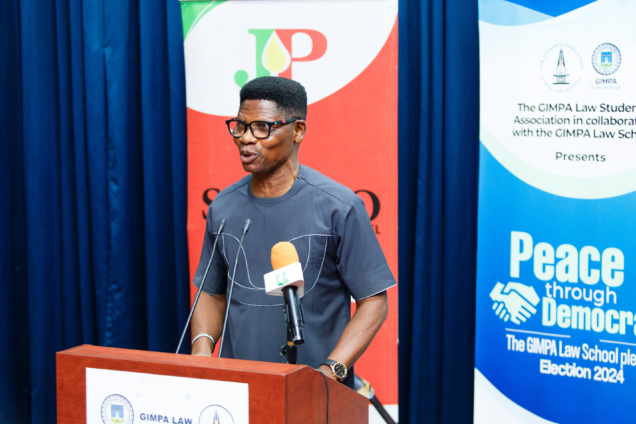
Speaking at the Peace Through Democracy forum organised by the GIMPA Law Students Association on Wednesday, he outlined deliberate strategies that contributed to the election’s success.
“The 2016 general election in Ghana remains, arguably, the most peaceful in the Fourth Republic,” Dr. Agordzo said.
“Not even a fly was reported to have died during the election.”
In the 2020 election, the opposition National Democratic Congress (NDC) protested the results, describing them as “flawed” and alleging that state security forces were used to intimidate voters in their strongholds.
The National Election Security Taskforce (NESTF) reported that eight lives were lost during the 2020 general elections, with 61 recorded cases of electoral and post-electoral violence across the country, including six incidents involving gunshots.
Read also: NDC won’t sign peace declaration ahead of election, says Asiedu Nketia
Giving an insight into why the 2016 election had such a peaceful outcome, Dr Agordzo stated that it was the result of systematic dialogue with stakeholders and an inclusive planning process led by the National Election Security Task Force.
A key factor was the dialogical approach adopted by the Task Force.
“We realised that a militant posture alone could not resolve crises,” Dr Agordzo noted.
Dialogues were held with a wide range of groups, including political parties, youth groups, religious leaders, and civil society organisations.
One milestone was the Adaa Communiqué, where political parties publicly renounced violence and disassociated themselves from vigilante activities. The process was unprecedented in its scope.
“For the first time ever, systematic and well-coordinated meetings were held nationwide, involving the IGP and police leadership on one hand and stakeholders on the other,” Dr Agordzo said.
These sessions were marked by open and frank discussions, which helped to build trust and clarify issues that could otherwise cause mistrust during the elections.
Another innovation was the extensive use of literature to educate stakeholders on peaceful elections.
“We created over 5,000 election booklets for senior security officers and 42,000 copies for every police officer deployed on duty,” he revealed.
These materials clarified the roles of police officers, emphasizing that they were subordinate to the presiding officers at polling stations.
Dr. Agordzo also highlighted the role of community policing.
“We visited churches, mosques, and communities to engage directly with citizens,” he said.
This proactive engagement fostered trust and cooperation between the police and the public.
He praised the deployment strategy, which included special police officers stationed at border areas but excluded military personnel at polling stations.
“No military officer was deployed at any polling station in 2016,” he said, adding that this approach prevented unnecessary intimidation of voters.
Dr. Agordzo attributed the success of the 2016 elections to deliberate planning, inclusivity, and trust-building.
“It didn’t just happen. It was the result of deliberate efforts,” he stressed.
Latest Stories
-
Anti-LGBTQ Bill: Forget the rumour mongers, I’m a man of action, and will pass the bill – Speaker
40 minutes -
Women and children among those killed in Sudanese army shelling of wedding celebration
43 minutes -
President Mahama is not sincere with Ghanaians on LGBTQ bill matter – Hassan Tampuli
1 hour -
Gov’t to establish Prison Industrial Hub to equip inmates with income-generating skills – Prison Service boss
1 hour -
Alhassan Tampuli donates cement, roofing sheets to support storm victims in Gushegu
1 hour -
Alhassan Tampuli appeals for urgent support for storm victims in Gushegu
1 hour -
The hypocrisy must stop; pass Anti-LGBTQ+ Bill now – Alhassan Tampuli to Mahama
1 hour -
Imprisonment should be rehabilitative, not punitive – Ghana Prisons boss at UNGA
2 hours -
Ga Adangbe traditional priests petition Mahama over McDan aviation licence revocation
2 hours -
Anti-LGBTQ Bill: NDC’s arrogance is worrying – Hassan Tampuli
2 hours -
Let’s give OSP time to mature, not to scrap it – Hassan Tampuli
2 hours -
Nigeria convicts 386 Islamist militants in mass trials
2 hours -
Djibouti president wins election with 97.8% of vote, state media says
2 hours -
We don’t have mandate to deduct tax from rent allowance of security services personnel – Interior Ministry clarifies
3 hours -
Ablakwa receives Presidential Special Envoy on Reparations to advance global agenda
3 hours