


Audio By Carbonatix
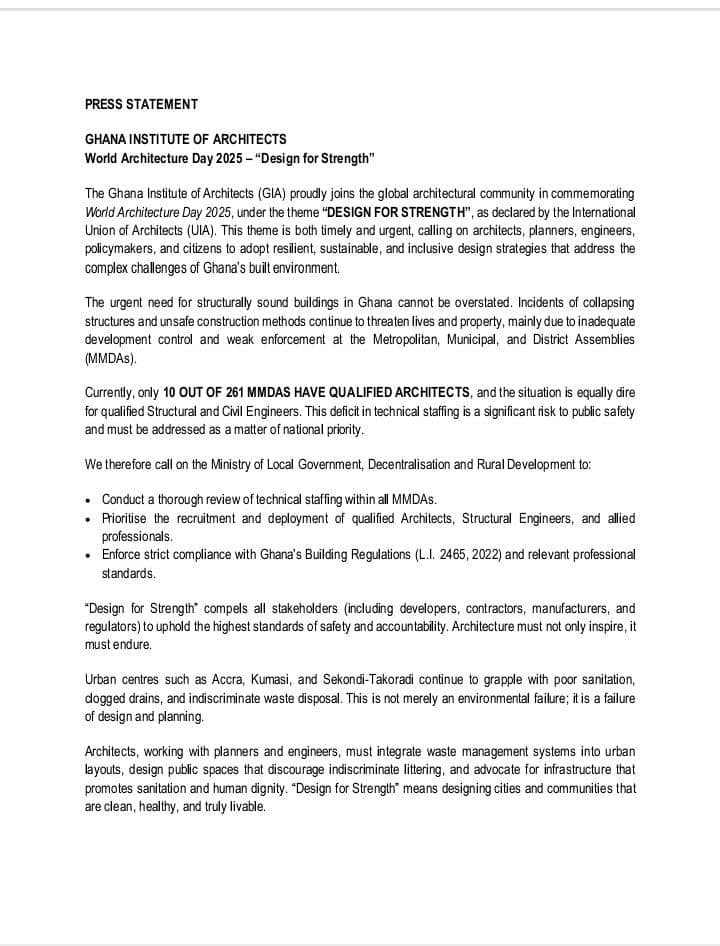
The Ghana Institute of Architects (GIA) has raised alarm over what it describes as a national safety risk, the severe shortage of qualified architects across the country’s local assemblies.
According to the institute, only 10 out of Ghana’s 261 Metropolitan, Municipal and District Assemblies (MMDAs) currently have qualified architects on staff, a situation it says is endangering lives and undermining the structural integrity of the nation’s buildings.
Marking World Architecture Day 2025 under the theme “Design for Strength”, the GIA warned that the absence of technical professionals such as architects, structural engineers, and planners within MMDAs has created major regulatory gaps in development control and building supervision.
“This deficit in technical staffing is a significant risk to public safety and must be addressed as a matter of national priority,” the institute cautioned in a statement signed by Arc. Daniel Kwadjo Teye, its Honorary Secretary.
The GIA pointed to recurring incidents of building collapses, unsafe construction practices, and widespread non-compliance with Ghana’s Building Regulations (L.I. 2465, 2022) as evidence of weak institutional oversight at the local government level. It attributed the failures largely to the lack of trained professionals to vet building plans, inspect sites, and enforce safety standards.
The institute is urging the Ministry of Local Government, Decentralisation and Rural Development to undertake a comprehensive review of technical staffing within all MMDAs and to prioritise the recruitment and deployment of architects and allied professionals.
“Architecture must not only inspire, it must endure,” the GIA stressed, emphasising that safety and resilience must be central to all design and construction efforts in the country.
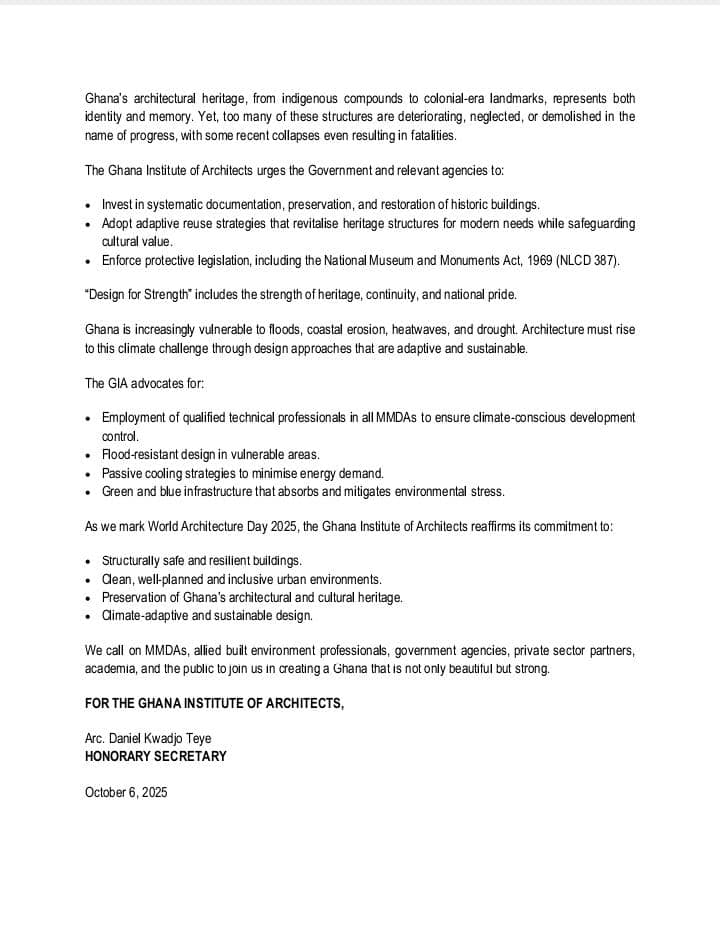
Beyond structural safety, the GIA also linked the shortage of architects to broader urban management challenges such as poor sanitation, clogged drainage systems, and unplanned settlements in cities like Accra, Kumasi, and Sekondi-Takoradi.
It said architects, working closely with planners and engineers, are key to integrating waste management systems, designing livable public spaces, and ensuring sustainable growth in urban areas.
The GIA’s statement further touched on climate resilience and heritage conservation, urging the government to employ technical expertise to safeguard vulnerable communities from floods and to preserve Ghana’s aging architectural landmarks.
“Design for Strength,” the institute added, “is not just about concrete and steel—it’s about systems that protect people, preserve culture, and prepare our cities for the future.”
The GIA concluded by calling on government agencies, private developers, and professional bodies to collaborate in rebuilding Ghana’s capacity for safe, sustainable, and climate-adaptive development, warning that without such coordinated effort, “the nation risks paying a high price for weak design and weaker enforcement.”
Latest Stories
-
GAEC must retain nuclear scientists for Ghana’s nuclear ambitions – Minister
19 minutes -
Man reportedly mistaken for game and shot by hunter dead in forest
22 minutes -
19-year-old mason jailed 15 years for defiling seven-year-old pupil
26 minutes -
Ghana’s banking sector assets rise 20.47% to GH¢500.2bn – BoG Governor
30 minutes -
22 injured as Sprinter bus overturns at Sege after tyre burst
32 minutes -
UN housing expert urges Ghana to strengthen Rent Control Department amid housing affordability concerns
40 minutes -
Delta-BCI partnership reaches 166,000 people with breast cancer education
50 minutes -
Power restoration fault suspected in Kumasi Central Market fire
6 hours -
The 7-foot giant of Ngleshie Amanfro: Seven-foot Ghanaian Ephraim Saawa dreams of joining the national basketball team
7 hours -
Government promises support for Kumasi Central Market fire victims
7 hours -
Vibes The Movie: Big Ghun’s Ghanaian film earns five nominations at 2026 REFFA
7 hours -
‘I’m a fulfilled man’—Justice Korbieh on missing out on Supreme Court despite two nominations
7 hours -
MamaCare CEO warns unresolved conflicts among health workers could undermine maternal and neonatal care
8 hours -
Health professionals urged to translate medical knowledge into practice to save mothers
8 hours -
Retired judge Justice Francis Korbieh charges 1,568 new lawyers to uphold integrity
9 hours