

Audio By Carbonatix
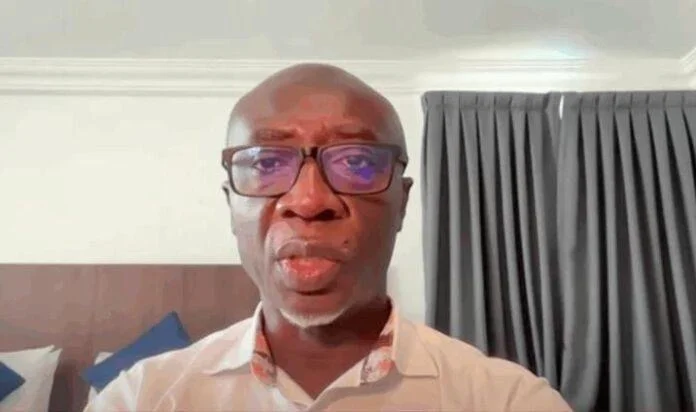
Professor of International Law at the University of Ghana, Kwadwo Appiagyei Atua, has argued that the Office of the Special Prosecutor (OSP) should not bear sole responsibility for the challenges surrounding Ghana’s efforts to secure the return of former Finance Minister Ken Ofori-Atta.
His comments follow a decision by a United States court that raised questions about aspects of the evidence presented in Ghana’s pursuit of Mr Ofori-Atta, while the OSP maintains that the former minister remains a fugitive from justice.
Speaking on JoyNews' Newsfile on Saturday, Prof Atua said the responsibility for the situation should extend beyond the OSP to include other state institutions involved in criminal investigations and enforcement.
“The OSP is being overly held responsible for the so-called fleeing of Mr Ofori-Atta. I think that there are other agencies involved who could have been held or should be responsible as well,” he said.
He mentioned the Attorney-General’s Office and Ghana’s security agencies as among the institutions that should also be considered when assessing how the matter has developed.
Prof Atua also challenged the characterisation of Mr Ofori-Atta’s departure from Ghana, arguing that he did not leave the country unlawfully because he had received permission to travel for medical reasons.
“We are talking about the Attorney-General’s Office, we are talking about the security agencies and so on,” Prof Atua stated.
He explained that while the former minister stayed beyond the period initially granted, there was evidence that he required further medical attention, including surgery.
“He didn’t really flee because he got permission to go and seek medical attention. He overstayed his permission or the timeframe given him, but we also know that there is evidence that he had to undergo further healthcare, including surgery and so on,” he said.
According to Prof Atua, the medical circumstances provided a reason for Mr Ofori-Atta’s extended stay in the United States, although he acknowledged that questions remain over what is currently preventing his return to Ghana.
“As of now, I don’t know what else is keeping him there, but the bottom line is that now he has applied for immigration status and has got his green card,” he said.
Prof Atua also commented on the action taken by the US immigration judge, arguing that the judge may have gone beyond the scope of the matter before the court.
He explained that the immigration proceedings were primarily concerned with Mr Ofori-Atta’s continued stay in the United States on humanitarian grounds, rather than determining the merits of Ghana’s criminal case against him.
“I agree with the positions expressed that he went beyond the boundaries of what an immigration judge is supposed to do,” Prof Atua said.
He said the judge’s responsibility was limited to considering whether Mr Ofori-Atta should be allowed to remain in the United States based on humanitarian considerations.
“The matter before him was simply to look at the case on humanitarian grounds because he has overstayed his time, not only from not returning to Ghana, but also his stay in the US, and for that matter, on humanitarian grounds, the judge has a discretion to decide one way or the other,” he explained.
Prof Atua questioned the relevance of bringing the OSP’s extradition request and related matters into the immigration proceedings, suggesting that those issues fall outside the main responsibility of an immigration court.
“But bringing in the OSP’s application and so on…” he said.
Latest Stories
-
Imagination Africa, Mentors Chess Academy to host second African Genius Chess Championship at Ghud Park
1 hour -
Nana B passport claims a diversionary tactic — Abu Jinapor
2 hours -
Pope Leo diagnosed with cancer as doctors remove lobe of lung, Vatican says
2 hours -
Legal Aid Commission takes free legal services to Techiman main lorry terminal
2 hours -
Nana B denies seeking passport favour, accuses Ablakwa of failing to account for GH¢16.4m
2 hours -
Young girls demand climate action, stronger protection against child marriage
2 hours -
Ex-gang boss sentenced to 40 years for orchestrating Tupac Shakur’s murder
3 hours -
From near-deferral to three awards: UMaT graduate’s academic journey
3 hours -
Atta Akyea denies seeking presidential pardon for Wontumi in galamsey case
3 hours -
Photos: Mahama commissions 85-bed Police Hospital ward, donates two ambulances
3 hours -
GTEC directs Ghana’s public universities to reopen by October 16 and begin lectures on October 19
3 hours -
Star Oil donates GH¢1million towards construction of new CID facility
3 hours -
Court hands Adjetey Sowah, two others lifetime bans after Amputee Football legal dispute
4 hours -
NDC appoints Julius Kwame Anthony as a Deputy Communications Director
4 hours -
Ghana repatriates 120 Nigerians rescued from suspected cybercrime centres
4 hours