

Audio By Carbonatix
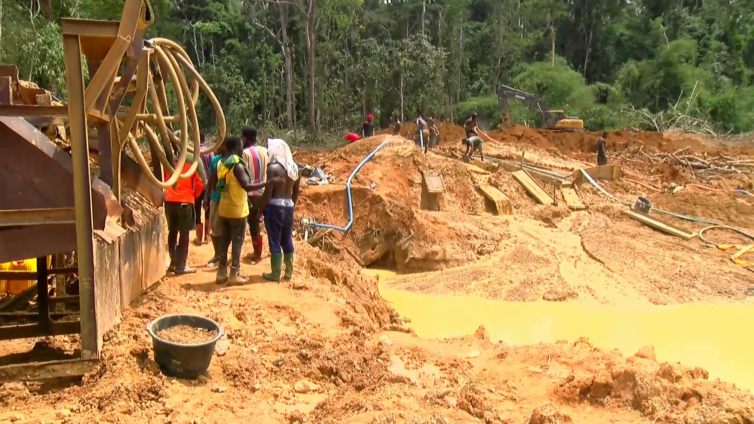
The former Chairman of the Inter-Ministerial Committee on Illegal Mining (IMCIM), Professor Frimpong Boateng, says the Committee under his leadership had been successful in quelling the galamsey menace until ‘big companies’ sponsored by ‘big men’ began agitating.
He noted that in an effort to quell the galamsey menace, the IMCIM had successfully developed software, Galamstop, that had aided formalizing and regularizing the activities of small scale miners in the country.
By doing so, he noted that the small scale miners that were once notorious for engaging in illegal mining were given the opportunity to receive license and proper concessions to work, and had afforded the committee to also train these miners on sustainable mining practices.
“We developed a software which we call galamstop that will aid in the registration of licenses. And the software was so good that if a miner started the process at Minerals Commission, it will trigger the process in the other regulatory agencies like EPA, Water Resources Commission and Forestry Commission so that within three months they should get their licenses if everything went well.
“We took about 4,000 of them to Tarkwa to study sustainable mining. And so after all these things we were able to vet them and make sure that we registered their companies and everything went well. So within about six to nine months, the period that they were asked not to work, we were able to register some of them, license thousands of them and they went back to work. And they were working very well, nobody was harassing them because they were doing things very well.”
However, the progress the Committee was recording, unbeknownst to them, was causing agitation in some quarters of influence.
According to the Professor, the seizing of machines of illegal miners had affected some highly influential people who soon became displeased with the work the committee was doing.
It was then, the former Chairman revealed he realised the illegal mining activities were not being carried out only by small-scale miners, but some big companies as well.
“And so it was very very successful, but unknown to me there were people behind, big companies and they started agitating and I didn’t know. So that was where we started having problems and when we noticed that there were a lot of people also engaged who were not small-scale miners but people who had influence and they were engaged in this thing it was a problem.
“So that happened till I was ordered by the Chief of Staff to write a report on the fight against illegal mining and suggest a way forward and that was why I wrote that report and sent it to the Chief of Staff on the 19th of March 2021,” he said.
Latest Stories
-
FTBLRLIFE targets Ghana in expansion of global grassroots football network
6 minutes -
Former ‘American Idol’ contestant sentenced to life without parole for wife’s murder
1 hour -
Education Ministry commends Ghanaian teachers on World Teachers’ Day 2026
2 hours -
NPP can reconcile with aggrieved members who want to return – Nana Akomea
2 hours -
Tamale Child Deaths: Vehicle owner arrested as IGP deploys homicide team
2 hours -
From ShattaFest to MoMo Fest: Entertainment takes centre stage in youth engagement
2 hours -
Nigerian military aircraft crashes, killing 32
2 hours -
MTN encourages Ghanaians to use MoMo for saving, investing and financial planning
2 hours -
Absa Bank Ghana names Stephen Ato Frimpong as Board Chair
3 hours -
Pickford ‘almost caused crash’ with careless driving
3 hours -
Author and former politician Jeffrey Archer dies aged 86
3 hours -
No education reform can succeed without teachers – Education Ministry
3 hours -
Gauff condemns racist abuse after China Open win
3 hours -
Medvedev disqualified for hitting spectator with ball
3 hours -
Oliseh scores twice in late comeback win for France
4 hours