

Audio By Carbonatix
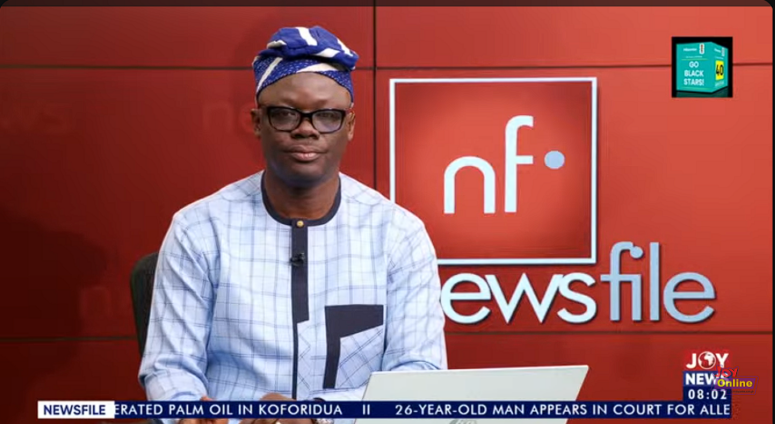
JoyNews’ Newsfile this Saturday tackled two major national issues shaping Ghana’s economy and infrastructure.
First, the news analysis programme examined the recent fire outbreak at the Ghana Grid Company Limited substation near Akosombo, which triggered widespread power outages across the country.
The incident resulted in a significant loss of electricity supply from the Akosombo hydro system, affecting households, businesses, and industry nationwide. Emergency response teams from GRIDCo, the Volta River Authority, and other power sector agencies worked to restore supply in phases by rerouting electricity and repairing damaged systems.
Partial restoration began within days, with several generating units brought back online to ease pressure on the national grid. By April 29, a significant portion of lost capacity had been restored.
Full restoration was achieved by May 1, 2026, when authorities confirmed that all generating units at Akosombo were back in operation and national power supply had stabilised.
Investigations into the cause of the fire are ongoing, while long-term repairs to the damaged substation are expected to continue over the coming months.
Despite the disruption, officials say the rapid recovery demonstrated improved coordination and resilience within Ghana’s power sector.
This issue has sparked debate over whether the incident exposes systemic weaknesses in Ghana’s energy sector or was simply an isolated accident. The discussion will focus on what caused the disruption, the response, and what it means for Ghana’s energy resilience going forward.
The second major issue on the table was the Bank of Ghana’s GH¢15.6 billion loss for 2025, which has sparked widespread debate.
The loss, significantly higher than the previous year, has been attributed to aggressive inflation control measures, foreign exchange revaluation losses, and accounting pressures linked to gold and reserve management. While some experts describe it as a “necessary cost” of stabilising the economy, others are raising concerns about sustainability and the impact on the central bank’s balance sheet.
Newsfile broke down the facts, interrogated the policy decisions behind both developments, and explored their implications for Ghana’s economic stability and future planning.
Join host Samson Lardy Anyenini this Saturday at 8 a.m. on JoyNews (DSTV channel 421 and GoTV channel 144), or stream live on JoyNews’ Facebook and YouTube channels, as well as MyJoyOnline, for a rigorous, solutions-focused national conversation.
Listeners can also tune in on Joy 99.7 FM or Luv 99.5 FM, or follow the discussion via Google or Apple Podcasts.
Newsfile is your most authoritative news analysis programme.
If it’s Saturday… It’s Newsfile.
Latest Stories
-
Afenyo-Markin’s lawsuit against Sammy Gyamfi takes focus away from development – Kpebu
4 minutes -
FWSC urges media to guard against misinformation in proposed IPEC transition
5 minutes -
MoMo Fest 2026: Shatta Wale to Rock Accra Stadium on October 17
6 minutes -
Zimbabwean author denies using AI to write award-winning story
27 minutes -
GTEC’s letter directing public universities to reopen by October 16 is unprofessional – GAUA
27 minutes -
Suspect in viral video assaulting wife jailed for 3 months
27 minutes -
GAUA insists strike will end only after Fair Wages addresses market premium issue
28 minutes -
Kpemka seeks compensation as he sues BOST over alleged unlawful termination
31 minutes -
GES asks applicants to check status of 2026 promotion applications on October 15
55 minutes -
Kobe Boujee joins Olympics.com team for Dakar 2026 Youth Olympic Games
1 hour -
Slaty egret’s shifting nesting sites offer clues to changing ecosystems
1 hour -
First phase of arrears for promoted teachers to be paid on Friday – Haruna Iddrisu announces
1 hour -
Caveman Watches partners with Mfantsipim School for 150th anniversary
2 hours -
We’ll pursue GH¢15m defamation suit against Sammy Gyamfi to its logical conclusion – Afenyo-Markin’s lawyers
2 hours -
Martin Kpebu urges Afenyo-Markin not to return to court over Sammy Gyamfi lawsuit
2 hours